


Let's be honest — watching your child lose marks on questions they actually know is one of the most frustrating things about the 11 Plus. Not the hard questions. The ones they should have got right. According to GL Assessment, one of the main providers of 11+ tests in England, maths is consistently where children drop the most marks. And most of those marks? Lost to avoidable errors, not difficult content. If you're already looking into 11 plus exam preparation online in the UK, you're ahead of most parents — because fixing these mistakes early is genuinely worth more than a hundred extra practice questions.
Why Does This Keep Happening?
Here's something nobody really tells you at the start of this process.
The 11 Plus doesn't just test whether your child knows maths. It tests whether they can use what they know — quickly, accurately, under time pressure, in questions that are worded slightly differently from anything they've practised before.
That combination is brutal for a ten-year-old.
Your child might do fractions perfectly at the kitchen table on a Sunday afternoon. Then sit a mock exam on Wednesday and get three fraction questions wrong. Same child. Same knowledge. Completely different result.
The Education Endowment Foundation has found that test anxiety and working memory pressure are two of the biggest reasons children underperform relative to their actual ability. The exam itself gets in the way. That's not a maths problem — it's a preparation problem.
The Mistakes That Actually Cost Marks
I want to be specific here, because vague advice doesn't help anyone.
These are the errors that come up time and time again — in papers from Kent, Buckinghamshire, Birmingham, Greater Manchester, and everywhere else grammar schools exist across England.
Misreading the question
This is number one. By a distance.
Children rush. They skim-read. They see a number problem, and their brain jumps to what looks familiar, rather than what's actually being asked. They calculate the total when the question asks for the difference. They work out the area when it's asking for the perimeter.
It's like someone asks you, "What time does the film end?" and you tell them what time it starts. You answered confidently. You answered completely wrong.
The fix is simple but takes repetition to stick: underline the instruction word before doing any maths. Not after. Before. Just that one habit can recover three or four marks on a real paper.
Arithmetic slips under pressure
Your child knows 7 × 8 is 56. They've known it for two years. But in a timed exam, with twenty questions left and ten minutes on the clock, they write 54.
This isn't a knowledge gap. It's a pressure problem.
The best way around it — and this sounds almost too simple — is to estimate first. Roughly what should the answer be? If you estimated "around 56" and you've written 540, you know something's gone wrong before you move on.
Forgetting units
This one genuinely surprises parents when they find out. Their child worked out the correct number, set up the calculation right, didn't make any arithmetic errors, and still lost the mark.
Because they wrote "45" instead of "45 cm²."
Examiners are strict on this. Always have been. The habit to build is simple: before writing the final answer, ask "what type of thing am I measuring?" Time? Distance? Area? Then write the unit.
The fraction-decimal-percentage tangle
These three topics are deeply connected. The 11+ knows that, and exploits it. A question might ask something that starts as a fraction, requires a decimal conversion halfway through, and ends with a percentage comparison.
Children who've practised each topic separately — but never together — hit a wall exactly here. They know fractions. They know percentages. They just can't switch between them mid-question.
This is one of the areas where working with a specialist changes things fastest. The difference between muddling through on your own and having someone who spots exactly where the confusion kicks in is significant. The 11 plus maths tutor benefits go well beyond content knowledge — a good programme finds the precise gap and fixes it at the source, rather than just assigning more of the same practice.
Algebra confusion — not solving, but building equations
Primary schools do cover algebra. But often quite lightly, and almost always in the "solve for x" format.
The 11+ goes further. It asks children to write the equation from a word problem first, then solve it. "I think of a number, multiply it by four, and subtract five. The answer is 19. What's the number?"
Many children can solve 4n − 5 = 19 if you put it in front of them. But translating the words into that equation? That's where they freeze.
The fix is practising the translation step separately — just turning sentences into algebra — before worrying about solving anything.
Geometry in unfamiliar diagrams
Children memorise that the area of a rectangle = length × width. Then they see a diagram where the shape has been split into two parts, or rotated, or shaded in a way that hides which measurements to use — and the formula suddenly feels useless.
It isn't useless. They just haven't practised it in enough different contexts.
This is an important pattern across the whole list, actually. Knowledge that's been practised in one format tends to stay locked in that format under pressure.
Skipping written work
In multiple-choice papers, children assume they don't need to show working. So they try to do everything in their head — and make errors they'd have caught if they'd written two lines down.
Even in multiple-choice, jotting a rough calculation takes ten seconds and catches mistakes before they happen. It's a small habit that's worth a lot.
Reverse percentage problems
This one deserves its own mention because it's so consistently underestimated.
Forward percentages — "find 20% of £80" — most children can handle by Year 5. But reverse percentages — "after a 20% discount, the price is £64, what was the original price?" — trip up a huge proportion of students because they try to add 20% back on rather than divide by 0.8.
These questions appear in almost every 11+ maths paper. They're worth practising specifically, not just as part of general percentage work.
Blowing the time management
Spending six minutes on one hard question, then rushing the last twelve. This is one of the most damaging patterns in the whole exam — and it's completely preventable.
A rule that genuinely works: if a question is taking longer than ninety seconds to two minutes, circle it, move on, and come back at the end. No single question is worth rushing four others.
Memorising methods without understanding them
This is the deepest problem on the list, and the one that's hardest to fix quickly.
A child who has memorised the method for long division but doesn't actually understand what division means will fall apart the moment the question looks slightly different. Different wording, different context, combined with another concept — and the memorised method doesn't fit anymore.
This is why doing more practice papers doesn't always help. If you keep practising the same thing the same way, you get better at that exact version. You don't get better at maths.
So What's the Pattern Here?
Go back through that list. Most of these mistakes aren't about difficult content. They're about:
- Foundations that were covered once and never properly revisited
- Techniques that were only ever practised in one format
- Habits that were never built under exam conditions
That's a fixable problem. But it needs the right approach.
This Is Why the Spiral Curriculum Actually Matters
Most maths teaching — at school and in standard tutoring — follows a linear model. Cover fractions in week three, move on. Come back to fractions never, or maybe briefly before the exam.
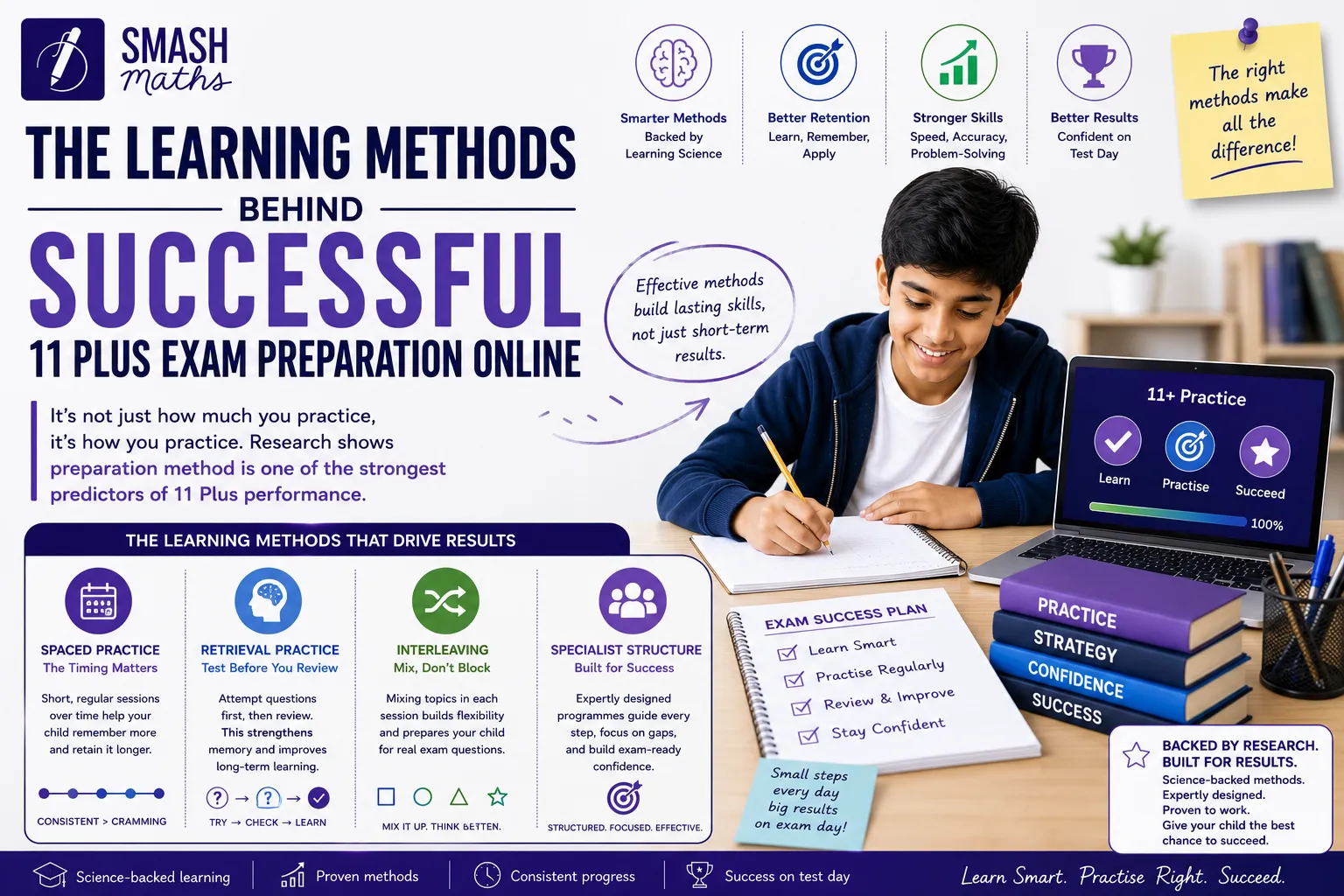
The Spiral Curriculum works differently. It's a framework developed by psychologist Jerome Bruner, and the idea is straightforward: you keep coming back to the same topics, each time at a slightly higher level. The knowledge builds in layers rather than sitting in one forgotten corner of the brain.
At Smashmaths, this isn't just a reference to Bruner's theory. It's how the entire programme is actually structured. Fractions don't appear once. They come back regularly — in different contexts, at increasing difficulty, woven together with percentages and decimals just like they are in real exam questions.
Think of it like learning to drive. First lesson: just getting used to the controls. Fifth lesson: controls plus steering. Tenth lesson: all of that plus junctions and roundabouts. Nobody teaches you roundabouts on day one, but nobody forgets about the controls by week ten either. Everything builds.
That's what proper spiral learning looks like — and it's why children on the Smashmaths programme tend to make fewer of the mistakes on this list. It's not magic. Its structure.
A Straightforward Four-Week Plan
If you're not ready to commit to a programme yet, here's something concrete you can do right now.
Week one: Go through your child's most recent practice paper and categorise every wrong answer. Was it a misread? An arithmetic slip? A forgotten unit? A genuine knowledge gap? You need to know which before you can fix which.
Week two: Introduce the underlying habit. For every practice question this week — every single one — underline the instruction word before starting. It feels slow at first. It saves marks.
Week three: Do timed mini-sessions. Ten questions, eight minutes. Not for speed — for getting used to thinking accurately when there's a clock involved. Review every answer together.
Week four: Focus specifically on reverse percentages and algebra word problems. These two topics give the highest return for focused practice. Twenty minutes a day on just these.
Honest Comparison: What Actually Makes a Difference
| Practice Papers Only | Weekly Private Tutor | Smashmaths Online Programme | |
|---|---|---|---|
| Targets recurring mistakes | Rarely — you just repeat them | Depends on tutor quality | Yes — spiral approach catches patterns |
| Exam technique | Almost never covered | Variable | Built into every session |
| Works around school schedule | Yes | No — fixed slot | Yes — fully online and flexible |
| Confidence building | Can backfire with repeated failures | Depends on rapport | Structured wins build it gradually |
| Covers the UK curriculum properly | Partially | Depends | Yes — designed around 11+ content |
No preparation method is perfect. But there's a meaningful difference between repeating practice papers and hoping for the best, and following a structured programme that actually tracks where marks are being lost.
Questions Parents Ask Most Often
When should preparation start? Honestly? Year 4 is ideal for light, regular work. Year 5 is when to ramp up. Starting in the summer before the exam isn't ideal — you can still make progress, but there's almost no time to fix foundation gaps properly.
Does online preparation actually work? Yes — if it's properly structured. The format matters far less than whether the programme adapts to your child's specific weak areas and revisits them consistently.
Which topics matter most? Fractions, percentages, and decimals — all interlinked. Algebra from word problems. Area and perimeter in unusual diagrams. Multi-step problems. These appear in every major 11+ paper.
My child does fine at home but falls apart in mock exams. What's happening? This is very common and almost always comes down to time pressure plus unfamiliar question wording. The knowledge is there — it just hasn't been practised under exam conditions enough.
How many practice papers should we do? Fewer than you think, done properly. Three well-reviewed papers with careful mistake analysis are worth more than ten rushed ones. Always spend more time reviewing than testing.
One Last Thing
Here's what I'd want any parent reading this to take away.
The 11 Plus is hard. But the reason most children underperform isn't that they're not clever enough. It's that they've practised content without practising how to use it in an exam. Those are genuinely different skills — and both need to be trained.
Smashmaths was built specifically around this reality. The spiral curriculum means children keep revisiting and deepening what they know. The exam technique element means they practise using it under real conditions. And the online format means families across the UK — whether you're in Tunbridge Wells, Solihull, Trafford, or Truro — can access it without rearranging your whole week.
The mistakes on this list are not signs that your child can't do this. There are signs that the preparation hasn't been structured to prevent them yet. That's the part that can change.
Key Takeaways
- Most marks in 11+ maths are lost to avoidable mistakes, not genuinely hard questions
- Misreading, forgotten units, and reverse percentages are the biggest culprits
- Practising content in one format doesn't prepare children for the same content in a different context
- The Spiral Curriculum — the foundation of the Smashmaths programme — fixes this by revisiting topics repeatedly at increasing depth
- Underline the instruction word before calculating. Always
- Four focused weeks on the right things beats months of unfocused paper practice
- Start in Year 4 or 5. The earlier the better — but it's never too late to improve




























Sign in to leave a comment.