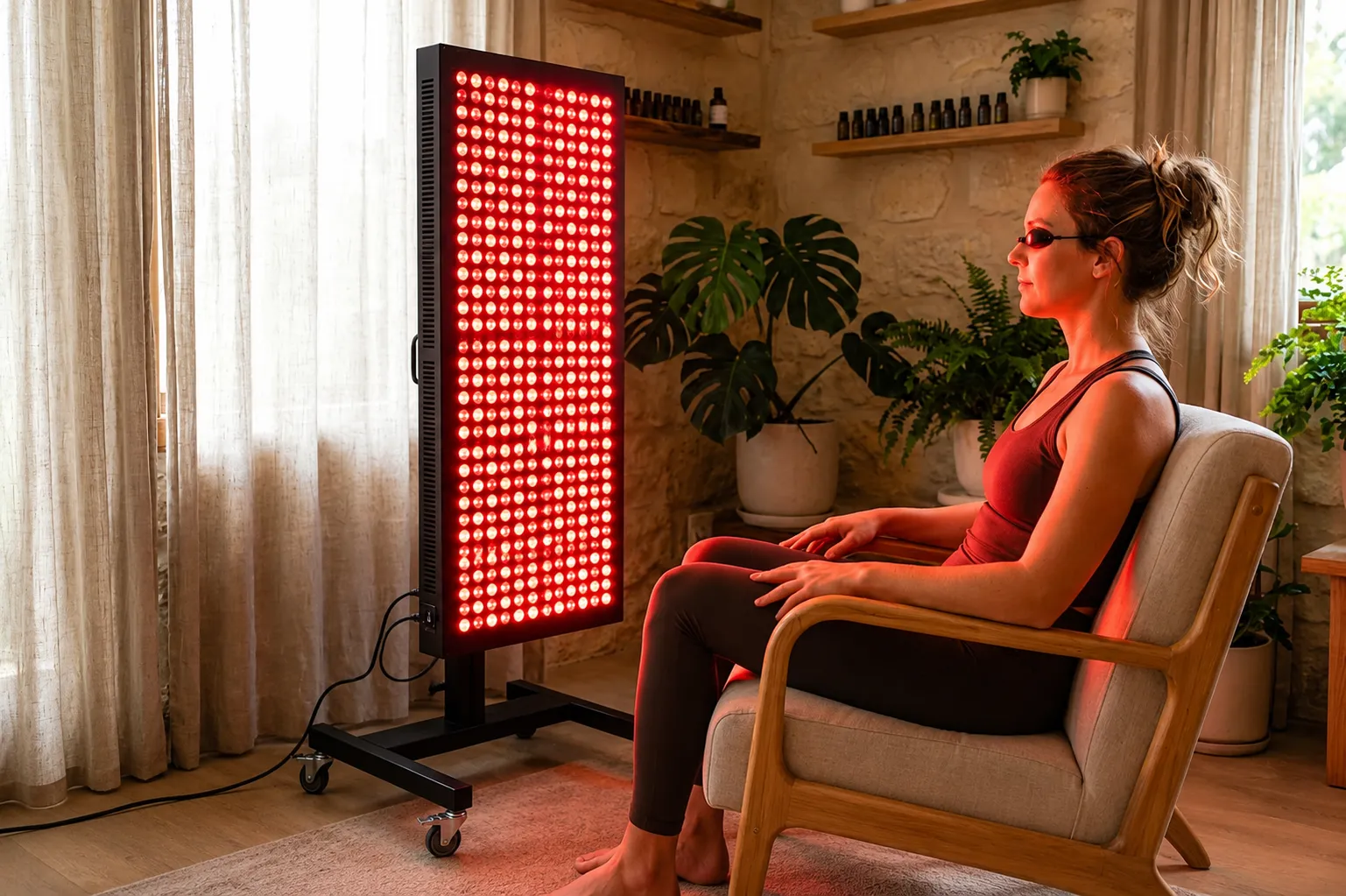

I’ve seen hundreds of health gadgets come and go. Most of them end up in the closet of forgotten resolutions. But Red Light Therapy (RLT), specifically high-output red light therapy panels are different.
We are no longer talking about a beauty trend fueled by influencers. Now, the clinical data is undeniable. Whether you are an athlete looking to cut recovery time in half, a professional struggling with chronic inflammation, or someone simply trying to reclaim a youthful complexion, the science of photobiomodulation (the technical term for RLT) offers a biological shortcut to cellular health.
Let’s talk about it!
The Biological Battery Charger: How It Works
To understand RLT panels, we have to look past the skin and into the mitochondria. You might remember from high school biology that the mitochondria are the powerhouses of the cell.
When your cells are stressed (due to age, illness, or injury), they produce excess nitric oxide. This molecule binds to cytochrome c oxidase, a critical enzyme, and effectively shuts down the cell’s ability to produce energy. Your cells become sluggish, leading to slower healing and visible aging.
When you stand in front of a high-quality red-light panel, photons of light penetrate your tissue and kick that nitric oxide out of the way. This allows the mitochondria to resume their primary job: producing Adenosine Triphosphate (ATP).
Wavelengths (660nm vs. 850nm)
The most common mistake I see people make is buying a red light that is just a red-painted bulb. True therapeutic panels use specific, narrowed wavelengths measured in nanometers (nm). I often focus on two specific wavelengths:
Red Light (660nm)
This wavelength is absorbed primarily by the skin tissue. It’s the beauty light. It’s highly effective for boosting collagen production, reducing fine lines/wrinkles, and healing surface-level scars/acne.
Near-Infrared Light (850nm)
Near-infrared (NIR) is invisible to the human eye, but it’s the heavy lifter. Because it has a longer wavelength, it can penetrate through the skin, into the muscle, and even to the bone. This is the wavelength we use at the clinic for deep muscle recovery, reducing joint pain/ arthritis, and lowering systemic inflammation.
Why Panels Beat Other Devices?
You’ve likely seen RLT masks, wands, and belts. While they have their place, panels are the undisputed kings of the RLT world for three reasons:
I. Irradiance (The Strength)
Irradiance is the power density of the light. To get results, the light must be strong enough to reach the target tissue. A handheld wand might have 10 mw/cm², while a professional-grade panel like those from Hooga or Therasage can deliver over 100 mw/cm² at close range.
II. Coverage
Recovery is a numbers game. If you want to treat systemic inflammation, a small mask won't help your lower back or your quads. A full-body panel allows you to treat thousands of square centimeters of skin simultaneously, triggering a systemic "healing" response throughout the body.
III. EMF Safety
Quality panels are engineered to be Low EMF. Since you are standing further away from a panel than you would from a wearable belt, your exposure to electromagnetic fields is significantly lower.
Real Results: What the Data Says
In my practice, I don't care about feeling better; I care about measurable outcomes. Here is what the data currently shows in 2026:
- Muscle Recovery: A meta-analysis of over 40 studies indicated that RLT applied before exercise can increase the number of repetitions and decrease post-workout soreness markers like Creatine Kinase (CK).
- Skin Elasticity: Clinical trials show an increase in collagen density after 10 weeks of consistent use (3 sessions per week).
- Chronic Pain: Patients with osteoarthritis have reported a significant reduction in pain scores when using 850nm NIR light consistently over 4 weeks.
How to Use a Panel Like a Pro?
If you decide to invest in a panel, don't just turn it on and hope. Follow these protocols, I give my clients in Los Angeles:
- Direct Skin Exposure: Light cannot penetrate clothing effectively. You need bare skin.
- Distance Matters: For deep tissue/joint pain, stay 6–12 inches away for 10 minutes. For skin health/anti-aging, you can sit 18–24 inches away.
- Consistency is King: You cannot binge red light therapy once a month. Taking short, frequent sessions (5-15 minutes, 5 days a week) yields the best results.
- Timing: Use red light in the morning to mimic the sunrise and "set" your circadian rhythm, or use it post-workout to jumpstart recovery.
The 2026 Verdict: Is It Worth It?
My answer is always the same: Look at the biology. We are light-based organisms. We evolved under the sun, which is rich in red and near-infrared light. Modern life has left us malnourished from a light perspective.
A Red-Light Therapy panel is a tool that provides the specific energy your cells need to function at their peak.
Also, don't settle for cheap, unbranded panels from massive marketplaces. Look for:
- Third-party testing (to verify the wavelengths).
- Zero or low flicker (to protect your eyes and nervous system).
- Dual-switch capability (so you can choose 660nm, 850nm, or both).
Whether you’re looking to fade a scar, heal a knee injury, or just wake up with more energy, the science is clear: Red light is one of the most powerful non-invasive tools we have in 2026.
Check out my Ultimate Guide to the Best Red Light Therapy Panels and Masks of 2026 to see which brands passed my clinical testing this year.
Frequently Asked Questions
What is red light therapy and how does it work?
Red light therapy (RLT) uses specific wavelengths of light, primarily 660nm and 850nm, to penetrate the skin and stimulate cellular processes. It enhances mitochondrial function, allowing cells to produce more energy (ATP) which can promote healing and reduce inflammation.
How does red light therapy differ from other light therapy devices?
Unlike masks or handheld devices, high-output red light therapy panels provide greater irradiance and coverage for more effective treatment. Panels deliver stronger light intensity and can treat larger areas of the body, making them more suitable for systemic issues.
Can red light therapy help with muscle recovery?
Yes, clinical studies indicate that red light therapy can enhance muscle recovery by increasing the number of repetitions one can perform and reducing post-workout soreness. Regular use before workouts has shown to decrease markers of muscle damage.
Are there any side effects associated with red light therapy?
Red light therapy is generally considered safe with minimal side effects, especially when using high-quality panels designed to be low EMF. However, it’s always wise to consult with a healthcare provider before starting new treatments, especially if you have underlying health conditions.
How often should I use a red light therapy panel for best results?
For optimal results, it's recommended to use a red light therapy panel 5 days a week for short sessions of 5 to 15 minutes. Consistency is key to achieving the desired benefits, whether for skin health or muscle recovery.
What should I look for when purchasing a red light therapy panel?
When buying a red light therapy panel, look for third-party testing to verify wavelengths, low flicker rates to protect your eyes, and dual-switch capability to select between 660nm and 850nm light. Quality panels are crucial for effective results.
Is red light therapy effective for skin issues like scars and wrinkles?
Yes, red light therapy has been shown to boost collagen production and improve skin elasticity, making it effective for reducing scars, fine lines, and wrinkles. Regular use can lead to noticeable improvements in skin appearance.


























Sign in to leave a comment.