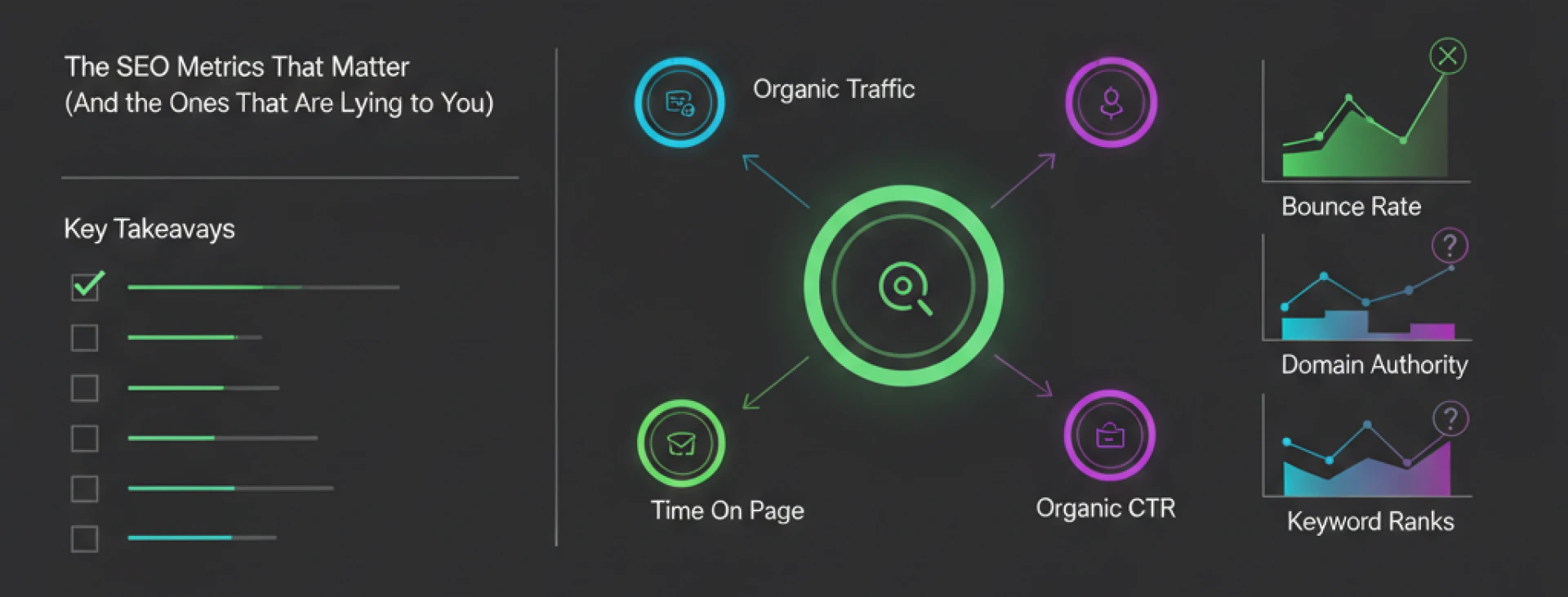

SEO success depends on focusing on metrics that truly reflect user behavior and content relevance, like organic traffic, time on page and organic click-through rate (CTR).
Bounce rate often misleads because it counts one-page visits as failures, even if users find what they need. Domain authority offers context on site trust but isn’t a direct ranking factor. Keyword ranks show potential but don’t guarantee results without engagement insights.
Key Takeaways
- Focus on user intent, content relevance, keyword rankings and organic traffic as primary metrics driving SEO success.
- Bounce rate can be misleading and should be analyzed alongside time on page and scroll depth for accurate engagement insights.
- Organic click-through rate (CTR) reveals how effectively titles and descriptions convert search impressions into visits.
- Domain authority estimates ranking potential but is not a direct ranking factor and should be interpreted cautiously.
- Combine multiple engagement metrics like social shares and user feedback for a comprehensive understanding of SEO performance.
Which SEO Metrics Actually Drive Traffic and Rankings
What SEO metrics truly influence website traffic and search engine rankings? Key factors include user intent and content relevance, which guide search engines in matching queries with the most helpful pages by accurately interpreting search intent.
When content aligns closely with what users seek, it naturally attracts and retains visitors, boosting rankings through consistent content optimization. Metrics like keyword rankings and organic traffic reflect this alignment, showing how well a site meets user needs.
Moreover, metrics related to page authority and backlinks signal credibility but must support relevant content. Ultimately, understanding and optimizing for user intent and content relevance creates a strong foundation for sustained SEO success.
Why Bounce Rate Can Be Misleading for SEO Success
Bounce rate often appears as a straightforward indicator of website performance, but it can be misleading because it doesn’t account for user intent or content type when bounce rate is viewed in isolation.
For example, a visitor might find exactly what they need on a single page and leave without exploring further, which registers as a bounce despite a successful visit. To get a clearer picture of engagement, alternative metrics like time on page, scroll depth and conversion rates should be considered alongside bounce rate.
Bounce Rate Interpretation Challenges
Although it is often used as a quick indicator of website performance, interpreting bounce rate can be tricky and sometimes misleading in evaluating SEO success. Bounce rate causes vary widely, including visitors finding information quickly or leaving due to poor user experience.
For example, a high bounce rate might mean users got what they needed immediately, like contact info, which isn’t bad. Conversely, it could signal confusing navigation or slow loading times. Because bounce rate alone doesn’t reveal intent, it requires careful analysis alongside other data to understand user behavior accurately and assess true SEO effectiveness.
Alternative Engagement Metrics
Since relying solely on bounce rate can lead to misunderstandings about user engagement, alternative metrics offer a clearer picture of how visitors interact with a website.
Instead of just measuring quick exits, consider these four key indicators:
- Time on page – measures actual user attention span.
- Scroll depth – shows how far visitors read content.
- Social shares – reflect content’s appeal and reach beyond the site.
- User feedback – direct opinions reveal satisfaction and issues.
Together, these metrics provide a richer understanding of engagement, avoiding the pitfalls of bounce rate’s simplicity.
How to Use Organic Click-Through Rate to Measure Keyword Performance
Organic click-through rate (CTR) measures how often users click on a website link after seeing it in search results, providing insight into keyword effectiveness as defined by CTR - click-through rate metrics.
By tracking organic CTR, one can identify which keywords attract the most clicks and adjust strategies to improve visibility. This metric acts like a spotlight, highlighting which keywords successfully draw attention and lead to more site visits.
Understanding Organic CTR
Three key factors influence how well a website performs in search engine results and one of the most important is the click-through rate (CTR). Understanding organic CTR helps measure how often users click a site’s link after seeing it.
To grasp organic CTR, consider these points:
- Position on search results affects visibility and clicks.
- The relevance of the title and description drives user interest.
- Click through trends reveal user behavior shifts over time.
- Organic CTR strategies optimize content to increase engagement.
Tracking organic CTR provides clear insight into keyword performance beyond basic rankings.
Improving Keyword Clicks
Improving keyword clicks involves analyzing the click-through rate (CTR) to understand how users interact with search results. By focusing on keyword optimization, one can tailor titles and meta descriptions to better match search intent, making listings more appealing.
When search intent aligns with content, users are more likely to click, boosting CTR. This metric acts like a thermometer, measuring how well a keyword performs in attracting attention.
Monitoring organic CTR helps identify which keywords need adjustments, guiding improvements in SEO strategy. Ultimately, using CTR to gauge keyword success supports smarter decisions and enhances overall site traffic.
The Role of Domain Authority and When It Matters
How does Domain Authority influence a website’s performance in search engines? Domain authority significance lies in its ability to estimate a site’s ranking potential based on link quality and quantity as measured by domain authority metrics. However, domain authority limitations mean it is not a direct ranking factor and can be misleading if used alone.
It matters most when:
- Comparing sites within the same niche,
- Evaluating potential link-building targets,
- Monitoring long-term SEO growth trends,
- Gauging overall site trustworthiness at a glance.
Understanding these points helps clarify when domain authority is a useful SEO metric and when it should be viewed cautiously.
Why Keyword Rankings Alone Don’t Tell the Whole Story
Although high keyword rankings can seem like a clear sign of SEO success, they do not provide a complete picture of a website’s performance. Keyword relevance is essential; ranking for terms unrelated to the website’s content or audience offers little value.
Furthermore, understanding search intent - the reason behind a user’s query - matters more than just position. A top ranking for a keyword that doesn’t match what users want can result in low engagement or high bounce rates.
Consequently, relying solely on rankings ignores important factors that influence traffic quality and user satisfaction, limiting the effectiveness of SEO strategies.
Tracking Conversions - The SEO Metric That Impacts Your Bottom Line
Many SEO metrics offer valuable insights, but tracking conversions stands out as the most direct measure of success because it links website visits to actual business results through conversion rate CRO analysis. Understanding conversion funnels reveals how user behavior guides customers through the site.
Cost analysis clarifies if marketing spend yields profitable lead generation. Sales attribution connects conversions to specific campaigns, ensuring marketing alignment. A/B testing refines customer journeys by comparing strategies for better outcomes.
Together, these four steps highlight conversion tracking’s power:
- Analyze user paths
- Calculate marketing ROI
- Attribute sales accurately
- Optimize with testing
































Sign in to leave a comment.