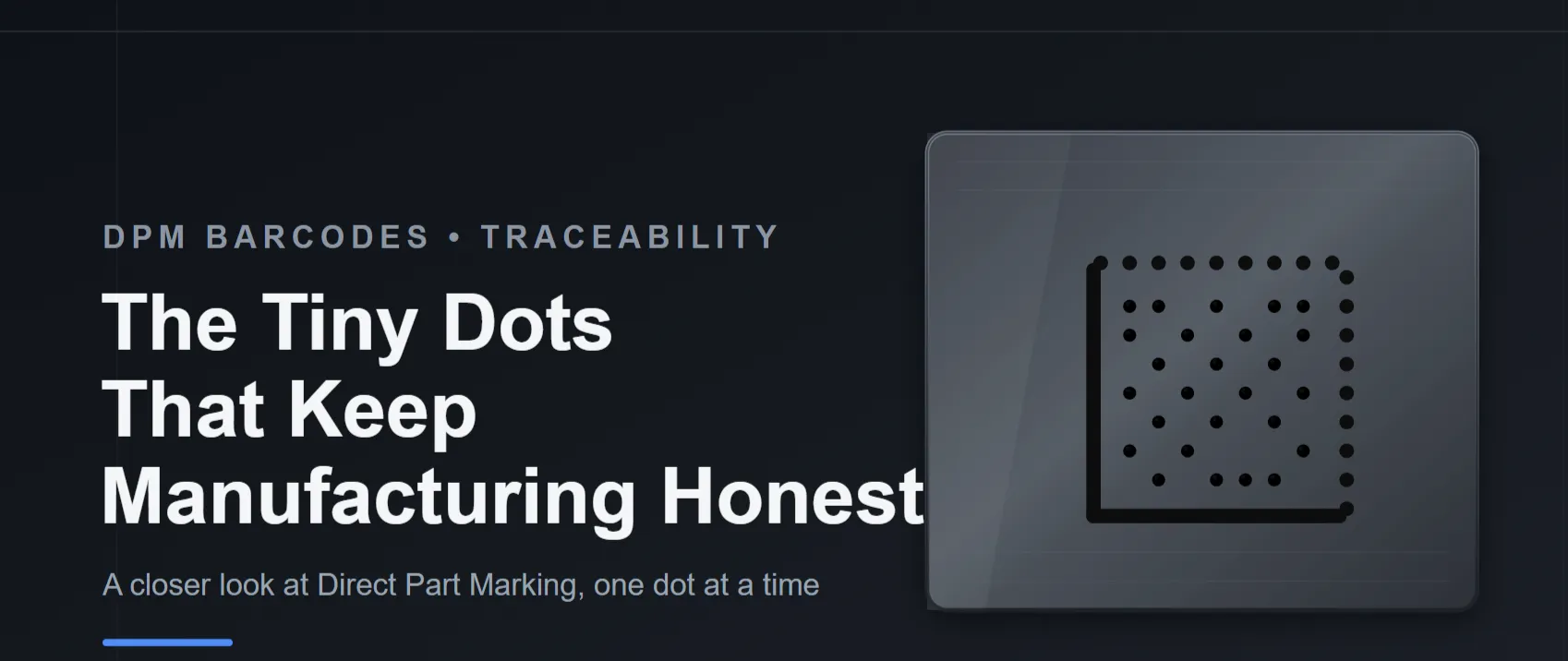

A Look at DPM Barcodes
Pick up almost anything mechanical made in the last decade — a jet engine bracket, a surgical implant, a car's engine block — and flip it over. Chances are you'll find a faint grid of dots or a laser-etched pattern stamped directly into the metal. No label, no sticker, no ink. Just the part itself, carrying its own ID for life.
That's a Direct Part Mark, or DPM barcode, and it's quietly become one of the most important pieces of infrastructure in industries where a mislabeled or lost part isn't a minor inconvenience — it's a safety issue.
What Makes DPM Different From a Regular Barcode
Most of us know barcodes as the black-and-white stripes on a cereal box, printed on paper or a plastic label and stuck onto a product. That works fine for retail. It does not work for a turbine blade that will spend the next 20 years inside a jet engine at 600°C, or a bone screw that gets sterilized in an autoclave a hundred times before it's ever used.
Labels peel. Ink fades. Adhesive fails under heat, oil, or chemical exposure. So for parts that need to be tracked across a decades-long lifecycle — through manufacturing, assembly, maintenance, repair, and eventual recycling — the code has to become part of the object itself.
That's what DPM does. Instead of printing a code onto a surface, manufacturers mark it directly into the material using one of a few methods:
- Dot peening — a pin physically punches a series of tiny indentations into metal to form the code
- Laser etching — a laser burns or discolors the surface in a precise pattern
- Chemical etching — acid selectively removes material to create contrast
- Electrochemical marking — an electric current etches the code using a conductive stencil
The result is a code that survives essentially anything the part itself survives.
Why This Matters More Than It Seems
DPM isn't just a manufacturing curiosity — it's the backbone of traceability regulations in several industries.
- In aerospace, regulators require that critical components be traceable back to the exact batch of raw material and the exact machine that produced them. If a defect is found in one part, manufacturers need to instantly identify every other part from the same production run, wherever it is in the world. That's only possible if every individual part carries its own permanent, unique identifier.
- In medical devices, the FDA's Unique Device Identification (UDI) rule pushed DPM adoption hard. Surgical instruments and implants now routinely carry direct marks so that if a device is later recalled, hospitals can pinpoint exactly which units are affected — down to the individual screw or clip.
- In automotive manufacturing, DPM helps track engine and transmission components through assembly lines that build thousands of vehicles a day, and later supports warranty claims and recall management years after the car has left the factory.
None of this works, though, unless something on the other end can actually read the mark reliably. And that turns out to be a much harder problem than it sounds.
The Reading Problem Nobody Talks About
A printed barcode is high contrast by design — dark ink on a light background, consistent size, flat surface. A DPM code has none of those guarantees.
Dot-peened marks are physical dents in metal, so their visibility depends entirely on how light falls across them. Move the light source a few degrees and a perfectly good code can become nearly invisible to a camera. Laser-etched codes on polished stainless steel can be almost the same color as the surrounding surface. Codes get scratched, partially worn away, covered in oil or dust, or stamped onto curved surfaces that distort the pattern geometrically.
Traditional barcode scanners — the kind built for flat labels — largely fail here. Reading DPM reliably requires a different approach altogether: specialized lighting (often angled or diffuse LED domes to create shadow contrast), high-resolution imaging, and decoding software sophisticated enough to reconstruct a readable pattern from a low-contrast, distorted, or partially damaged image.
This is where computer vision and barcode-recognition libraries have had to get genuinely clever. Several imaging SDKs on the market today — including tools like the Dynamsoft Barcode Reader — have built specific decoding models tuned for exactly this scenario: adaptive image binarization, distortion correction for curved surfaces, and damage-tolerant decoding that can reconstruct a code even when a meaningful chunk of it is missing. It's a good example of how much of the "barcode problem" has quietly moved from hardware into software over the last decade.
Where This Is Headed
A few trends are shaping what comes next for DPM:
- AI-assisted decoding. Machine learning models trained on thousands of damaged or low-contrast marks are getting noticeably better at recovering codes that rule-based decoding algorithms simply can't parse.
- Edge processing. Instead of sending images to a central server for decoding, more scanning happens directly on handheld devices or fixed-mount cameras on the factory floor, cutting latency in high-throughput inspection lines.
- Convergence with quality inspection. The same high-resolution cameras reading a DPM code are increasingly doing double duty — checking for surface defects, dimensional accuracy, or corrosion in the same pass, since the imaging hardware is already in place.
- Standardization pressure. As more industries adopt UDI-style traceability rules, there's growing push toward standardized mark formats (Data Matrix remains dominant for DPM) and consistent quality thresholds, so a code produced by one manufacturer's marking machine is reliably readable by another company's scanner.
The Takeaway
DPM barcodes are a quiet piece of engineering most people never think about, but they're doing real work: making sure a single faulty component can be traced back through a global supply chain in hours instead of weeks, and that a recalled medical implant can be identified down to the individual unit. As marking methods and decoding software keep improving in tandem, that tiny grid of dots stamped into a piece of metal is likely to become even more central to how physical products get tracked through their entire lifecycle — not as an add-on, but as part of the object itself.
























Sign in to leave a comment.