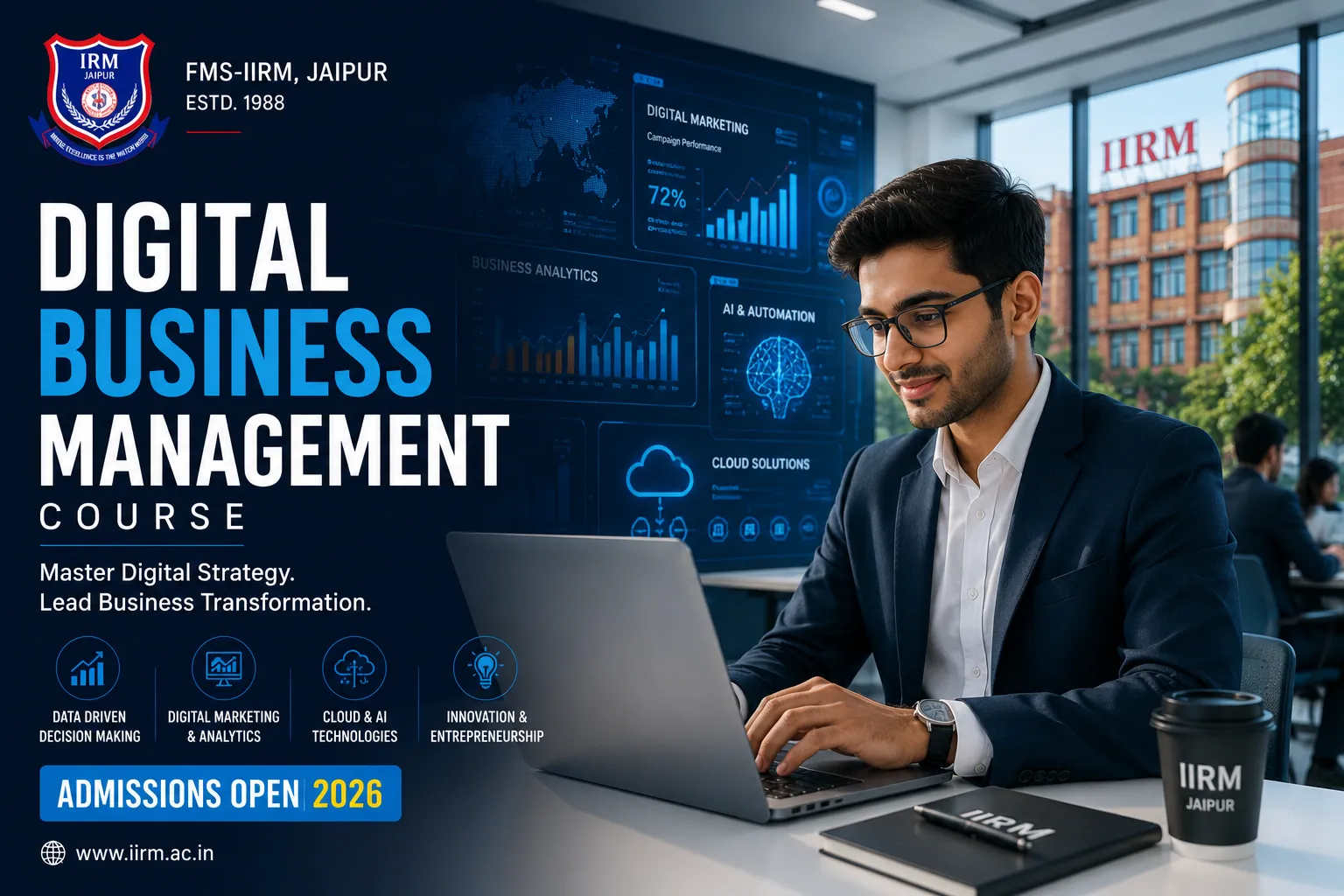

Why Digital Business Management Matters in 2026
Businesses in 2026 are no longer operating solely on traditional models. Artificial intelligence, data analytics, digital marketing, e-commerce, automation, cloud technology, and online customer experiences have become essential to how companies compete, innovate, and grow. The World Economic Forum reports that 86% of employers expect AI and information-processing technologies to transform their businesses by 2030, while AI and big data are among the fastest-growing skill areas. This creates an important opportunity for students who want to understand both business and technology through digital business management.
India is also experiencing rapid digitalisation. Government data suggests that India's digital economy could contribute nearly one-fifth of the country's national income by 2029–30 and grow significantly faster than the overall economy. In this changing environment, a digital business curriculum can be particularly valuable for students aspiring to management careers that combine business strategy with technology.
1. Builds Future-Ready Digital Skills
One of the greatest advantages of studying digital business management is the opportunity to develop skills that are relevant to an evolving workplace. Students can learn about digital platforms, business analytics, e-commerce, digital transformation, customer experience, and emerging technologies. This knowledge can help students understand not only how businesses operate but also how technology is transforming the way companies function.
The demand for technology-savvy professionals is increasing across industries as employers look for candidates who can adapt to changing technologies. The World Economic Forum identifies AI and big data, networks and cybersecurity, and technological literacy among the fastest-growing skill areas through 2030. Developing these capabilities can therefore help students prepare for a workplace where digital knowledge is becoming increasingly important.
2. Creates Strong Career Opportunities
Digital Business Management can open career opportunities in marketing, sales, consulting, business development, e-commerce, analytics, and digital transformation. Instead of restricting graduates to one traditional management function, the programme can provide a broader understanding of how modern digitally enabled businesses operate.
Potential career roles include Digital Marketing Executive, Business Development Executive, E-commerce Manager, Digital Transformation Associate, Business Analyst, and Product Marketing Executive. As organisations continue to adopt digital technologies, professionals who understand both business objectives and digital tools can become valuable contributors to management teams.
3. Develops AI and Data-Driven Decision-Making
Modern businesses generate enormous amounts of data. However, data becomes useful only when managers know how to interpret it and apply it to business decisions. Digital Business Management can introduce students to business analytics, data interpretation, and AI-powered decision-making, helping them understand how data can support business planning and strategy.
This is particularly important because AI is rapidly evolving from an experimental technology into a practical business tool. Managers do not necessarily need to become programmers, but they increasingly need to understand how AI can be used to improve productivity, customer engagement, forecasting, and decision-making. This knowledge can give management graduates an advantage in technology-driven workplaces.
4. Strengthens Digital Marketing Knowledge
Consumers are increasingly discovering brands through search engines, social media platforms, websites, online marketplaces, and mobile applications. As a result, digital marketing has become an important component of modern business growth.
A Digital Business Management programme can introduce students to areas such as SEO, social media marketing, content marketing, paid advertising, customer analytics, and online brand management. Combining marketing knowledge with technology can be particularly useful for students who want to build careers in the rapidly evolving digital marketing industry.
5. Supports Entrepreneurship and Startups
Digital technology has reduced many traditional barriers for entrepreneurs. Today, businesses can reach customers through online stores, social media platforms, and digital marketplaces without immediately requiring a large physical presence.
Students studying Digital Business Management can learn how to identify market opportunities, understand customer needs, develop digital business models, and use online channels to support business growth. These skills can be valuable for students who want to launch their own startups as well as those who eventually want to manage digital businesses.
6. Improves Business and Leadership Skills
Digital business is not only about technology. Successful managers still need communication, leadership, strategic thinking, problem-solving, and decision-making skills. Digital Business Management combines these traditional management capabilities with modern digital knowledge.
This combination can help students become more comfortable working with technology teams, marketing professionals, business managers, and data analysts. It provides a broader understanding of business rather than focusing exclusively on either technical or traditional management skills.
7. Opens Opportunities Across Industries
Another major advantage of Digital Business Management is its versatility. Digital transformation is affecting almost every major industry, including retail, banking, healthcare, education, insurance, manufacturing, logistics, tourism, and professional services.
Graduates of this programme are therefore not necessarily restricted to technology companies. Digital skills are becoming relevant across different business sectors, creating opportunities for professionals who understand how technology can be applied to solve business challenges and improve organisational performance.
8. Enhances Employability and Adaptability
Technology changes rapidly. A tool that is widely used today may eventually be replaced by a newer and more advanced solution. Because of this, employers increasingly value professionals who can learn, adapt, and solve unfamiliar problems.
Digital Business Management encourages students to develop adaptability by combining business knowledge with technological awareness. According to the World Economic Forum, approximately 39% of workers' existing skill sets are expected to be transformed or become outdated between 2025 and 2030. This highlights why continuous learning and adaptability are becoming increasingly important for long-term career growth.
9. Provides Practical Industry Exposure
Management education becomes more valuable when students can connect classroom concepts with real-world business situations. Depending on the institution, Digital Business Management programmes may include live projects, internships, case studies, presentations, business simulations, and industry interactions.
This practical exposure can help students understand how organisations use digital tools to attract customers, analyse market trends, improve operations, and make strategic decisions. It can also give students opportunities to develop practical portfolios and demonstrate their skills during the recruitment process.
10. Prepares Students for Global Business
The growth of digital platforms has made geographical boundaries less important for many businesses. A company based in India can serve international customers, collaborate with global teams, and sell products through international marketplaces.
Studying Digital Business Management can therefore help students develop a broader understanding of global markets, digital consumers, international competition, and technology-driven business models. For ambitious management graduates, this knowledge can create opportunities to work with multinational corporations, global consulting firms, e-commerce companies, and digitally focused startups.
Career Scope After Digital Business Management
The career scope after studying Digital Business Management is broad because digital transformation is influencing multiple areas of business. Graduates can explore opportunities in digital marketing, e-commerce, consulting, business analytics, sales, product management, business development, and digital transformation.
The biggest advantage is the combination of skills. A professional who understands business strategy, technology, data, and customer behaviour can potentially contribute to different teams rather than being limited to a single traditional business function. This flexibility can be particularly valuable in a job market where companies increasingly prefer professionals with multidisciplinary capabilities.
Conclusion
Studying Digital Business Management in 2026 can be a strong option for students who want to prepare for the intersection of business and technology. From developing AI and analytics knowledge to understanding digital marketing, entrepreneurship, and global business, the programme can provide a broad management foundation.
The real advantage lies in adaptability. As companies continue to digitise their business processes, professionals who can understand business challenges and identify appropriate digital solutions may be better prepared for changing career requirements. Digital Business Management is therefore not simply about learning new technologies; it is about understanding how technology can be used to make better business decisions, improve customer experiences, and create sustainable growth opportunities.
FAQs
1. What is Digital Business Management?
Digital Business Management focuses on combining traditional management principles with digital technologies, data-driven business models, digital marketing, e-commerce, and emerging technologies such as artificial intelligence.
2. Is Digital Business Management a good career choice in 2026?
Yes. The increasing use of AI, data analytics, digital platforms, and e-commerce is creating demand for professionals who understand both management principles and digital technologies.
3. What jobs can I get after studying Digital Business Management?
Career opportunities can include Digital Marketing Executive, Business Analyst, Business Development Executive, E-commerce Manager, Product Marketing Executive, and Digital Transformation Associate, depending on your skills, experience, and chosen specialisation.
4. Is Digital Business Management suitable for students without a technical background?
Yes. Students do not necessarily need to become programmers. The focus is generally on understanding how digital technologies can be applied to solve business and management problems and support organisational growth.
5. What skills are important for a career in Digital Business Management?
Important skills include analytical thinking, digital marketing, AI awareness, communication, leadership, data interpretation, strategic thinking, problem-solving, and adaptability. Developing these skills alongside practical experience can help students prepare for a wide range of digital business careers.





























Sign in to leave a comment.