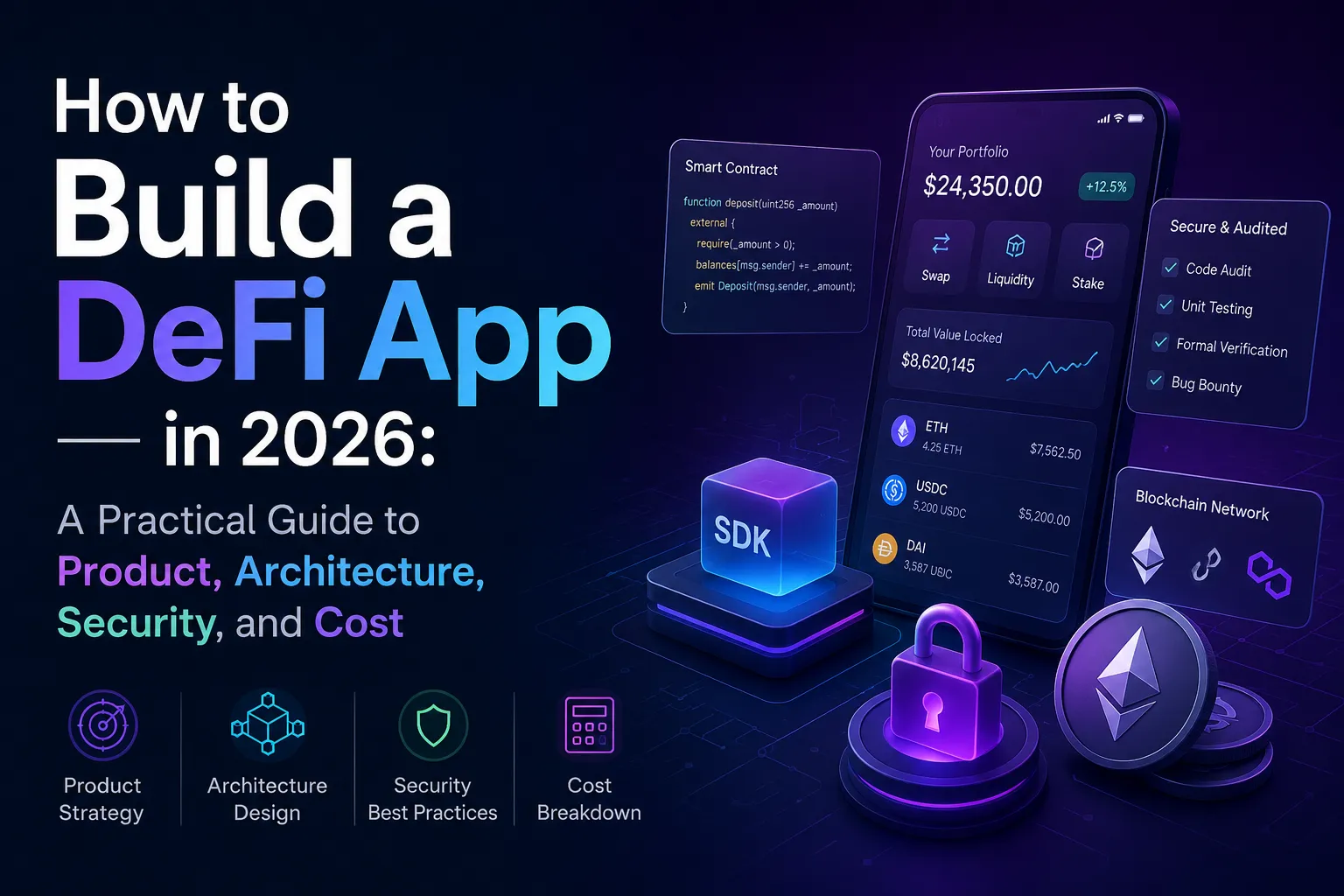

Traditional capital markets rely on a centralized web of custodian banks, clearinghouses, and brokerages to facilitate financial transactions. While these intermediaries provide structural oversight, they introduce substantial operational friction: multi-day settlement delays ($T+1$ and $T+2$), fragmented international liquidity pools, and high administrative fees that extract capital from market participants. Decentralized finance replaces these central intermediaries with deterministic, self-executing code. By establishing peer-to-peer liquidity pools, algorithmic interest rate curves, and transparent collateralization rules on public distributed ledgers, decentralized protocols enable 24/7 global trading with immediate transaction finality.
However, executing DeFi app development requires specialized software engineering that carries zero margin for error. In a decentralized financial application, on-chain smart contracts maintain direct custody of user capital. A single logic vulnerability, an unhandled reentrancy vector, or an unhedged oracle latency gap allows adversarial arbitrageurs to drain protocol liquidity via flash loans within a single transaction block. Furthermore, DeFi developers must engineer protocols that withstand Maximal Extractable Value (MEV) sandwich attacks, optimize computational gas execution for high-frequency liquidity providers, and implement account abstraction (ERC-4337) so non-technical users can trade without managing raw private keys.
Selecting the right development partner dictates whether a decentralized finance application establishes deep institutional liquidity or suffers catastrophic exploit events. This market analysis evaluates the top 10 software engineering firms specializing in DeFi app development, examining their mathematical modeling capabilities, smart contract security standards, and liquidity architecture.
How We Selected These Companies
Evaluating development firms for decentralized finance requires assessing technical competencies across financial engineering, distributed systems, and adversarial security. We analyzed candidate engineering firms against five core benchmarks:
- Algorithmic Liquidity & AMM Engineering: Demonstrated technical expertise in designing automated market maker (AMM) mathematical curves, including constant product ($x \cdot y = k$), concentrated liquidity algorithms (similar to Uniswap v4 architectures), and multi-asset invariant pools (Curve-style stableswaps).
- Adversarial Security & Flash-Loan Mitigation: Proven software architecture designed to resist economic exploit vectors, incorporating multi-block Time-Weighted Average Price (TWAP) oracles, decentralized price bounds, reentrancy locks, and automated circuit breakers.
- Non-Custodial Lending & Collateralization Mechanics: The technical capability to build multi-tier collateralized debt markets, dynamic interest rate curves, flash-loan settlement mechanics, and automated health-factor liquidation bots.
- Cross-Chain Interoperability & Bridge Architecture: Engineering experience implementing cross-chain communication protocols (such as Chainlink CCIP, LayerZero, and Wormhole) to route liquidity across Ethereum, Arbitrum, Base, and Solana without introducing centralized bridge vulnerabilities.
- Account Abstraction & Frictionless User Experience: Proven implementation of ERC-4337 smart contract accounts, WebAuthn passkey authentication, and gasless transaction paymasters to eliminate manual seed-phrase management and gas token barriers for retail users.
Top 10 DeFi App Development Companies
1. Idea Usher
Best suited for: End-to-end custom DeFi platforms, concentrated liquidity AMMs, cross-chain yield routing, and institutional compliance rails.
Idea Usher builds custom digital software and decentralized applications, specializing in full-stack DeFi software engineering for fintech institutions, digital asset funds, and Web3 startups. Their engineering teams approach decentralized finance from an institutional product perspective, designing on-chain financial state machines alongside real-time trading dashboards, automated keeper networks, custom indexing subgraphs, and secure mobile clients. They build across major Layer 1 and Layer 2 ecosystems—including Ethereum, Arbitrum, Base, Polygon, and Solana—enabling protocols to achieve deep liquidity and sub-second execution speeds.
The company specializes in engineering secure, gas-optimized decentralized trading and lending architectures. Idea Usher develops automated market makers (AMMs) featuring customizable concentrated liquidity hooks, dynamic fee tiers, and low-slippage routing algorithms. Their developers implement multi-layered oracle aggregation pipelines that combine Chainlink feeds with internal time-weighted average price (TWAP) calculations to prevent flash-loan price manipulation. Idea Usher also builds institutional access modules that integrate zero-knowledge identity verification (ZK-KYC) and automated transaction screening, enabling permissioned DeFi pools that satisfy regulatory requirements without compromising on-chain composability.
- Core Strengths: Concentrated liquidity AMM engineering, multi-source oracle integration, algorithmic lending protocols, and ZK-compliant institutional DeFi architecture.
2. Intellivon
Best suited for: AI-driven algorithmic yield optimization, predictive liquidity rebalancing, and on-chain risk analytics.
Intellivon operates at the intersection of enterprise artificial intelligence and specialized decentralized software engineering, developing custom machine learning models and autonomous agent workflows for decentralized finance ecosystems. While standard DeFi protocols execute static mathematical formulas, Intellivon develops intelligent off-chain compute layers that allow protocols to dynamically respond to volatile market conditions, shifting borrowing rates, and cross-pool arbitrage opportunities.
Their engineering team builds autonomous agentic pipelines that manage high-frequency DeFi operations. For example, Intellivon engineers custom keeper bots that analyze mempool transaction order flows to protect liquidity providers from sandwich attacks and front-running bots. Their predictive machine learning models assess protocol-wide collateral risk in real time, automatically adjusting borrow-to-value (LTV) limits and interest rate curve slopes before market volatility triggers systemic bad debt. Furthermore, Intellivon develops automated auditing tools powered by specialized Large Language Models (LLMs) that inspect DeFi smart contract codebases for state-inconsistency vulnerabilities prior to deployment.
- Core Strengths: Autonomous AI keeper agents, mempool transaction flow analytics, predictive collateral risk modeling, and automated smart contract audit tools.
3. PixelPlex
Best suited for: Custom decentralized exchange (DEX) platforms, algorithmic staking mechanisms, and multi-chain liquidity bridges.
PixelPlex is an international software development company that specializes in custom blockchain development, decentralized finance protocols, and Web3 enterprise software. Having established its blockchain development practice in 2013, the firm has engineered hundreds of decentralized financial products, ranging from automated market maker (AMM) exchanges to non-custodial crypto lending platforms.
Their engineering team specializes in complex on-chain financial logic, including custom staking mechanisms, liquidity pool routing, and synthetic asset protocols. PixelPlex builds cross-chain liquidity bridges utilizing threshold signature schemes and decentralized relayer networks, allowing seamless asset transfers between isolated blockchain environments. Their developers emphasize low-latency frontend synchronization, using custom WebSockets and event listeners to ensure real-time price feeds and transaction states display accurately across user interfaces.
- Core Strengths: Custom DeFi protocol architecture, automated market maker (AMM) engineering, cross-chain bridge development, and high-performance Web3 frontends.
4. Boosty Labs
Best suited for: High-throughput DeFi protocols, algorithmic stablecoins, and scalable off-chain indexer infrastructure.
Boosty Labs is a prominent blockchain development and system integration company that builds scalable decentralized applications, fintech platforms, and custom smart contracts. With a deep bench of blockchain engineers, the firm provides dedicated development teams to high-growth Web3 startups and established financial institutions.
Their engineering practice specializes in complex decentralized finance logic. Boosty Labs develops automated market maker contracts, decentralized exchange routing algorithms, and multi-collateral lending protocols. They write gas-optimized contracts across EVM-compatible networks, ensuring that high-frequency trading actions do not incur prohibitive transaction fees. Boosty Labs also builds the critical off-chain infrastructure—including fast RPC node indexers and custom API gateways—that allows web interfaces to sync instantly with smart contract state changes.
- Core Strengths: DeFi protocol smart contracts, automated market maker (AMM) algorithms, EVM optimization, and fast off-chain indexer integration.
5. Unicsoft
Best suited for: AI-integrated blockchain solutions, custom DeFi analytics, and secure smart contract engineering.
Unicsoft delivers custom blockchain and decentralized software development services, focusing on data-driven fintech platforms, digital asset exchanges, and automated financial workflows. The firm provides full-cycle engineering services, bridging machine learning models with decentralized smart contracts to deliver intelligent DeFi applications.
Their technical teams specialize in developing non-custodial lending protocols, staking platforms, and decentralized portfolio management tools. Unicsoft places strong emphasis on algorithmic modeling, testing liquidity curves and collateralization ratios under simulated high-volatility market events. Their engineers implement automated testing frameworks and continuous integration pipelines that audit code for vulnerabilities, ensuring decentralized applications operate reliably under high transaction loads.
- Core Strengths: AI-driven financial analytics, custom lending and staking dApps, smart contract security testing, and data-driven portfolio management tools.
6. ScienceSoft
Best suited for: Enterprise core banking synchronization, private-to-public blockchain bridges, and ISO 27001 data governance.
ScienceSoft brings over 35 years of enterprise IT consulting and custom software development experience to decentralized computing. Operating under ISO 27001 information security standards, the company provides specialized blockchain engineering services for financial institutions, healthcare networks, and global logistics enterprises.
Their developers excel at integrating decentralized smart contract systems into established enterprise software environments. ScienceSoft builds secure middleware that connects private permissioned ledgers (like Hyperledger Fabric) with public chains (like Polygon or Ethereum), allowing enterprises to verify internal audit trails on public networks while keeping sensitive business logic private. Their technical teams prioritize complete data security, implementing role-based access control, cryptographic key management (HSM integration), and automated audit logs that satisfy global data privacy standards.
- Core Strengths: Enterprise software and blockchain integration, private/public hybrid ledger engineering, ISO 27001 data governance, and secure middleware architecture.
7. LimeChain
Best suited for: Zero-knowledge (ZK) infrastructure, modular blockchain tooling, and Substrate framework engineering.
LimeChain is a specialized blockchain development and consulting firm that builds developer tooling, decentralized protocols, and custom blockchain networks. The firm has built core infrastructure for prominent blockchain foundations, specializing in low-level systems programming, Polkadot/Substrate parachain development, and Zero-Knowledge (ZK) cryptography.
Their technical teams excel at building modular rollup components and custom state transition logic. LimeChain engineers decentralized software across EVM and non-EVM ecosystems, writing gas-optimized smart contracts in Solidity and Rust. They have deep expertise in building cross-chain communication protocols and state verification bridges using light client architectures. Organizations developing custom application-specific blockchains (appchains) or requiring advanced zero-knowledge proof verification rely on LimeChain for deep, protocol-level engineering.
- Core Strengths: Substrate/Polkadot framework engineering, Zero-Knowledge proof implementation, custom appchain development, and low-level protocol tooling.
8. Innowise Group
Best suited for: Full-stack fintech engineering, multi-currency payment rails, and cross-platform mobile dApps.
Innowise Group is an international software development company with extensive engineering capabilities across fintech, digital banking, and spatial computing. Their financial technology practice focuses on building scalable, API-first lending platforms that connect capital providers and retail traders in real time.
When developing decentralized finance platforms, Innowise engineers end-to-end solutions spanning front-end consumer portals, automated underwriting microservices, and back-office loan management dashboards. Their developers have deep expertise in implementing open banking protocols and decentralized wallet integrations. Innowise Group builds modular software that easily scales across international markets, incorporating multi-currency processing and localized compliance modules for diverse regulatory frameworks.
- Core Strengths: Full-stack fintech development, open banking API integrations, modular microservices architecture, and cross-platform mobile client engineering.
9. Nadcab Labs
Best suited for: DeFi tokenomics design, automated staking protocols, and smart contract security auditing.
Nadcab Labs is a specialized blockchain development agency that provides custom engineering services for decentralized financial applications, tokenized asset protocols, and smart contract infrastructures. The firm focuses heavily on the cryptographic logic and tokenomics architecture required to launch decentralized platforms.
Their engineering practice specializes in building automated staking protocols, decentralized lottery contracts, and peer-to-peer lending pools. Nadcab Labs builds custom smart contract auditing pipelines that conduct static analysis and unit testing to identify reentrancy and access control flaws before protocol deployment. Their developers also engineer intuitive web frontends that connect to multiple non-custodial wallets, providing users with clear visual interfaces for tracking yield rates and managing open positions.
- Core Strengths: DeFi smart contract development, automated staking pool architecture, tokenomics modeling, and smart contract vulnerability analysis.
10. OpenZeppelin
Best suited for: Standardized smart contract libraries, formal protocol verification, and decentralized governance systems.
OpenZeppelin sets the global benchmark for smart contract engineering, maintaining the open-source Solidity libraries that power the vast majority of the Ethereum ecosystem. Beyond their foundational open-source work, OpenZeppelin provides premium custom software engineering, security architecture design, and comprehensive code audit services for leading Web3 protocols and institutional decentralized autonomous organizations (DAOs).
Their engineers specialize in building mathematically secure, highly composable smart contract architectures. OpenZeppelin conducts deep formal verification, utilizing advanced mathematical proofs to verify that mission-critical contract functions behave identically to their exact technical specifications under all computational states. They also provide enterprise protocol teams with OpenZeppelin Defender, a security operations platform that automates smart contract administration, monitors on-chain threats, and manages multi-signature access controls securely after deployment.
- Core Strengths: Battle-tested Solidity standard libraries, mathematical formal verification, upgradeable proxy patterns, and automated security operations (Defender).
Comparison of Top DeFi App Development Companies
| Company | Best Suited For | Core Technical Strength | Primary Deployment Focus |
|---|---|---|---|
| Idea Usher | Custom Full-Cycle DeFi Platforms | Concentrated liquidity AMMs, oracle protection & ZK-KYC compliance | Multi-chain DEXs, lending markets & institutional DeFi |
| Intellivon | AI-Driven Yield & Risk Analytics | Autonomous keeper agents, mempool analytics & predictive LTV models | Predictive DeFi protocols, automated market makers & analytics |
| PixelPlex | Custom DEXs & Cross-Chain Bridges | Automated market makers, staking mechanisms & liquidity routing | Decentralized exchanges, staking platforms & liquidity protocols |
| Boosty Labs | High-Throughput Trading Engines | EVM optimization, algorithmic stablecoins & fast RPC indexers | High-frequency trading dApps, lending pools & tokenomics |
| Unicsoft | AI-Integrated DeFi & Analytics | AI yield analytics, custom lending dApps & smart contract testing | Data-driven DeFi platforms, yield aggregators & staking |
| ScienceSoft | Enterprise IT & Hybrid Blockchain | ISO 27001 data governance, ERP middleware & hybrid ledger sync | Enterprise ERP integration, compliance ledgers & audit trails |
| LimeChain | ZK-Rollups & Modular Appchains | Zero-knowledge proof systems & low-level Substrate developer tooling | Appchain engineering, ZK-rollup tools & custom consensus |
| Innowise Group | Full-Stack FinTech & Cross-Chain | API-first architecture, multi-currency processing & mobile dApps | Consumer mobile DeFi apps, payment gateways & analytics |
| Nadcab Labs | Staking Protocols & Tokenomics | Smart contract vulnerability auditing & staking pool engineering | P2P lending dApps, staking platforms & token contracts |
| OpenZeppelin | Security Frameworks & Auditing | Formal verification, standard contract libraries & Defender tooling | High-stakes protocol audits, governance & upgradeable proxies |
The 5-Phase Technical Roadmap: How to Build a DeFi App
Engineering a production-ready decentralized financial application requires a disciplined development lifecycle that aligns mathematical modeling with adversarial smart contract security.
Phase 1: Quantitative Modeling & Tokenomics Architecture
Before writing smart contract code, quantitative financial engineers define the mathematical models governing the protocol. This includes formulating automated market maker (AMM) invariant curves (e.g., constant product $x \cdot y = k$ or stableswap curves), setting borrowing interest rate curves based on pool utilization rates, and establishing safe loan-to-value (LTV) limits and liquidation threshold penalties to protect the protocol against market insolvency.
Phase 2: Smart Contract Engineering & Gas Optimization
Smart contract developers build the protocol state machines using Solidity or Rust. The code must strictly follow the checks-effects-interactions pattern to eliminate reentrancy vulnerabilities. Developers utilize Universal Upgradeable Proxy Standards (UUPS) to decouple business logic from persistent user balance storage. Furthermore, engineers optimize storage slot layouts and use low-level Yul assembly for math-heavy operations to minimize execution gas costs for liquidity providers.
Phase 3: Oracle Integration & Flash-Loan Defense
To prevent price manipulation, developers implement robust oracle pipelines. Rather than querying single on-chain spot prices (which can be manipulated within a single transaction using flash loans), the protocol integrates decentralized oracle networks (such as Chainlink or Pyth) combined with internal multi-block Time-Weighted Average Price (TWAP) filters. The system also incorporates automated circuit breakers that pause trading if asset prices experience sudden, mathematically anomalous deviations.
Phase 4: Off-Chain Indexing, Keepers & Account Abstraction UX
Querying blockchain nodes directly for historical order books or user yield charts causes extreme interface latency. The development team deploys custom indexing subgraphs (via The Graph) that process on-chain event logs into normalized GraphQL endpoints for instant frontend rendering. Concurrently, engineers deploy off-chain keeper bots to monitor open debt positions and execute liquidations the millisecond health factors drop below minimum thresholds. The client interface embeds ERC-4337 account abstraction, allowing traders to onboard via biometric passkeys and execute batched transactions without confirming multiple pop-up prompts.
Phase 5: Adversarial Testing, Formal Verification & Mainnet Release
Before public deployment, the protocol undergoes property-based fuzz testing using tools like Foundry, executing millions of randomized transaction sequences to verify that core invariants (such as total vault assets matching total share liabilities) can never be broken. The codebase is submitted to recognized independent audit firms for formal verification and manual review. Finally, the protocol is deployed to a Layer 2 network behind a multi-signature governance vault governed by a mandatory 48-hour time-lock contract.
Strategic Evaluation Guide: How to Select a DeFi App Development Partner
Selecting an engineering partner to build a decentralized finance application requires evaluating technical competencies across financial engineering, smart contract security, and system integration:
1. Evaluate Mathematical and Financial Engineering Capabilities
Building a functional DeFi protocol requires deep domain knowledge of quantitative finance. Ensure your prospective development team understands liquidity curve formulas, dynamic interest rate models, and debt liquidation mechanics. The engineering team must be capable of running mathematical simulations to stress-test your protocol against liquidity crises and market volatility.
2. Inspect Flash-Loan Defense and Oracle Integration Architecture
The vast majority of DeFi exploits stem from oracle manipulation rather than coding bugs. Inquire how the engineering partner designs price discovery mechanisms. A qualified development team should demonstrate how they aggregate multiple independent oracle feeds, filter out outlier price anomalies, and implement minimum holding periods to neutralize single-transaction flash-loan manipulation attacks.
3. Require Modern Testing Frameworks and Formal Verification
In decentralized finance, simple JavaScript unit tests are inadequate. Require your development partner to use Foundry or Hardhat to construct comprehensive test suites. The team must demonstrate experience conducting property-based fuzz testing (bombarding contracts with millions of randomized transactions to test protocol invariants) and symbolic execution to ensure no input can cause unexpected state corruption.
4. Ensure Full Intellectual Property Transfer and Custody Independence
Verify that your development contract guarantees full, unencumbered ownership of all smart contract source code, deployment scripts, keeper bot repositories, and frontend codebases upon completion. Furthermore, ensure that the development agency follows strict cryptographic key management practices during deployment, using hardware security modules (HSMs) or multi-signature vaults so your organization retains sole custody of deployer and administrative keys.
Frequently Asked Questions
What is DeFi app development?
DeFi app development is the process of designing, engineering, and deploying decentralized financial applications and smart contracts on blockchain networks. These platforms replace traditional financial intermediaries (such as banks and centralized exchanges) with self-executing code that automates trading, borrowing, lending, asset staking, and yield generation.
How much does it cost to build a custom DeFi app?
Developing a custom DeFi app typically ranges from $75,000 to $300,000+, depending on architectural complexity. A straightforward token staking pool or decentralized exchange clone sits at the lower end of the range. Enterprise-grade platforms featuring concentrated liquidity AMMs, algorithmic multi-collateral lending vaults, cross-chain bridges, automated keeper bot infrastructure, and formal security audits require higher capital investment.
How do DeFi protocols protect against flash-loan attacks?
DeFi protocols defend against flash loans by eliminating single-block price dependencies. Developers implement decentralized oracles (such as Chainlink) combined with Time-Weighted Average Price (TWAP) filters that calculate prices over multiple blocks, preventing an attacker from manipulating a price within a single atomic transaction. In addition, contracts use reentrancy guards and state validation checks to prevent unauthorized state manipulation.
What is the ERC-4626 token standard in DeFi app development?
ERC-4626 is a standardized yield-bearing token vault standard built on Ethereum. It establishes a unified API for depositing tokens into yield strategies and receiving vault shares in return. This standardization simplifies integration between different DeFi protocols, allowing lending platforms, yield aggregators, and AMMs to interact with token vaults without requiring custom adapter contracts.
The Future of Decentralized Financial Architecture
Decentralized finance has evolved from experimental yield farming into a robust, high-performance financial infrastructure that rivals traditional capital markets in speed, transparency, and composability. By replacing opaque administrative intermediaries with deterministic, mathematically verifiable smart contracts, modern DeFi platforms deliver 24/7 liquidity, instant settlement, and global capital access.
Successfully launching an enterprise-grade DeFi application requires an engineering partner that balances deep quantitative modeling with adversarial smart contract security and high-performance Layer 2 integration. Selecting a development team with verified blockchain engineering capabilities ensures your protocol deploys securely, scales cost-effectively, and establishes enduring liquidity in a competitive digital economy.




















Sign in to leave a comment.