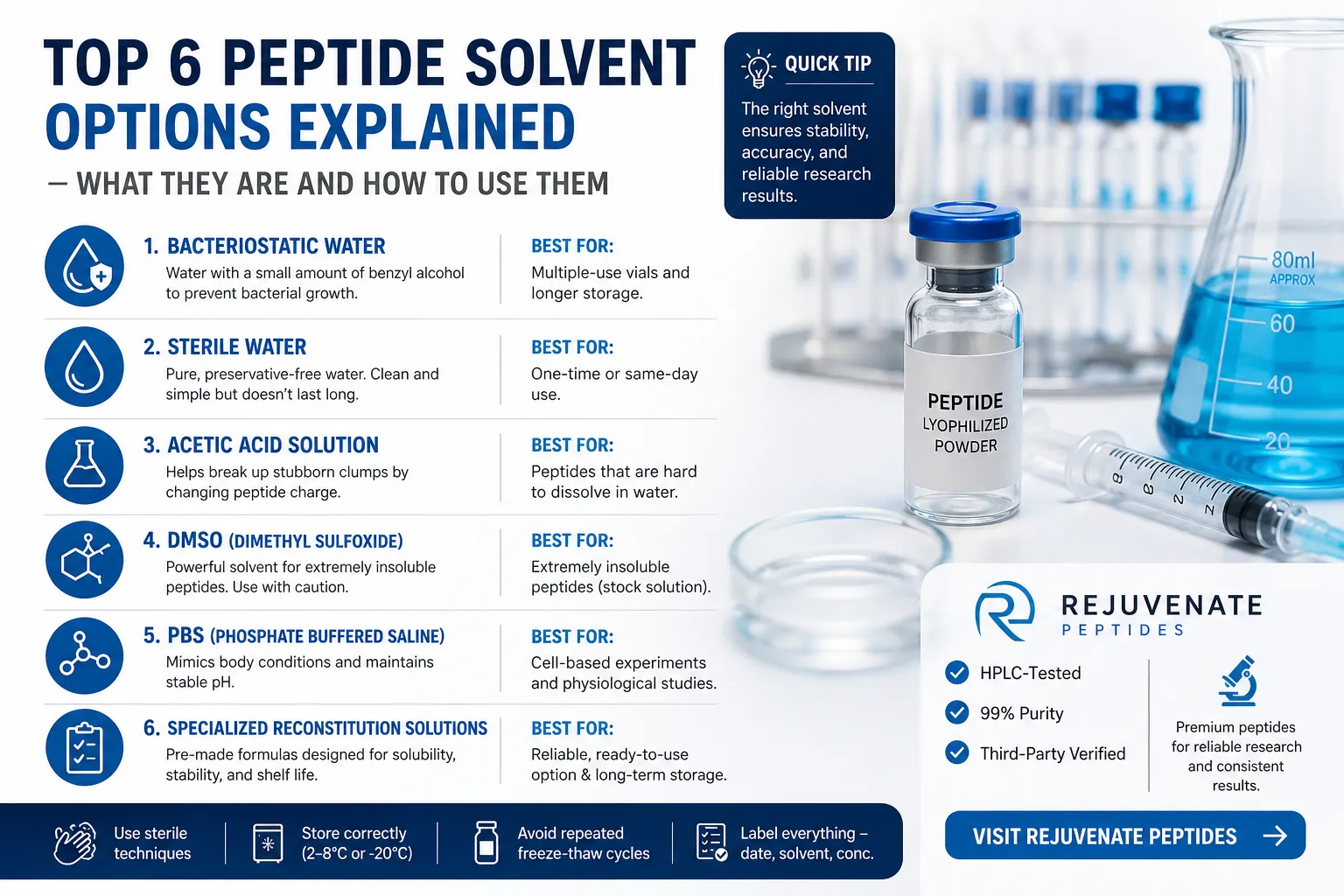

What are the Top 6 Solvents
When you get a peptide, it usually comes as a dry powder. To use it in research, you need to dissolve it in a liquid first. That liquid is called a peptide solvent — and picking the right one really matters. The wrong choice can break down the peptide, cause clumping, or give you inconsistent results. This guide explains your six main options in plain terms.
The 6 solvents — and when to use each
1. Bacteriostatic water
Most commonly used
This is water with a tiny amount of benzyl alcohol added — just enough to stop bacteria from growing. It's the go-to choice for most peptides because it keeps your solution safe to use over several weeks without going bad.
Best for: Any peptide you plan to use multiple times from the same vial. It gives you flexibility and a longer usable window after mixing.
2. Sterile water
Clean and simple
Just plain purified water — no preservatives, no additives. It's the cleanest option, which makes it ideal when you don't want anything extra interfering with your experiment. The downside is it doesn't last long once the peptide is dissolved.
Best for: One-time or same-day use. If you're only doing a single session, this keeps things simple and contamination-free.
3. Acetic acid solution
For hard-to-dissolve peptides
Some peptides just won't dissolve in water — they clump together no matter what you do. A mild acetic acid solution (basically very diluted vinegar) helps break up those clumps by changing the electrical charge on the peptide, making it easier to dissolve.
Best for: Peptides that feel "sticky" or refuse to fully dissolve in water-based solvents. A common first step is trying 10–30% acetic acid in water.
4. DMSO (Dimethyl Sulfoxide)
Powerful, use carefully
DMSO is a strong industrial-grade solvent that can dissolve peptides that won't budge in anything else. It works by breaking through the molecular forces that cause clumping. However, it's quite potent and needs to be diluted before use.
Best for: Extremely insoluble peptides as a stock solution only. Always dilute DMSO significantly before any use — a little goes a long way.
5. PBS (Phosphate Buffered Saline)
Matches body conditions
PBS is a salt-based solution that mimics the pH and salt levels found in the human body. Researchers use it when they need conditions that closely match a biological environment — like when working with cells or tissue samples. It keeps the pH stable throughout the experiment.
Best for: Cell-based experiments or any work where you need to replicate physiological conditions. Check solubility first — not all peptides dissolve well in PBS.
6. Specialized reconstitution solutions
Purpose-built formulas
These are pre-made solutions specifically designed for peptides. Instead of mixing your own, you get a ready-to-use formula that's been optimized for solubility, stability, and shelf life. They take the guesswork out of the process and give you more consistent results.
Best for: Researchers who want a reliable, ready-made option without having to troubleshoot solvent compatibility. Great for long-term storage needs.
Simple rules for mixing peptides safely
- Always use a clean, sterile syringe and needle — contamination is the most common cause of ruined batches.
- Add the solvent slowly, along the side of the vial. Don't squirt it straight onto the powder.
- Gently swirl or roll the vial — never shake it. Shaking causes foaming and can damage the peptide.
- Once dissolved, split it into small single-use portions right away. This avoids repeated freezing and thawing.
- Write the date, peptide name, solvent used, and concentration on every vial. You'll thank yourself later.
- When in doubt, test with a small amount before committing your whole supply to one solvent.
How to store peptides after mixing
30–40%
That's how much peptide effectiveness can drop when stored incorrectly. Poor storage is one of the biggest reasons research results become unreliable.
- Short-term (a few days): keep in the fridge at 2–8°C.
- Long-term (weeks to months): freeze at −20°C or colder.
- Keep vials away from light — use amber glass or wrap in foil.
- Don't freeze and thaw the same vial more than once or twice. Repeated cycles break the peptide down.
- Keep moisture out of dry, unopened peptide powder until you're ready to use it.
Mistakes that quietly ruin results
- Using water on a peptide that needs acid or DMSO to dissolve — it just won't fully dissolve, and your concentration will be off.
- Skipping the pH check — some peptides break apart or clump when the pH isn't right for them.
- Storing a dissolved peptide in a non-sterile container, even briefly. Bacteria get in fast.
- Freezing and thawing the same vial over and over. Split into small portions first.
- Eyeballing amounts instead of calculating precisely. Even small errors in concentration multiply across experiments.
Common questions answered simply
Which solvent should I start with?
Start with bacteriostatic water. It works for most peptides and is the easiest to handle. If the peptide doesn't dissolve fully, try acetic acid next, then DMSO as a last resort.
How long does a dissolved peptide last?
In the fridge, usually a few days to a couple of weeks depending on the peptide and solvent. In the freezer at −20°C, most last several months. Sterile water solutions should be used the same day.
Can I use the same solvent vial multiple times?
Bacteriostatic water is designed for this — it stays safe across multiple draws. Plain sterile water is not — use a fresh vial each time to avoid contamination.
How do I know if my peptide has gone bad?
Look for cloudiness, unexpected clumps, or a color change in the solution. If the peptide was working before and suddenly seems less effective, degradation is likely. When in doubt, HPLC testing gives you a definitive answer.
Does the solvent affect my results?
Yes, significantly. The wrong solvent can mean the peptide never fully dissolves, changes structure, or breaks down faster than expected — all of which throw off your results. Consistent solvent use across experiments is just as important as consistent dosing.
Need research-grade peptides?
Rejuvenate Peptides offers HPLC-tested peptides with 99% purity, third-party verified.
Visit Rejuvenate Peptides


























Sign in to leave a comment.