The digital landscape of 2026 is radically different from just a few years ago. We have moved past the era where "fast enough" was acceptable. Today, user expectations are driven by instant gratification, AI-integrated experiences, and hyper-responsive interfaces that feel native to the device. For businesses and developers, this means the choice of a web framework is no longer just about preference; it is a critical strategic decision that dictates scalability, SEO ranking, and user retention.
As we navigate this advanced ecosystem, the frameworks leading the charge have evolved to prioritize "zero-lag" interactions and seamless edge computing. Whether you are an enterprise technical lead or a startup founder, aligning with the right technology is paramount. Often, the smartest move is to collaborate with a specialized web app development company that can navigate these shifting tides, ensuring your architecture is robust enough to handle the demands of the modern web.
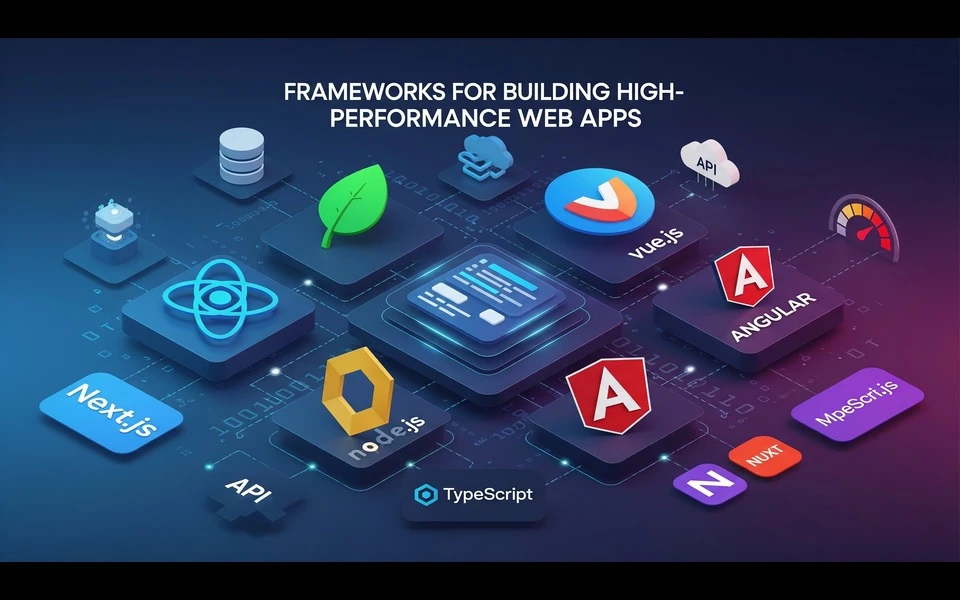
In this guide, we dive deep into the top frameworks of 2026, categorized by their strengths in performance, scalability, and ecosystem maturity.
1. The Heavyweights: Evolved and Optimized
The "Big Three"—React, Angular, and Vue—remain dominant in 2026, but they are not the same frameworks they were in 2020. They have undergone significant architectural shifts to address the "hydration" bottlenecks that previously plagued JavaScript-heavy applications.
React (with Next.js 15+)
React remains the undisputed king of the ecosystem, but the way we write React has fundamentally changed. By 2026, React Server Components (RSC) have become the default standard rather than an experimental feature.
- Why it wins: The integration of server-side logic directly into components allows for massive reductions in the JavaScript bundle sent to the client. Next.js has solidified its position as the production engine for React, offering seamless "streaming" of UI components. This means parts of a page become interactive immediately, without waiting for the entire data payload.
- Best for: Large-scale SaaS platforms, dynamic dashboards, and social networks where ecosystem support and talent availability are critical.
Angular (The Renaissance)
Angular experienced a massive resurgence in 2026, largely due to the complete adoption of "Signals" for reactive state management and the removal of Zone.js. This has made Angular applications significantly faster and lighter.
- Why it wins: Angular’s strict structure is its superpower for enterprise teams. The introduction of "partial hydration" means Angular apps now load instantly on mobile networks, competing directly with lighter libraries. It remains the safest bet for long-term, maintainable banking and healthcare applications.
- Best for: Enterprise-grade ERP systems, banking software, and large teams requiring strict architectural guidelines.
Vue.js (Vapor Mode)
Vue has always been the "developer's favorite" for its balance of power and simplicity. In 2026, Vue's "Vapor Mode" is the game-changer. This compilation strategy abandons the Virtual DOM entirely in favor of fine-grained, direct DOM manipulation—similar to SolidJS—while keeping the familiar Vue syntax.
- Why it wins: It offers top-tier performance with a low learning curve. You get the speed of a compiler-optimized framework without losing the rich ecosystem Vue has built over a decade.
- Best for: Rapid prototyping, interactive content sites, and progressive migration of legacy apps.
2. The Performance Specialists: Speed by Default
While the giants have adapted, a new breed of frameworks born in the post-hydration era has captured the high-performance market. These frameworks challenge the very premise that a web app needs to load massive amounts of JavaScript to function.
Qwik
Qwik has revolutionized e-commerce and media sites in 2026 with its philosophy of "Resumability." unlike other frameworks that "replay" logic in the browser to make a page interactive (hydration), Qwik apps pause execution on the server and resume it on the client.
- The Edge: This results in near-instant load times (Time to Interactive), regardless of app size. A Qwik app with 100 components loads as fast as one with 10. This creates a massive SEO advantage for public-facing web applications.
- Use Case: High-traffic e-commerce storefronts like Amazon clones or global news portals.
SolidJS
SolidJS continues to top the benchmark charts. By compiling components down to real DOM nodes and using fine-grained signals for updates, it eliminates the overhead of a Virtual DOM entirely.
- The Edge: It is predictably fast. In 2026, SolidJS is often the engine behind high-frequency trading dashboards and real-time analytics tools where every millisecond of rendering latency matters.
- Use Case: Real-time data visualization, financial apps, and complex widget systems.
SvelteKit
Svelte has matured into a formidable enterprise contender. With Svelte 5’s "Runes," the framework has simplified how state is handled across large applications, addressing one of its few previous criticisms.
- The Edge: Svelte shifts the work from the browser to the build step. The resulting code is tiny and efficient. SvelteKit, the full-stack framework around it, provides one of the best developer experiences (DX) in the industry, allowing for rapid iteration.
- Use Case: Interactive journalism, marketing sites with heavy animations, and startups needing to move fast.
3. The Specialized Architectures
Not every web app is a Single Page Application (SPA). In 2026, we see a divergence where specialized frameworks handle specific architectural needs better than generalists.
Astro (The Content King)
Astro has cemented its place as the default choice for content-driven websites. Its "Island Architecture" allows developers to build mostly static HTML sites but hydrate only the "islands" of interactivity (like a buy button or a carousel) using React, Vue, or Svelte.
- 2026 Update: Astro now includes powerful server-side innovations for handling database connections, making it a viable competitor for traditional CMS frontends.
- Ideal For: Blogs, documentation sites, marketing landing pages, and publishing platforms.
Blazor (WebAssembly Powerhouse)
For .NET shops, Blazor in 2026 is a force of nature. Utilizing WebAssembly (Wasm), it allows developers to run C# code directly in the browser at near-native speeds.
- 2026 Update: The "Blazor United" model seamlessly blends server-side rendering with client-side interactivity, removing the previous "loading" lag associated with Wasm.
- Ideal For: Internal enterprise tools, heavy calculation apps (like CAD or video editing in-browser), and teams deeply invested in the Microsoft ecosystem.
How to Choose the Right Framework
Selecting a framework in 2026 requires looking beyond GitHub stars. You must evaluate the "Total Cost of Ownership," which includes hiring costs, cloud infrastructure fees, and maintenance longevity.
Ecosystem and Talent Pool
If you need to scale a team quickly, React and Angular remain the safest bets. The talent pool is vast, and libraries exist for almost every problem. However, if performance is your primary product differentiator (e.g., an SEO-dependent listing site), moving to Qwik or Astro can provide a tangible ROI that justifies the niche hiring requirement.
Server-Side vs. Client-Side
The biggest trend of 2026 is the move to the Edge. Frameworks like Next.js, Remix, and SvelteKit are designed to run on Edge networks (like Cloudflare Workers or Vercel Edge). This brings the backend logic closer to the user. When scoping your project, professional web application development services will often conduct a latency audit to determine if your user base benefits more from static edge caching (Astro) or dynamic edge streaming (Next.js).
AI Integration
In 2026, your framework must play nice with AI. React and Python (via frameworks like Django or FastAPI) are often paired for AI-heavy apps. However, new patterns are emerging where AI agents generate UI components on the fly. Frameworks with modular, component-based architectures (React, Svelte) adapt better to these generative AI workflows than rigid monolithic structures.
Strategic Implementation
Choosing the framework is only step one. The success of a modern web application relies on the architecture surrounding it—Headless CMS, microservices, and CI/CD pipelines.
Complex, data-heavy applications often require a hybrid approach. For instance, a bank might use Angular for its internal transaction dashboard due to its strict typing and security patterns, while using Astro for its public-facing marketing pages to ensure top-tier Google Core Web Vitals scores.
To execute this level of architectural nuance, businesses increasingly rely on comprehensive web development solutions that look at the holistic picture. It is not just about writing code; it is about crafting a digital asset that is resilient, secure, and ready for the next wave of web evolution.
Conclusion
As we look toward the remainder of the decade, the line between "native" apps and "web" apps will continue to blur. The frameworks of 2026—whether it’s the optimized reliability of React and Angular or the blistering speed of Qwik and SolidJS—offer incredible power.
The key to success lies in matching the tool to the task. Do not choose a framework because it is trendy; choose it because it solves your specific bottleneck, be it load speed, developer velocity, or ecosystem integration.
If you are ready to transform your digital presence and leverage these next-generation technologies, the time to start is now. Build web apps that not only meet today's standards but set the benchmark for tomorrow.
























Sign in to leave a comment.