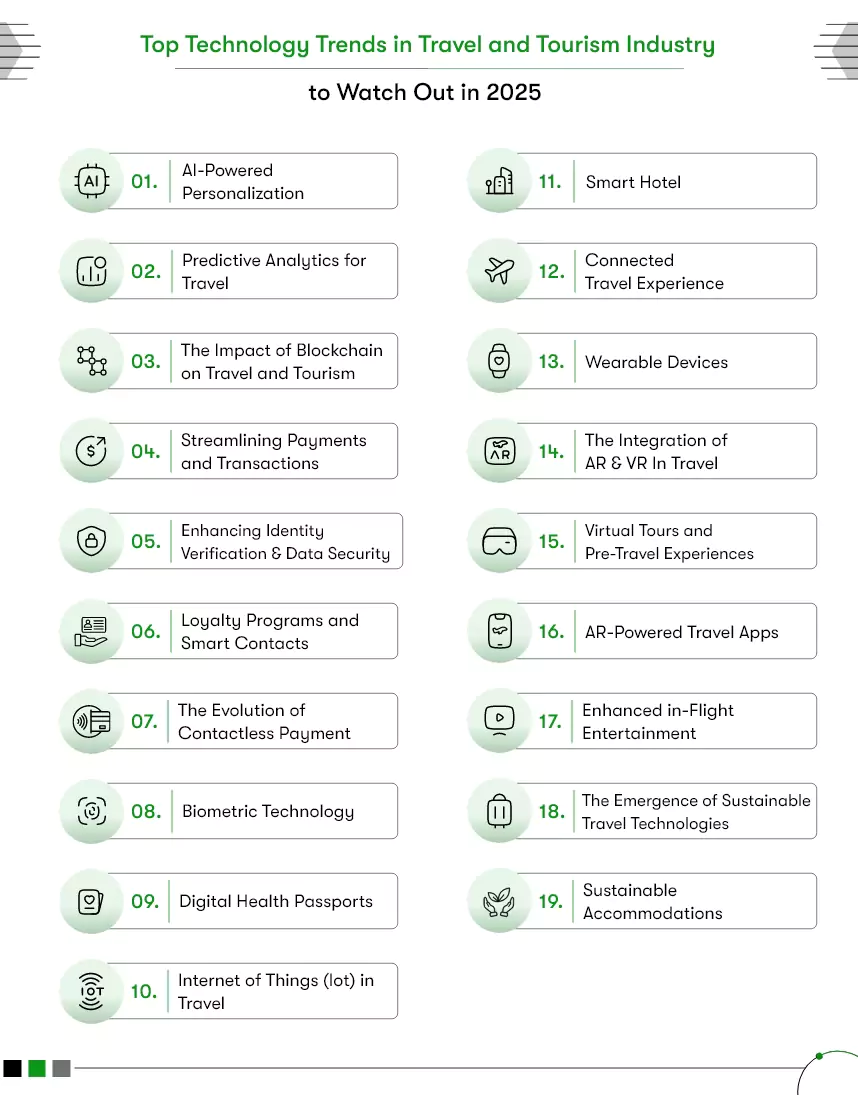

1. AI & Machine Learning: The Smart Engine of Travel
Artificial Intelligence (AI) and Machine Learning (ML) are driving a new era of smart travel, with capabilities spanning from personalization and route optimization to predictive maintenance and customer service automation.
- Personalized Experience: Travel platforms now offer custom itineraries tailored to user preferences, past behavior, and real-time factors. Real-time trend and demand predictions help companies optimize pricing and inventory.
- Virtual Agents & Chatbots: Travel chatbots—available 24/7—are handling bookings, cancellations, and queries, increasing both convenience and efficiency.
- Predictive Analytics: ML can forecast flight delays, price fluctuations, or booking demand to improve operational planning and customer convenience.
2. Blockchain: Secure, Transparent Travel Transactions
Blockchain technology is enhancing transparency, fraud protection, and trust in travel transactions:
- Secure Payments: Travelers and vendors can engage in payment exchanges that are immutable and transparent.
- Loyalty & Identity Programs: Cross-platform loyalty systems and identity verification are simplified and secured using blockchain-led infrastructure.
- Streamlined Settlements: Decentralized records reduce intermediaries, speeding up settlement times across different providers.
3. Augmented Reality (AR) & Virtual Reality (VR): Preview Before Booking
AR and VR technologies are transforming trip planning and customer engagement:
- Virtual Tours: Prospective attendees “visit” hotels, attractions, and destinations through immersive virtual previews.
- Interactive Overlays: Overlaid AR information helps travelers navigate cities, scan landmarks for instant data, or discover hidden points of interest.
- Training Applications: VR enables immersive training for staff—improving service readiness and response times.
4. IoT & Smart Infrastructure: Making Travel Seamless
The Internet of Things (IoT) is streamlining operations and enhancing guest comfort:
- Smart Rooms: Hotel rooms automatically adjust temperature, lighting, and entertainment based on guest profiles.
- IoT-Powered Reliability: Airports and fleets use connected sensors to manage luggage, monitor wear and tear, and reduce downtime.
- Location-Based Services: Geo-triggered offers and notifications enhance guest engagement at attractions, retail zones, or transit hubs.
5. Contactless & Biometric Travel: The Touch-Free Revolution
Digital transformation is minimizing manual touchpoints across the travel journey:
- Biometric Check-ins: Facial recognition and digital IDs are replacing physical passports and boarding passes.
- Seamless Payments: NFC, digital wallets, and QR transactions let travelers pay instantly—reducing friction at every stage.
- Voice & Gesture Interfaces: Voice-activated hotel controls and touch-free kiosk interactions are becoming mainstream.
6. Sustainability Tech: Green and Responsible Travel
Travel tech isn't just about innovation—it’s increasingly about ethics:
- Efficiency & Waste Reduction: AI-powered tools are making hotel kitchens and airline operations more resource-efficient.
- Eco-Tourism Integration: Apps that highlight green-certified accommodations and carbon-offset programs help travelers make sustainable choices.
- Smart Resource Use: Destinations are investing in solar-powered transport, energy-saving IoT systems, and low-impact infrastructure.
7. Digital Twins & Smart Destinations: Real-Time Operational Insight
Emerging tech is giving tourism planners new tools for insight and foresight:
- Digital Twin Modeling: Cities and sites can be modeled in real time to predict crowd flow, manage services, and personalize experiences.
- Dynamic Event Planning: Planners use virtual replicas to simulate operational changes, thereby optimizing layouts and guest outcomes.
8. Wearables & Personalized Travel via Tech
Connected wearables are making experiences more responsive and data-rich:
- Tailored Suggestions: Factoring in your pace, heart rate, and mood, apps can recommend tailored experiences.
- Convenience on the Go: With integrated payments and navigation, wearables turn your wrist into your travel companion.
9. 5G, Super Apps & Future Connectivity
Faster networks and integrated platforms are redefining how travel services converge:
- 5G & Edge Computing: High-speed connectivity supports instant translation, AI-powered guides, and autonomous shuttles.
- Super Apps: Platforms that bundle booking, transit, payments, and local recommendations into one seamless solution are emerging.
10. Tech-Driven Traveler Trends & Behavioral Shifts
Younger travelers are driving demand for technology-led services:
- AI-Powered Planning: Increasingly, travelers ask conversational tools to craft itineraries and discover deals.
- Digital Detox Preferences: A growing segment seeks intentional disconnection and wellness—prompting tech-free hospitality experiences.
- Localized, immersive experiences: Digital guides and smart audio tours are powering interest in sustainable, off-the-beaten-path travel.
Final Thoughts
The technology trends in the travel and tourism industry are charting a course toward smarter, safer, and more sustainable journeys. From AI-driven personalization and blockchain security to VR immersion and eco-conscious innovations, these technologies are setting the standard for 2025 and beyond.
Travel businesses that embrace these trends will not only enhance satisfaction and operational efficiency—they’ll shape the future of exploration.





























Sign in to leave a comment.