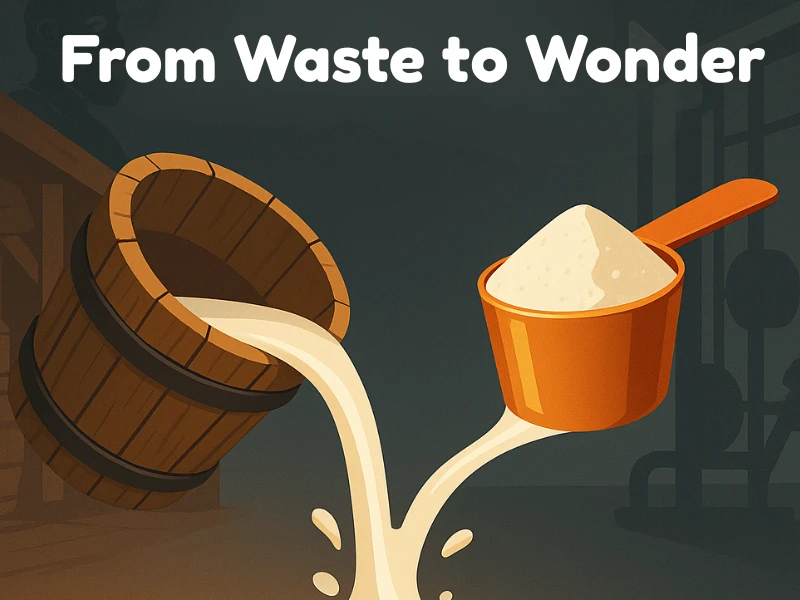

Kojavy, a tiny Polish village, is where our story starts. While making cheese centuries ago, local farmers noticed something odd. Acid treatment caused milk to separate into solid curds and a hazy liquid called whey.
This liquid was useless at first. It was either thrown away or used again in the subsequent cheese batch. They were unaware that this alleged waste was nutrient-dense and would eventually revolutionize fitness nutrition.
Era Use of Whey
Ancient Poland Treated as waste from cheese-making
Ancient Greece Used by Hippocrates for health and healing
16th Century Europe Popular wellness and skincare trend
Whey Enters the Healing Field
Hippocrates, the founder of modern medicine, was the first to recognize the full potential of whey. He referred to it as serum and suggested using it to boost immunity and promote healing.
This tradition was later continued by the Roman physician Galen. Whey was a popular wellness beverage in Switzerland and England by the 16th century. People drank it for health reasons and even bathed in it because they thought it slowed aging and improved skin.
Plasmon's Birth: Germany's Breakthrough
One of the first powdered forms of whey protein, Plasmon, was introduced in Germany in the 19th century for use in hospital nutrition. Although it wasn't particularly smooth or tasty, it was the first significant step toward contemporary whey supplements.
Plasmon was marketed as a high-protein food around 1890 by renowned strongman Eugen Sandow, who is frequently referred to as the father of bodybuilding, as a healthier and more effective substitute for meat in terms of strength and stamina.
The Age of Whey and Fitness
Whey had established itself as a mainstay in the bodybuilding industry by the 1950s. Athletes found it could promote lean growth, speed up muscle repair, and improve recovery.
Whey protein entered the mainstream in the 1990s and early 2000s. It moved from gyms to kitchens all over the world as it became more palatable, smooth, and accessible in shakes, bars, and snacks.
Whey Protein Today
Today, whey protein is no longer just a fitness supplement — it’s a lifestyle choice. From whey concentrate to isolate and hydrolyzed whey, this once-forgotten byproduct has become a key part of global nutrition.
Trusted brands like QNT continue to push boundaries with products like QNT Prime Whey and QNT ISO Ripped, combining quality, taste, and certification for modern fitness needs.
From being discarded in a cheesemaker’s shop to becoming a symbol of strength and wellness, whey protein’s journey is truly a story of transformation — from byproduct to powerhouse.
This article is contributed by QNT Sport India- a European-standard nutrition brand.Learn more at www.qntsport.in






























Sign in to leave a comment.