
A drain that blocks once is annoying.
A drain that blocks again and again is a different problem—because at that point you’re not dealing with a “clog,” you’re dealing with a pipe that’s struggling to do its job, and it’s often time to talk to pipe relining specialists for damaged pipes in Sydney.
Across Sydney, repeat blockages often come back to the same culprits: cracked pipes, shifted joints, tree root intrusion, and old sections that have rough, damaged interiors.
This guide explains trenchless pipe relining in plain English, when it’s a good fit, when digging is unavoidable, and how to plan the next 7–14 days so the fix is a long-term repair—not another short-term clear.
Why drains keep blocking (and why “clearing” isn’t always fixing)
Clearing a blockage restores flow.
It doesn’t automatically restore the pipe condition.
If the pipe has a crack, an offset joint, or repeated root intrusion, the blockage you see is often a symptom of a bigger issue: debris gets snagged on rough edges, roots catch paper and sediment, and flow slows just enough for the line to re-block.
That’s why some properties fall into a cycle of “call-out, clear, repeat.”
The main decision point is whether you’re looking at a one-off build-up issue—or an underlying pipe defect that needs repair.
What pipe relining actually is
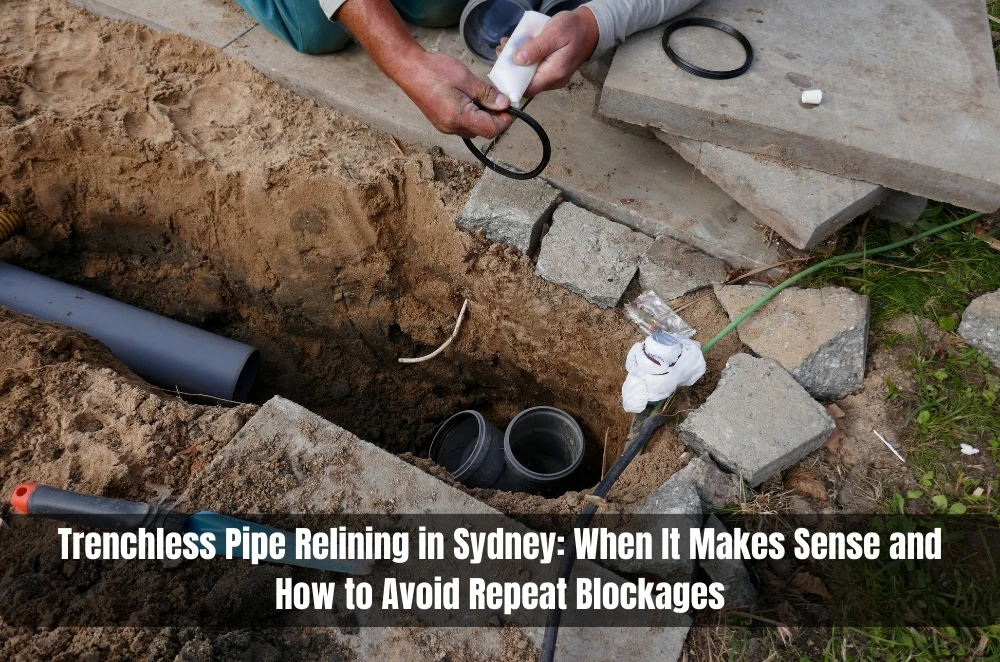
Pipe relining is a trenchless repair method where a new lining is installed inside an existing pipe.
Instead of digging the whole pipe out, a liner is placed through an access point, positioned in the damaged section, then cured so it forms a hard, smooth “pipe within a pipe.”
The purpose is to seal cracks, bridge small gaps and defects, and create a smoother internal surface that resists snagging and reduces places where roots and debris can catch.
It’s not magic, and it’s not suitable for every situation, but it can be a smart option when the pipe is structurally repairable and access is workable.
When relining is a good fit vs when excavation is unavoidable
Relining tends to be attractive when disruption is costly—finished landscaping, driveways, tiled areas, busy commercial sites, or strata properties where excavation creates bigger headaches.
But the pipe still needs to be a reasonable “host” for the liner.
Relining is often a good fit when
The pipe is cracked, leaking, or has root intrusion, but still has an intact pathway.
The issue is localised to certain sections rather than the entire line being collapsed.
Access points exist (or can be managed) without ripping apart half the property.
You need to minimise digging because of surfaces, access limitations, or site operations.
Excavation can be unavoidable when
Sections are fully collapsed, severely deformed, or missing to the point that a liner can’t pass or seat properly.
There are major-level issues, severe offsets, or structural failures that need physical correction.
There’s no practical access for inspection and installation without opening up key areas.
The best way to stay out of “guess mode” is to treat the decision as evidence-based: if you can’t confirm what’s happening inside the line, you can’t choose the right fix confidently.
Common mistakes that lead to repeat call-outs
A lot of repeat costs come from choosing a solution before the cause is properly understood.
- Assuming every blockage is just a build-up. Recurring blockages often signal a defect.
- Chasing symptoms instead of patterns. Where it blocks and how often matters.
- Not getting clear evidence of the damaged sections. Repairs work better when the target is specific.
- Underestimating access constraints. Tight sites and strata settings need planning.
- Skipping a proper handover record. Without documentation, the next incident starts from scratch.
- Expecting any solution to make future maintenance “never needed.” Even good repairs still need sensible use habits.
- Treating relining and excavation as moral choices. They’re tools—pick the one that suits the actual condition.
Decision factors: comparing quotes and confirming scope
Relining quotes can look similar on the surface.
What matters is what’s included in scope and what evidence supports the proposed repair.
What to confirm before you approve any relining work
Ask what sections are being repaired and why those sections (not just “the line”).
Confirm how access will be handled and whether reinstatement is needed after entry points are used.
Confirm what reporting you’ll receive for records, especially if you’re dealing with strata, a tenancy, or an insurance conversation.
Confirm what the plan is if the inspection shows the pipe is not suitable for relining in a key area.
If you want a clear view of what a relining scope usually includes, the trenchless pipe relining for Sydney homes and businesses is a helpful reference before approving the work.
A useful comparison lens
When comparing options, don’t just compare price.
Compare certainty and disruption.
- How confident is the diagnosis?
- How much disruption is the repair trying to avoid?
- What will you be left with afterwards (documentation, proof, clarity for future maintenance)?
The cheapest option often becomes expensive if it doesn’t reduce recurrence.
A simple 7–14 day plan from symptoms to a long-term repair
This plan is built to stop the “clear it again” loop.
Days 1–2: Log symptoms and stop guessing
Write down when the blockage happens, which fixtures are affected, and whether it’s getting more frequent.
If it’s a business site, note whether the issue aligns with peak usage periods.
Days 3–5: Get clarity on the likely cause
Focus on evidence and repeatability: where is the restriction occurring and what is likely contributing (roots, cracks, offsets, collapse).
If you’re in a strata or a multi-tenant setting, coordinate early so access doesn’t delay diagnosis.
Days 6–9: Confirm repair scope and access
Lock down which sections are being repaired, what access is needed, and what “finished” looks like (flow restored, site tidy, documentation provided).
Confirm how disruption will be managed for gardens, driveways, or trading hours.
Days 10–14: Complete the repair and protect the outcome
After the repair, keep a simple record: what was repaired, where, and what to watch for.
If the property has a history of root issues or older pipework, agree on a sensible review cadence so problems don’t surprise you again.
Operator Experience Moment
The properties that stop having “mystery blockages” are usually the ones that switch from reactive call-outs to evidence-led decisions.
Once the damaged section is identified, the conversation changes from “clear it again” to “fix the reason it blocks.”
That’s when relining (or a targeted excavation) becomes a planned repair instead of an emergency expense.
Local SMB Mini-Walkthrough
A small Sydney café keeps getting slow drains during peak service, and the issue returns every few weeks.
They log when it happens and which fixtures are affected to avoid chasing random fixes.
Access is coordinated early, so inspection work doesn’t collide with trading hours.
The repair scope targets the sections that repeatedly restrict flow, not the entire line “just in case.”
Work is scheduled in a low-traffic window to reduce downtime and mess.
A handover record is kept so future issues can be diagnosed faster and with less disruption.
Practical Opinions
If it’s recurring, treat it as a defect problem until proven otherwise.
Pay for clarity first—repairs are cheaper when the target is specific.
Minimising digging is great, but only if the pipe is actually suitable for relining.
Key Takeaways
- Clearing restores flow; relining repairs damaged sections to reduce repeat blockages.
- Relining suits many cracked or root-affected pipes, but collapsed or badly deformed lines may need excavation.
- Compare quotes by scope, access plan, and documentation—not just the total.
- A 7–14 day plan turns a reactive problem into a controlled repair.
Common questions we hear from Australian businesses
Q1) How do we know if relining is better than replacing the pipe?
Usually, it depends on pipe condition and access—relining can be a good fit when the pipe is damaged but still structurally repairable and digging would be highly disruptive. A practical next step is to request clear identification of the affected sections and the reasoning for the proposed approach. In most Sydney sites, finished surfaces and access constraints heavily influence the decision.
Q2) Will relining stop blockages forever?
It depends on what’s causing the issue and how the system is used afterwards. A practical next step is to treat relining as a structural repair and then keep a basic maintenance mindset—avoid habits that overload the line and keep a simple record of any future symptoms. In most Sydney properties with older pipework and trees, recurrence risk is lower after repair, but not magically zero.
Q3) What should we ask for in a relining quote?
In most cases, ask what sections are being relined, what access is required, what reinstatement is included, and what reporting you’ll receive at handover. A practical next step is to request the scope in plain language so it can be compared easily across providers. In Sydney strata and commercial sites, access planning and work windows can matter as much as the repair itself.
Q4) How do we avoid repeat emergency call-outs while we’re deciding?
Usually, the best approach is to reduce guesswork: document symptoms, avoid actions that worsen the line, and coordinate access quickly for proper diagnosis. A practical next step is to set a 7–14 day decision window and book the necessary inspection and repair slots early. In most Sydney businesses, choosing a low-traffic work window helps reduce downtime while you get a long-term fix in place.
























Sign in to leave a comment.