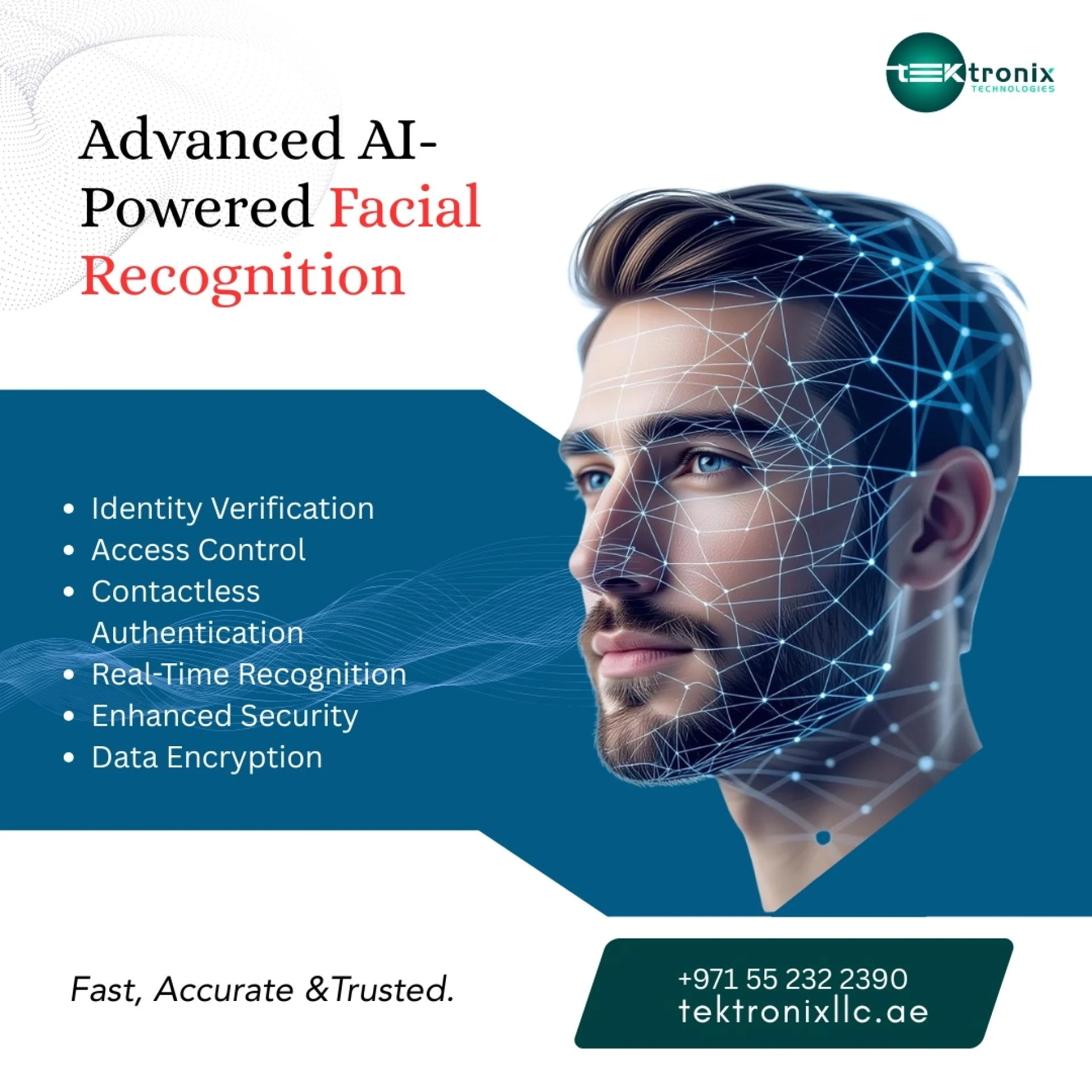

In the rapidly changing world of digital, facial recognition is now a key component of the modern security infrastructure. All over the UAE and in other countries where the latest technology is paired with intelligent governance, companies have been increasingly taking advantage of facial recognition systems to enhance security, efficiency and operational controls. From government and airports to retail and corporate office settings, face scanners have redefined how identity security and verification work.
Its incorporation into every day commercial operations shows the UAE's dedication to creating robust, secure and contactless systems. In this post we look at how the facial recognition technology transforms the security of businesses, the benefits application, as well as ethical issues that will shape its future.
1. Understanding Facial Recognition Technology
Face Recognition is a type of biometric identification that utilizes distinctive facial characteristics to recognize the identity of an individual. The system makes use of face detection, facial analysis as well as the face verification to verify individuals in real-time.
In contrast to traditional passwords and access cards that are typically used, face authentication is a non-fussy and safe method for managing identity which makes it the ideal choice for companies that want both convenience and security.
2. How Facial Recognition Works
The method that is the basis of the creation of a facial recognition system involves several crucial actions:
- Face detection - The software first detects the face of a person through an image or video feed.
- Analysing Facial Features, It is a map of unique facial characteristics, including the distance between eyes and jawline contour.
- Face Recognition - The data extracted will be compared with the face database to verify or identify the particular.
- Face Verification The process confirms identity and ensures that faces that are detected match with those on the profile that is registered.
3. Why UAE Businesses Are Turning to Facial Recognition
The UAE is always a pioneer in the adoption of new technology. Companies are now adopting the use of facial recognition for:
- Increase security and stop unauthorized access.
- Allow contactless operation in post-pandemic times.
- Automate attendance monitoring by using face recognition attendance systems.
- Enhance customer experiences by personalizing and enhancing convenience.
- Enhance Biometric Security using high precision and speed.
4. The Role of AI in Modern Facial Recognition Systems
AI has transformed the facial recognition system analyse and process information. Facial Ai lets systems change and adapt, thereby increasing the accuracy of their systems even under difficult light or angle conditions.
By utilizing AI -based facial tracking along with facial expression analysis Businesses can obtain more insights, not just in authentication of identities but also behaviour analytics to improve user experience.
5. Facial Recognition in Access Control and Attendance
One of the most effective uses of technology is the management of attendance and access.
- System for Face Recognition along with system for face scanning of attendance do away with manual check-ins and ID cards.
- Workers can access facilities in moments with facial authentication which reduces queues as well as human error.
- Integration of the biometric security frameworks will ensure the accuracy of data and improved conformity.
6. Biometric Security Beyond Facial Recognition
As facial biometrics dominating the market, the enterprises are also investigating other complementary technologies like iris recognition as well as 3d facial recognition.
- Iris Recognition is an added level of security in high-security zones.
- 3D Face Recognition can capture facial contours and depth with greater precision than conventional 2D scans.
7. Improved Accuracy by Liveness Detection
For the sake of system security, liveness detection is now a crucial feature of any modern face
recognition system. It helps prevent spoofing by identifying between real people and an image or video that is static.
In analysing the micro-movements like the blinking of eyes, tilted head as well as thermal patterns, liveness detection enhances the trust factor in each face authentication procedure.
8. Applications of Facial Recognition Across Industries
The innovative initiatives create a favourable atmosphere for the development of face recognition software applications in a variety of sectors:
- Corporate Offices Security-enabled entry as well as automatic attendance.
- Airports and Transportation: Verification of passengers and speedier board.
- Retail: Personalized customer experiences via facial analysis.
- Financial and Banking face verification to ensure KYC conformity.
- Healthcare Security of entry to restricted areas with biometric identity.
- Education: Contactless attendance via face scanning attendance systems.
9. Data Privacy and Ethical Concerns
In the course of time, as facial recognition grows more commonplace, privacy concerns in facial recognition have been gaining the attention of. Business owners must make sure that they are transparent about ethics in data use and the strictest compliance with the regulations on data protection.
A few of the most crucial considerations are:
- Restricting the storage of data sharing.
- Information to individuals on data collection.
- Confirming the consent-based face identification.
- Avoiding misuse by implementing ethical use of facial recognition guidelines.
The ethical use of technology ensures that facial recognition systems can be used as a tool for security and effectiveness and not for the purpose of surveillance or discrimination.
10. The Future of Facial Recognition in the UAE
The vision of the UAE to create smart cities as well as digital change is in perfect alignment with the development of facial recognition systems. the next version of the solution include:
- AI-driven Facial Recognition to speed up, faster and more precise confirmation.
- Cloud-driven Face Databases with an enhanced encryption.
- Integration with IoT devices to create smart security ecosystems.
- Real-time Face Tracking to provide predictive analysis as well as proactive security.
11. Advantages of Adopting Facial Recognition Systems
Firms that adopt Facial Recognition Systems can expect many benefits:
- Contactless Security Perfect for those who are health-conscious environment with high traffic.
- Performance and Speed: Instant authentication with minimum human intervention.
- Capability to Scale: Suitable for organizations with all sizes.
- Integration Integrates seamlessly HR, access control and security system.
- Enhanced Accuracy: With facial artificial intelligence as well as 3d facial recognition the accuracy is higher than 99%.
12. Overcoming Implementation Challenges
Although adoption is increasing however, issues such as the cost of infrastructure, readiness for deployment, and facial recognition remain.
In order to overcome these hurdles, businesses must:
- Join forces with reputable face recognition systems service providers.
- Perform face database security evaluations.
- Adopt stringent data protection policy.
- Instruct employees and clients about the ethical use of facial recognition.
Conclusion
UAE firms set the standard for other businesses in integrating facial recognition systems for unparalleled security and efficacy. Starting from facial scanning attendance systems up to 3d facial recognition in addition to liveness detection the technology is changing the face of identity management using accuracy and speed. As we embrace the new possibilities of facial biometrics which is crucial to ensure that companies balance technology with privacy and ethics -making sure that the use of facial recognition is a reliable all-in-all to build a safer better, more intelligent, and connected UAE.
Frequently Asked Questions (FAQs)
1. What is Facial Recognition?
Face Recognition is a biometric identification technology that utilizes facial characteristics to validate or verify the identity of individuals.
2. What is the accuracy of a facial recognition system?
Contemporary face recognition systems that are equipped by facial ai along with 3d facial recognition provide accuracy levels that exceed 99%.
3. What are the primary benefits that can be made Facial Recognition in the UAE?
It's widely used to the control of access, attendance tracking, border security and confirmation of customer identities across all industries.
4. There are privacy issues when the use of Facial Recognition?
Yes. privacy concerns in facial recognition are centered around the misuse of data and unauthorised tracking. These issues are averted by ethical use of facial recognition as well as robust data security policies.
5. What is it that makes Facial Recognition better than other biometrics?
Facial authentication is non-contact, quick and extremely accurate and suitable for both private and public sector services.
For more information contact us on:
Tektronix Technology Systems Dubai-Head Office
+971 50 814 4086
+971 55 232 2390
























Sign in to leave a comment.