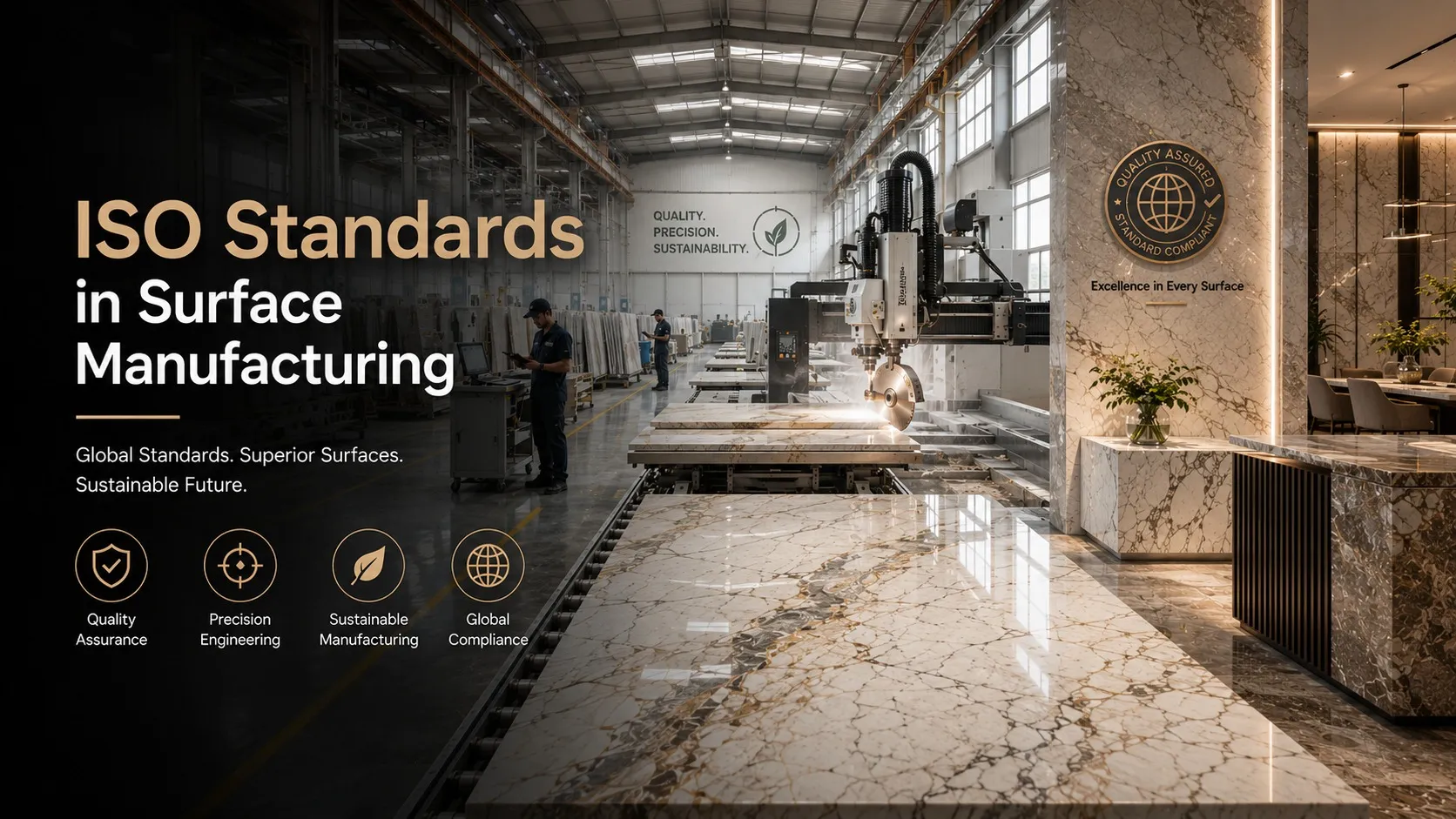

When you walk into a beautifully finished space, marble floors catching the light, stone cladding running seamlessly across the walls, the quality you're experiencing didn't happen by accident. It was engineered. Long before that slab was cut, polished, and installed, a set of decisions was made about how it would be produced, how consistent it would be, and what impact its manufacturing would have on the environment.
ISO standards are the framework behind those decisions. And for anyone specifying, sourcing, or simply buying surface materials, understanding what they mean in practice is more useful than most people realise.
What ISO Standards Actually Are?
The International Organization for Standardization (ISO) develops globally recognised frameworks that organisations voluntarily adopt to manage quality, environmental performance, safety, and more. The word "standard" can sound abstract, but in manufacturing, an ISO certification is anything but.
It means an independent certification body has audited a company's processes, documented systems, and performance data, and confirmed that they meet the requirements of that specific standard. It's not a one-time test. Annual surveillance audits and a full recertification every three years ensure that compliance isn't just claimed, it's continuously maintained.
Two ISO standards are particularly relevant when evaluating surface manufacturers: ISO 9001 for quality management and ISO 14001 for environmental management.
ISO 9001: What Consistent Quality Actually Looks Like
ISO 9001 is the world's most widely adopted quality management standard. In a surface manufacturing context, cutting, finishing, and supplying stone govern how a company manages every step of its process to ensure the product that arrives on site matches what was specified and ordered.
For architects and procurement teams, this matters more than it might seem. The stone industry, like many material categories, can be inconsistent. A slab that looks identical to a sample may perform differently, vary in finish quality, or arrive with dimensional tolerances that create installation headaches. ISO 9001 certification indicates that a manufacturer has documented processes designed to prevent exactly these issues.
In practical terms, a supplier operating under ISO 9001 will have:
- Defined procedures for raw material selection and quality checks at intake
- Controlled production processes with measurable performance targets
- Documented records of non-conformities and how they were resolved
- A formal system for capturing customer feedback and using it to improve
The result isn't perfection; no standard can guarantee that. But it does mean that quality is managed systematically, not left to chance or the experience of individual workers.
ISO 14001: The Environmental Commitment Behind the Product
ISO 14001 governs Environmental Management Systems (EMS). For a stone or marble manufacturer, this covers how the company identifies, monitors, and controls its environmental impact across the entire operation, from how water is used and recycled in processing, to how waste stone and dust are handled, to how energy is consumed across the facility.
Unlike ISO 9001, which is focused inward on product quality, ISO 14001 looks at the relationship between a manufacturer's operations and the broader environment. Certification requires a company to set measurable environmental objectives, track progress against them, and continuously improve over time.
For architects and specifiers working on green-rated projects, IGBC, LEED, or GRIHA submissions, a supplier's ISO 14001 status is meaningful documentation. It provides independent verification that the environmental claims behind a material aren't just marketing language. They're audited facts.
The Difference Between Having Standards and Living Them
Here's the part that doesn't always get discussed: some companies have ISO certifications, and companies that have genuinely built their operations around them. The difference is visible when things go wrong.
A manufacturer that has truly internalised ISO 9001 doesn't just fix problems when they surface; they have systems that anticipate and prevent them. One that runs its ISO 14001 commitments seriously doesn't reduce waste only when it's being audited. The standard becomes the way the organisation operates, not a compliance exercise.
For buyers and specifiers, this distinction is worth probing. Asking a supplier how their certifications have changed their processes, not just that they have them, reveals a great deal about how seriously those standards are taken.
Why Both Standards Together Matter for Surface Materials
ISO 9001 and ISO 14001 are often held simultaneously, and there's good reason for that. A surface manufacturer that manages quality without managing environmental impact is only doing half the job. Equally, a company that claims environmental responsibility but can't consistently produce what it promises creates problems downstream on a project.
Together, the two standards create a more complete picture of a supplier's operational maturity. Quality and sustainability aren't competing priorities in modern manufacturing; they reinforce each other. Reducing waste in production improves consistency. Controlling inputs tightly benefits both the product and the environment.
For surface materials specifically, where the physical properties of the material, the precision of the cut, and the consistency of the finish all affect the outcome an integrated approach to quality and environmental management is what separates suppliers worth specifying from those that create risk.
ISO in the Broader Certification Landscape
ISO 9001 and ISO 14001 don't stand alone. In the surface materials world, they sit alongside other standards that address different dimensions of product performance and safety.
CE Marking confirms that a product meets European health, safety, and environmental standards, relevant for any project with international compliance requirements. NSF International certification addresses public health and safety, independently verifying that a product is safe for its intended application. GREENGUARD certification evaluates indoor air quality impact, specifically, whether a surface material releases harmful chemical compounds into interior spaces.
Each standard answers a different question. Together, they build a comprehensive case for a supplier's trustworthiness across quality, safety, environmental responsibility, and indoor performance.
Certifications Are Only as Useful as the Supplier Behind Them
No certification can substitute for experience, material knowledge, or the professional relationships that make complex projects work. But they do provide something that experience alone cannot: independent, documented, third-party verification.
When specifying surfaces for a significant project, the question isn't just does this supplier have certifications? It's do those certifications reflect how the organisation actually operates? The answer to that question, found in the consistency of their output, the transparency of their documentation, and the depth of their process knowledge, is what really determines whether a supplier is worth trusting with a project.
Where Certified Quality Meets Exceptional Stone
Classic Marble Company (CMC) holds both ISO 9001 and ISO 14001 certifications, alongside IGBC, GREENGUARD, NSF International, and CE Marking, making us one of the most comprehensively certified marble manufacturers and suppliers in India.
For architects, developers, and designers who need surfaces that perform as reliably as they look, our 30-year track record and independently verified standards offer both the quality assurance and the documentation that modern projects demand.
View our full certification credentials and explore the collection of 2,000+ marble varieties.
























Sign in to leave a comment.