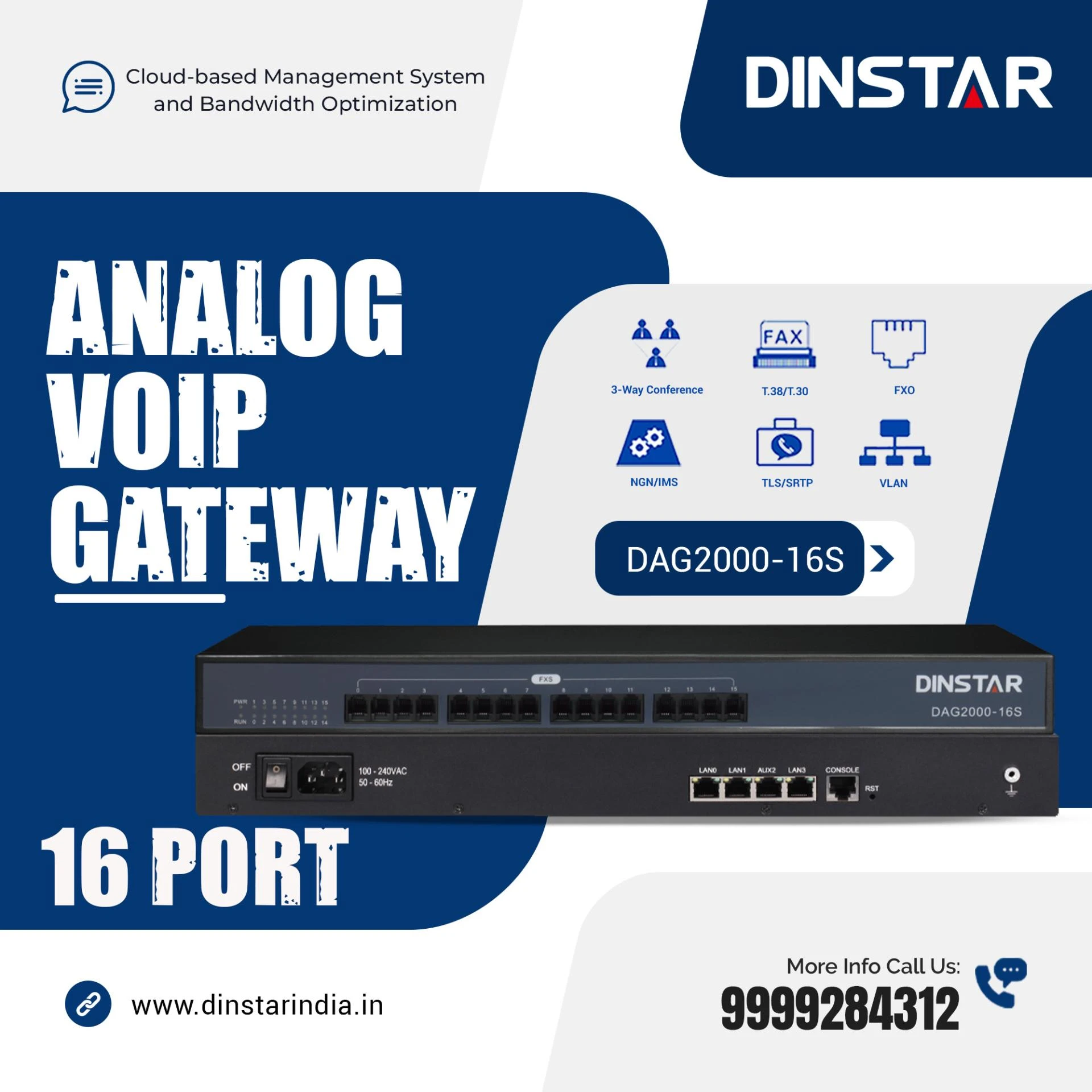

In today's rapidly evolving communication landscape, businesses are constantly seeking reliable, scalable, and cost-effective voice solutions. One such powerful piece of technology that supports this transformation is the 16 Port FXS Gateway. This device serves as a bridge between traditional analog telephone systems and modern VoIP (Voice over Internet Protocol) networks, enabling businesses to extend the life of their legacy equipment while tapping into the advantages of digital communication.
For organizations looking to optimize their communication infrastructure, a 16 port FXS gateway is an ideal solution. In this blog, we will explore what a 16 port FXS gateway is, its key features, use cases, benefits, and how it can be a game-changer for enterprises aiming to enhance connectivity and streamline their operations.
What is a 16 Port FXS Gateway?
A 16 port FXS (Foreign Exchange Subscriber) gateway is a VoIP device designed to connect analog phones, fax machines, or PBX systems to an IP-based telephony network. The term "16 port" indicates that the gateway can support up to 16 analog devices simultaneously. Each FXS port acts as a telephone line interface that supplies dial tone, battery current, and ring voltage to analog devices.
This kind of gateway is particularly useful for medium to large-sized enterprises, call centers, hotels, and educational institutions that have a considerable number of analog endpoints and want to migrate to VoIP without replacing existing hardware.
How Does a 16 Port FXS Gateway Work?
The FXS gateway acts as an interface between analog devices and an IP PBX or SIP server. It converts analog voice signals into digital IP packets and vice versa. When a user makes a call from an analog phone, the FXS gateway digitizes the voice signal, compresses it using a codec, and transmits it over the IP network to its destination. Similarly, incoming VoIP calls are converted back into analog signals for the analog phone to receive.
This seamless integration enables legacy analog devices to become part of a unified communication environment, enhancing interoperability and reducing operational complexity.
Key Features of a 16 Port FXS Gateway
- High Port Density: With 16 FXS ports, the device can handle multiple analog devices, making it ideal for businesses with extensive analog infrastructure.
- SIP Protocol Support: Most gateways support standard SIP protocol, ensuring compatibility with major IP PBX systems and SIP servers.
- Web-Based Management: A user-friendly web interface allows for easy configuration, monitoring, and management of the gateway.
- Advanced Voice Features: Support for caller ID, call forwarding, 3-way conferencing, call waiting, and Do Not Disturb (DND) enhances user experience.
- High Voice Quality: Use of high-quality voice codecs like G.711, G.729, and G.726 ensures clear and uninterrupted communication.
- Failover and Redundancy: Built-in redundancy mechanisms ensure continuous service availability, even in the event of network failure.
- Fax over IP (FoIP): T.38 protocol support for sending and receiving faxes over IP networks.
- Secure Communication: TLS and SRTP protocols help secure voice traffic from unauthorized access or interception.
Use Cases for a 16 Port FXS Gateway
- Hotels and Hospitality: Many hotels still use analog phones in guest rooms. A 16 port FXS gateway enables VoIP integration without needing to replace every room phone.
- Educational Institutions: Schools and universities can connect existing analog phones across multiple departments to an IP PBX system.
- Call Centers: Cost-effective solution for connecting multiple analog handsets and ensuring high call volume handling through SIP trunking.
- Government Offices: A cost-efficient method to modernize legacy telephone infrastructure while ensuring secure communication.
- Manufacturing Units and Warehouses: Facilities that rely on analog intercom systems can integrate with modern VoIP systems using FXS gateways.
Benefits of Deploying a 16 Port FXS Gateway
- Cost Savings: One of the most significant advantages is reduced operational and infrastructure costs. Businesses can continue using their analog phones while enjoying the cost benefits of VoIP services.
- Scalability: As your business grows, adding more gateways or integrating with additional IP-based systems is easy and flexible.
- Centralized Communication: Unified communication setup improves call routing, monitoring, and management.
- Improved Reliability: Built-in redundancy features minimize downtime and ensure continuous service availability.
- Seamless Migration: Businesses can transition to VoIP at their own pace without a full hardware overhaul.
- Remote Management: IT teams can remotely manage and configure devices, reducing the need for on-site maintenance.
What to Look for When Choosing a 16 Port FXS Gateway
- Compatibility: Ensure the device supports SIP and is compatible with your IP PBX or VoIP service provider.
- Voice Quality: Look for support of high-quality voice codecs and echo cancellation features.
- Management Tools: Choose a gateway with intuitive web-based management and remote configuration capabilities.
- Security Features: Ensure encryption protocols such as SRTP and TLS are supported.
- Vendor Support and Warranty: Go for trusted brands that offer after-sales support, firmware updates, and warranty coverage.
Popular Brands Offering 16 Port FXS Gateways
Some of the leading manufacturers in the VoIP space provide reliable and feature-rich 16 port FXS gateways. Brands like Dinstar, Grandstream, Cisco, and Yeastar have built a strong reputation for their durable and scalable FXS solutions. Among these, Dinstar stands out with its cost-effective, easy-to-deploy VoIP gateways that are ideal for SMEs and large enterprises alike.
Conclusion
A 16 port FXS gateway is a smart investment for businesses looking to bridge the gap between legacy telephony systems and modern IP-based communications. It offers flexibility, cost savings, and scalability, making it a vital component in today’s hybrid communication infrastructure. Whether you're running a hotel, a school, a call center, or a manufacturing plant, the integration of a 16 port FXS gateway can simplify your telephony needs, enhance call quality, and future-proof your communication setup.





























Sign in to leave a comment.