Clean and safe water remains one of the most vital resources for human health and industrial operations alike. As global populations increase and environmental regulations become more stringent, the challenge of efficiently treating wastewater and industrial effluents grows increasingly complex. In response, advanced chemical solutions are playing pivotal roles in optimizing water treatment processes. Among these innovations, Nonionic Polyacrylamide has emerged as a powerful, versatile polymer that enhances water purification in numerous applications.
At Shandong UPS Chemical Co., Ltd, we are proud to supply high-quality Nonionic Polyacrylamide tailored to meet diverse water treatment needs worldwide. Through our commitment to continuous development and customer support, we help industries achieve superior water quality, process efficiency, and regulatory compliance.
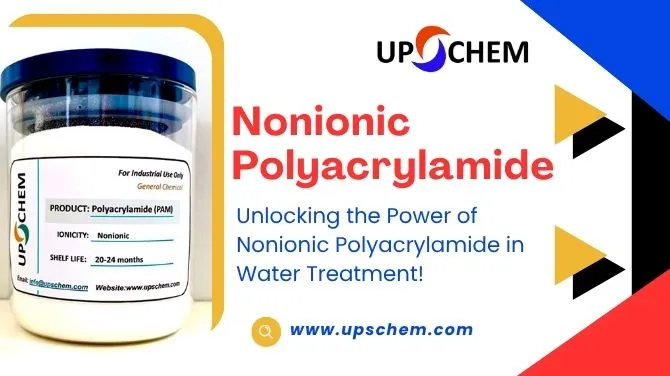
What is Nonionic Polyacrylamide?
It is critical to understand the fundamentals of Nonionic Polyacrylamide (PAM) and how it differs from other types of polyacrylamide used in water treatment.
Chemical Structure and Properties
Polyacrylamide molecules are long chains of repeating acrylamide units. Unlike anionic or cationic polyacrylamides, which carry negative or positive charges respectively, Nonionic Polyacrylamide contains minimal or no charge on its polymer chain. This neutral charge characteristic influences its behavior during the water treatment process.
How Nonionic Polyacrylamide Works?
The neutral charge of Nonionic PAM allows it to operate primarily through a bridging flocculation mechanism. Its large molecular weight polymer chains extend between suspended particles in water, physically connecting and aggregating them into larger flocs. These flocs then settle more efficiently or can be removed by filtration or flotation.
Because it does not rely on charge neutralization, Nonionic PAM is especially useful in water streams where charges vary or where traditional ionic polymers might be less effective.
The Unique Advantages of Using Nonionic Polyacrylamide in Water Treatment
Transitioning from basic understanding to tangible impact, the use of Nonionic Polyacrylamide has revolutionized numerous aspects of water purification.
Superior Flocculation in Variable Charge Environments
Unlike cationic or anionic polymers, Nonionic PAM’s performance is less sensitive to the pH and ionic strength of wastewater. Therefore, it can maintain consistent flocculation efficiency in water streams with complex chemistries or fluctuating charges, such as industrial effluents and natural waters.
This stability enables operators to reduce chemical dosing variability, optimize treatment processes, and achieve more predictable outcomes.
Improved Sludge Dewatering and Handling
Nonionic polyacrylamide enhances sludge dewatering by producing strong, dense flocs that expel water more easily during mechanical processes like centrifugation, belt pressing, or vacuum filtration. Better dewatering reduces sludge volume, lowers disposal costs, and minimizes environmental risks associated with sludge storage.
Reduced Chemical Consumption and Operating Costs
Because of its high molecular weight and effective bridging action, Nonionic PAM reduces the amount of chemical required per volume of water treated, compared to traditional inorganic coagulants. This efficiency translates into cost savings, less sludge production, and lower environmental footprints.
Versatility Across Industries
The uniquely neutral charge of Nonionic Polyacrylamide suits it for a wide range of industries including:
- Mining and Mineral Processing, where water can contain mixed charges and heavy metals.
- Pulp and Paper Manufacturing, for clarifying process waters with complex organic content.
- Oil and Gas, aiding in the treatment of produced water containing hydrocarbons and solids.
- Food and Beverage Processing, enabling safe and efficient wastewater treatment.
- Municipal Wastewater, especially in systems prone to fluctuations in water chemistry.
How Shandong UPS Chemical Co., Ltd Supports Your Water Treatment Success with Nonionic Polyacrylamide?
Our commitment to quality and innovation ensures we deliver Nonionic Polyacrylamide solutions customized to your specific water treatment challenges.
- Tailored Molecular Weight and Viscosity Options
We offer a spectrum of Nonionic PAM grades varying from low to ultra-high molecular weights, allowing you to select polymers that meet the precise flocculation and filtration needs of your system. - High Purity and Safety Standards
Produced under stringent manufacturing conditions, our polymers feature minimal residual monomers and meet international environmental and safety standards to protect operators and ecosystems. - Technical Assistance and Customized Solutions
Our expert technical team collaborates closely with clients, providing product selection advice, on-site dosage optimization, and troubleshooting support, ensuring maximum efficiency and reliability. - Worldwide Supply Capability
With robust manufacturing infrastructure and global distribution, Shandong UPS Chemical Co., Ltd ensures timely delivery, enabling uninterrupted water treatment operations regardless of location.
Emerging Trends and Future Prospects for Nonionic Polyacrylamide
As water treatment demands evolve, new developments in polymer chemistry and application technology are advancing the role of Nonionic PAM.
- Integration with Advanced Treatment Technologies
Nonionic polyacrylamide is increasingly combined with membrane filtration, advanced oxidation, and biological treatment to enhance overall removal efficiencies and water reuse potential. - Biodegradable Polymer Innovations
Research into biodegradable and bio-based polyacrylamides aims to improve environmental compatibility without sacrificing performance, aligning with global sustainability goals. - Digital Process Control and Automation
Real-time water quality monitoring coupled with automated polymer dosing systems enables precise Nonionic PAM usage, reducing chemical waste and improving process stability. - Expansion into Challenging Wastewater Streams
Emerging contaminants such as microplastics, PFAS, and pharmaceuticals are driving the development of specialized Nonionic PAM formulations tailored to remove these persistent pollutants.
Nonionic Polyacrylamide stands as a cornerstone innovation in modern water treatment, offering unmatched flexibility, efficiency, and environmental compatibility. Its neutral charge characteristic allows it to perform reliably in diverse and challenging wastewater conditions where traditional ionic polymers may falter.
Frequently Asked Questions (FAQs) about Nonionic Polyacrylamide
Q1: What exactly differentiates Nonionic Polyacrylamide from cationic and anionic types?
A: Nonionic PAM is neutral in charge, operating mainly by bridging particles physically. In contrast, cationic and anionic types operate partly by charge neutralization, targeting negatively or positively charged pollutants respectively.
Q2: Can Nonionic Polyacrylamide be used in highly variable wastewater?
A: Yes. Its neutral charge makes it less sensitive to pH, conductivity, and ionic strength fluctuations, ensuring consistent flocculation across diverse water chemistries.
Q3: Is Nonionic Polyacrylamide safe for environmental discharge?
A: Modern Nonionic PAM products, including those from Shandong UPS Chemical Co., Ltd, have low residual acrylamide content and are compatible with many environmental regulations, offering safe use in wastewater treatment.
Q4: How is dosage determined for Nonionic Polyacrylamide in water treatment?
A: Dosage varies widely based on water quality, solids concentration, and treatment goals. Jar testing and pilot studies help establish cost-effective dosing strategies for optimal performance.
Q5: What physical forms does Nonionic Polyacrylamide come in?
A: It is commonly available in powder and emulsion forms. Powders require pre-dissolution, offering long shelf life; emulsions dissolve quickly and are easier to handle but may have shorter storage lives.
Q6: In which industries does Nonionic Polyacrylamide excel?
A: It is effective across mining, municipal wastewater, pulp and paper, oil and gas, and many others due to its versatility with complex and variable wastewater streams.
























Sign in to leave a comment.