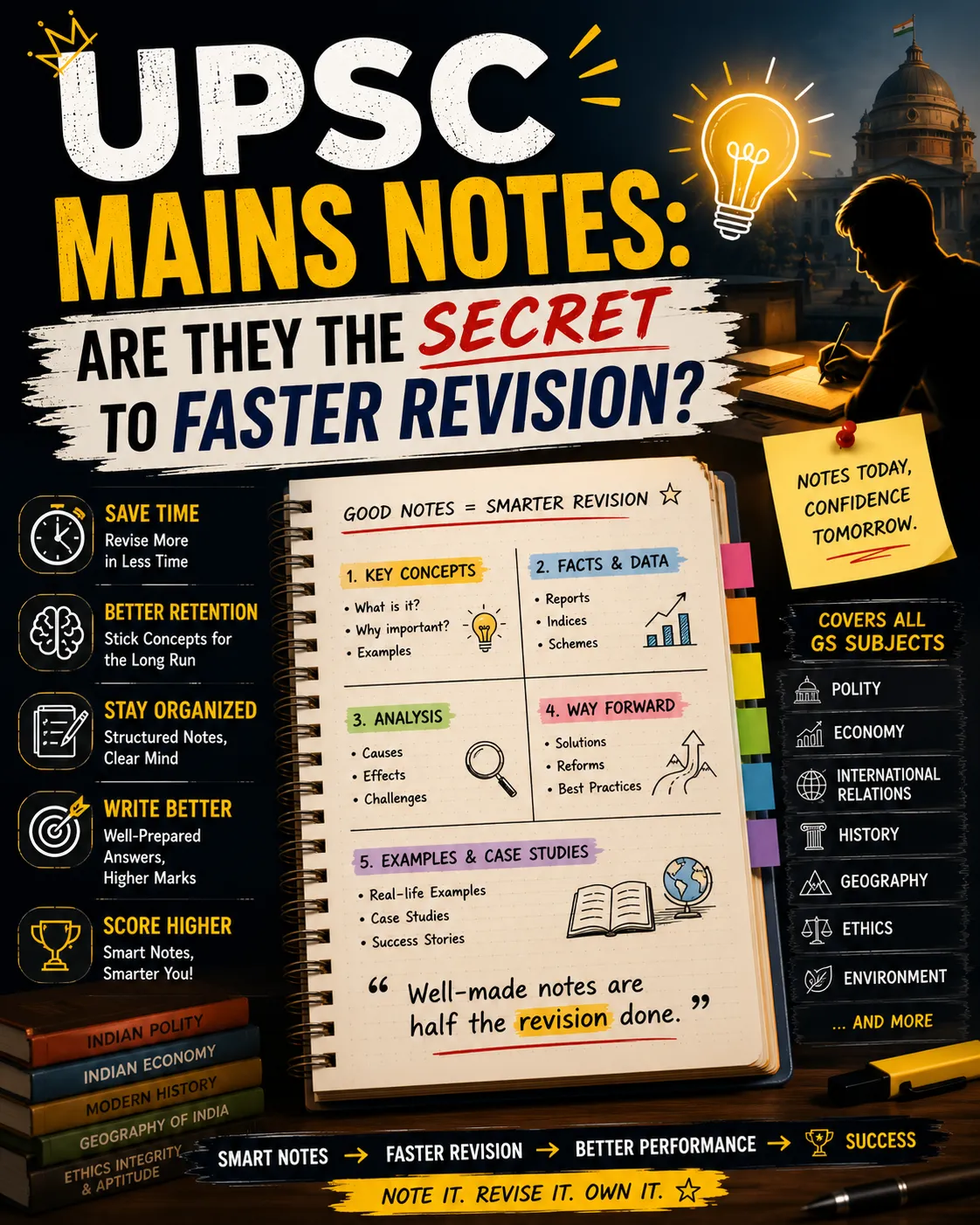

It is 5:00 PM on a rainy Tuesday, exactly three weeks before the UPSC Civil Services Mains exam. You are sitting at your desk, surrounded by a mountain of books. Your desk has three different standard textbooks for Indian Polity, a massive stack of monthly current affairs magazines, and a laptop open with forty-five different tabs of bookmarks, PDFs, and compilation links.
Your head is throbbing. You need to revise the entire syllabus of General Studies (GS) Paper 1, 2, 3, and 4 in the next ten days, but looking at the sheer volume of paper in front of you, a familiar wave of panic sets in. You realize it takes you roughly four hours just to skim through a single block of economy topics in a textbook. You do the math, and the realization hits like a physical blow: there are physically not enough hours left in the day to read all of this again.
This is the exact moment where the quality of your upsc mains study material determines your fate.
Every year, thousands of brilliant minds clear the Prelims, only to get crushed under the sheer weight of the Mains syllabus. The difference between those who make it to the interview list and those who miss out by five marks often comes down to one single factor: how quickly they can recall and synthesize information under extreme pressure.
Let's cut through the standard coaching institute fluff and look at the brutal, honest reality of upsc mains notes, how much time they actually save you, and how to structure them so you don't lose your sanity in the final stretch.
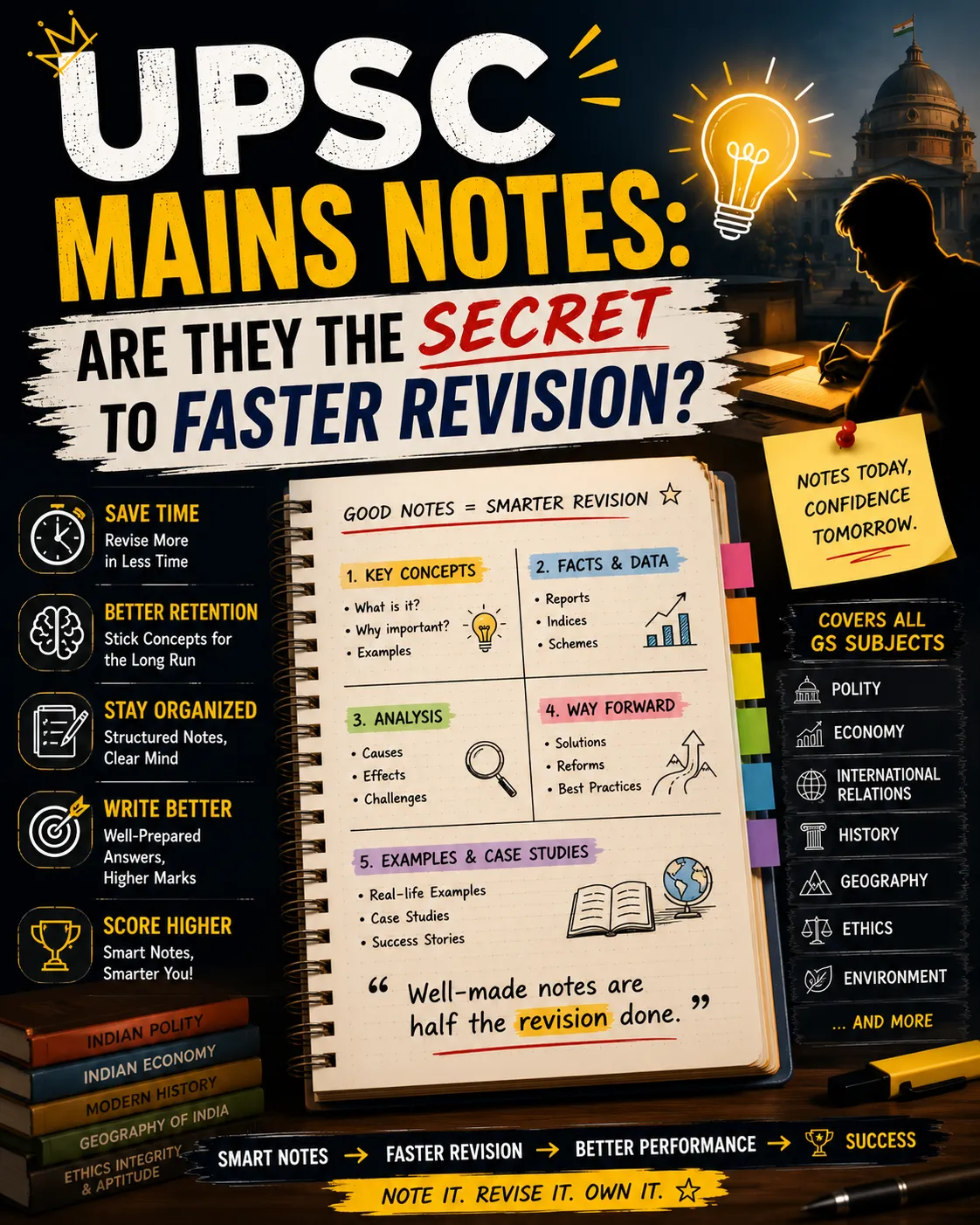
The Brutal Math of the 5-Day Gap
To understand the value of solid upsc mains gs notes, you have to look at the actual exam schedule. Once Mains begins, you are writing two papers a day, each three hours long, demanding roughly 4,000 to 5,000 words of highly structured, analytical writing per day.
Between GS Paper 1 & 2 on Friday and GS Paper 3 & 4 on Saturday, you have exactly one evening.
If you have to open a fresh 400-page standard textbook on Friday night to revise the concepts of "Internal Security" or "Investment Models," you have already lost the game. You cannot skim a textbook at 11:00 PM when your hands are cramping from writing for six hours straight.
This is where custom-built notes change the timeline.
- Without consolidated notes: Revising a single GS paper from primary sources takes roughly 18 to 24 hours of chaotic skimming. You miss key case studies, skip data points, and enter the exam hall relying on vague memory.
- With optimized notes: Revising a single GS paper takes 3 to 4 hours. You can scan through your micro-themes, look at your pre-pitted diagrams, refresh your memory on committee names, and get a solid six hours of sleep.
By the time you enter the exam hall, having a highly compressed upsc mains notes pdf or a sleek binder means you have effectively saved over 60 hours of raw panic during the final two weeks alone. That is time redirected entirely toward active recall and mental clarity.
The Information Trap: Why Most Notes Are Useless
Let's address a major misconception. Many aspirants spend months highlighted every third line of a textbook, copying paragraphs into a digital document, and calling it "note-making."
If your notes are just a slightly shorter version of the original book, you haven't made notes; you have just acted as an underpaid typist for a publishing house.
[Standard Textbook Paragraph] ──> Copying 90% text ──> [Useless 500-page Document] [Analytical Processing] ──> Extracting Key Metrics ──> [Sleek 1-Page Theme Sheet]
Effective notes for the Mains exam are not summary sheets. They are trigger mechanisms for answer writing.
When you look at a topic like Urbanization, your notes shouldn't define what a city is. Instead, your upsc mains notes for that topic should fit on a single page and contain exactly four things:
- Core Data/Stats: (e.g., According to Census 2011, 31.16% of the population lives in urban areas, projected to cross 50% by 2050).
- Key Issues: (Slums, water stress, municipal finance, haphazard planning) defined in single keywords.
- Committees/Policies: (Ahluwalia Committee on urban infrastructure, AMRUT, Smart Cities Mission).
- A Way Forward Template: A 3-point structural solution you can use for almost any urbanization question.
If your upsc mains study material is organized this way, your brain doesn't have to wade through beautiful prose to find the facts. You see the trigger words, and your mind immediately structures the skeleton of an introductory paragraph.
Real Experiences: Voices from the Trenches
To understand how this plays out in reality, look at how different approaches to study material impact an aspirant's mental state right before the big day.
Anjali K., Cleared Mains on her Second Attempt:
"During my first attempt, I didn't trust my own note-making skills, so I relied entirely on massive current affairs compilations and standard textbooks. I cleared Prelims comfortably, but the three months between Prelims and Mains were a living nightmare. I spent all my time reading, leaving zero time for answer writing practice. I panicked during the GS 3 paper because I couldn't remember the specific names of committees for agriculture reforms. For my second attempt, I restricted my entire GS 3 preparation to a 120-page loose-leaf binder. I saved hundreds of hours of repetitive reading and could write answers effortlessly because the structures were hardwired into my brain."
Rahul M., AIR 385 (UPSC 2025)
"I used a digital tool to build my upsc mains gs notes. Every time I read an editorial or a report, I forced myself to distill it into a maximum of three bullet points under a specific syllabus topic. When the final weeks arrived, my friends were carrying heavy backpacks filled with material to their test centers. I walked in with my iPad, scanning my 1-page summaries for every major syllabus keyword during the lunch break. The time saved wasn't just physical hours; it was the psychological peace of knowing I had covered everything."
Common Mistakes to Avoid in Note-Making
If you want your notes to be an asset rather than a time-sink, you must actively avoid these structural traps:
- Starting Too Early: Do not start making notes the very first time you read a textbook. You do not yet know what is important and what is basic context. Read the source at least twice, look at previous years' questions (PYQs), and then pick up the pen.
- Ignoring the Syllabus Keywords: The UPSC syllabus is your map. If your notes are organized by "Book Chapters" instead of specific syllabus phrases like “Effects of liberalization on the economy” or “Salient features of world’s physical geography,” you will struggle to apply them directly to exam questions.
- Chasing the Perfect PDF: Searching endlessly for a comprehensive upsc mains notes pdf online created by toppers can lead to passive collection. A topper's notes are a reflection of their gaps in knowledge, not yours. Use them as a reference template, but do not treat them as a replacement for your own cognitive processing.
- Forgetting Formats and Structures: Your notes should mimic the layout of your answer sheets. Write in crisp points, utilize bullet lists, draw quick flowcharts, and practice boxing your case studies so they are ready to be deployed on the actual paper.
How to Structure Your Core GS Material
When organizing your upsc mains study material, categorize your inputs based on how the papers are evaluated. Let's break down the ideal layout for your core GS subjects:
| Paper Component | What Your Notes Must Focus On | Length Target |
|---|---|---|
| GS Paper 1 (History, Society, Geo) | Conceptual clarity, chronological timelines, maps, cultural terms, and societal trend data. | Max 100 pages total |
| GS Paper 2 (Polity, Governance, IR) | Constitutional articles, landmark Supreme Court judgments, law commission reports, and global indices. | Max 150 pages total |
| GS Paper 3 (Economy, Environment, Tech, Security) | Core economic metrics, agricultural committee names, environmental treaties, and structural diagrams. | Max 150 pages total |
| GS Paper 4 (Ethics) | Definitional clarity for every syllabus term, 2 personal examples per value, and 5 versatile case-study frameworks. | Max 50 pages total |
Frequently Asked Questions (FAQs)
1. Is it absolutely mandatory to prepare my own upsc mains notes to clear the exam?
No, it is not mandatory, but it significantly alters your efficiency. Some candidates manage to clear the exam by highlighting and revising directly from standard textbooks and compilations. However, doing so requires an exceptionally strong retention capacity and takes up significantly more time during the final revision cycles compared to having personalized, condensed sheets.
2. Can I rely entirely on a commercial upsc mains notes pdf downloaded from online portals?
Using a readymade upsc mains notes pdf can save you initial time, but it has a major drawback: you skip the mental processing that happens when you condense information yourself. If you use commercial materials, make sure to actively annotate them, add your own current affairs updates, and convert their long paragraphs into actionable bullet points.
3. When is the ideal time to finish making upsc mains gs notes?
Ideally, your foundational upsc mains gs notes for static subjects (like History, Polity, and core Economics) should be ready before you sit for the Prelims exam. The intense period between Prelims and Mains should be reserved strictly for updating these notes with recent current affairs, adding data points, and practicing extensive answer writing.
4. How long should a note on a single syllabus topic ideally be?
As a rule of thumb, a single sub-topic mentioned in the UPSC syllabus (for example, “Issues relating to poverty and hunger”) should not take up more than one to two pages of loose-leaf paper or a single digital page. Anything longer will become too cumbersome to review on the eve of the examination.
5. Should I make my notes digitally or on physical paper?
Both mediums work well; it depends entirely on your comfort zone. Digital tools allow for easy reorganizing, quick searching, and effortless pasting of current updates. Physical notes on loose-leaf sheets allow you to practice drawing diagrams quickly and help build muscle memory for the handwritten format of the actual exam. Choose one style and stick with it consistently.
Conclusion
At its core, the UPSC Mains exam is not just a test of how much deep knowledge you possess; it is an exhausting logistical exercise in data management and mental endurance. The months leading up to the exam are a scarce resource, and how you manage that resource dictates your final performance.
Investing your time early in curating highly focused, streamlined upsc mains notes might feel like a slow, tedious process when you are in the thick of it. However, when the pressure mounts, the calendar shrinks, and you find yourself standing face-to-face with the final weeks of the cycle, that well-organized folder of upsc mains study material ceases to be just paper. It becomes your single greatest asset, saving you weeks of redundant reading and giving you the psychological confidence to face the exam hall calmly.

























Sign in to leave a comment.