
Acrylic has been a staple of signage and retail display for decades, but its role in interior design has expanded significantly. Architects, interior designers, and fabricators are increasingly specifying acrylic sheets for applications that would previously have defaulted to glass, timber, or painted surfaces — and for good reason. The material offers a combination of properties that few others match: optical clarity, colour range, light weight, workability, and the ability to diffuse or reflect light in ways that change how a space feels.
Here's how acrylic sheets are being used across three of the most common interior applications, and what to consider when specifying them.
Room Dividers and Partitions
The open-plan layout is well established in both residential and commercial interiors, but the demand for visual separation without complete enclosure has grown alongside it. A solid wall solves the privacy problem but kills the light. Glass solves the light problem but is heavy, expensive to cut and install, and unforgiving if it breaks.
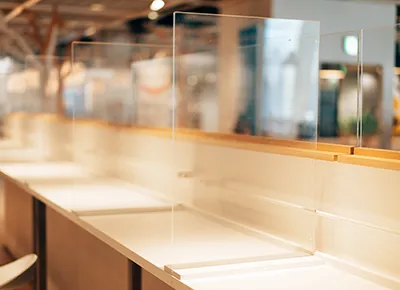
Acrylic sheets sit between these two options and often outperform both. A partition built from clear or lightly tinted acrylic maintains the visual connection and light flow of an open space while providing a defined physical boundary. Frosted or opal acrylic adds privacy without complete opacity — diffusing the view through the panel while still allowing light to pass.
In office environments, acrylic desk dividers and freestanding partitions became commonplace in recent years and have remained popular because they work. The material is easy to clean, visually unobtrusive, and far lighter than glass equivalents of the same size.
For residential use, acrylic partitions work particularly well in living areas where a visual break between spaces is needed without committing to a wall. A panel-mounted solid coloured acrylic sheet in a carefully chosen colour can also serve as a design feature in its own right, adding a structured element of colour without the permanence of a painted wall.
Thickness for partitions: 6mm to 10mm for freestanding or lightly supported panels; 3mm to 5mm for framed or desk-mounted dividers.
Furniture
Acrylic furniture is not a new idea — the all-clear acrylic chair and console table have been in production since the mid-twentieth century — but the material's application in furniture has become more sophisticated and more varied.
Clear acrylic in small spaces. The optical invisibility of clear acrylic is genuinely useful in compact rooms. A cast acrylic clear side table, shelf bracket, or chair takes up visual space without adding visual weight, which keeps a small room from feeling more crowded than it is. This is one of the more practical applications of acrylic in residential interiors and one that consistently produces the effect it promises.
Coloured acrylic for custom furniture elements. Solid and translucent acrylic sheets are increasingly used for custom furniture components — drawer fronts, shelf panels, table tops, and cabinet inserts where a specific colour is required and standard material options don't deliver it. With over 80 colour options available, acrylic gives fabricators and designers a colour specificity that painted surfaces and laminates can't match.
Mirror acrylic for decorative furniture. Mirror acrylic used on furniture faces — bedside table fronts, wardrobe door panels, console table surfaces — produces the same reflective effect as glass mirror at a fraction of the weight. It can be cut to precise dimensions and applied to curved or irregular surfaces where glass mirror would crack. It's also safer in environments where impact is a concern, such as children's furniture or high-traffic retail.
Thickness for furniture: 10mm to 19mm for structural table tops and load-bearing surfaces; 3mm to 6mm for decorative panels and inserts; 2mm to 3mm for mirror acrylic applied to flat surfaces.
Feature Walls and Architectural Details
This is where acrylic sheets are seeing the most growth in interior design applications, particularly in commercial and hospitality settings.
Backlit feature panels. Opal acrylic is the standard material for backlit wall panels. Mounted in front of LED strip lighting, opal acrylic diffuses the light evenly across the panel surface, eliminating hot spots and producing a smooth, glowing finish. This application is widely used in reception areas, restaurant feature walls, bar backdrops, and retail interiors. The effect is difficult to achieve with any other material at a comparable cost.
Coloured light effects. Translucent acrylic sheets in colour — grey tints, blue tints, tea tints, and coloured options — create coloured light effects when backlit. The depth of colour and the translucency percentage determine how much light passes through and what the panel looks like both lit and unlit. This allows designers to create panels that behave differently at different times of day or under different lighting conditions.
Fluorescent acrylic as a feature element. Fluorescent acrylic sheets have an edge-glow property — when lit from the edge, the light travels through the material and produces an intense glow at cut edges and engraved surfaces. Used as wall-mounted feature panels with concealed edge lighting, they create a distinctive visual effect that's not achievable with other materials.
Mirror acrylic for visual expansion. Mirror acrylic panels applied to feature walls reflect light and create the perception of more space — the same effect as glass mirror, with the significant advantages of lighter installation weight, easier cutting to shape, and availability in coloured mirror finishes (gold, rose gold, black, bronze, and coloured options) that glass mirror doesn't offer in the same range.
Pastel acrylic for soft colour applications. The growing use of pastel colour palettes in commercial and residential interiors has created a specific application for pastel acrylic sheets — wall panels, shelving, and decorative inserts where a soft, consistent colour is required without the variation of painted surfaces.
Thickness for wall panels: 3mm for panel-mounted decorative applications; 5mm to 6mm for self-supporting or edge-lit panels where rigidity is important.
Practical Considerations for Interior Use
UV stability. Cast acrylic has better UV resistance than extruded acrylic, which matters for panels in rooms with significant natural light exposure. For applications near windows or skylights, specifying cast acrylic reduces the risk of yellowing over time.
Cleaning. Acrylic surfaces clean easily but scratch more readily than glass. Use a soft cloth and acrylic-safe cleaning products — avoid abrasive cleaners and dry paper towels, which leave fine scratches on the surface.
Cutting to size. SAS Supplier offers a panel cutting service for all acrylic sheet types, which removes the need for on-site cutting and ensures clean, precise edges that are ready for installation.
SAS Supplier stocks Australia's largest range of acrylic sheets including clear, mirror, opal, solid, translucent, fluorescent, and pastel — with locations in Melbourne, Sydney, Brisbane, and Perth, and Australia-wide delivery.
























Sign in to leave a comment.