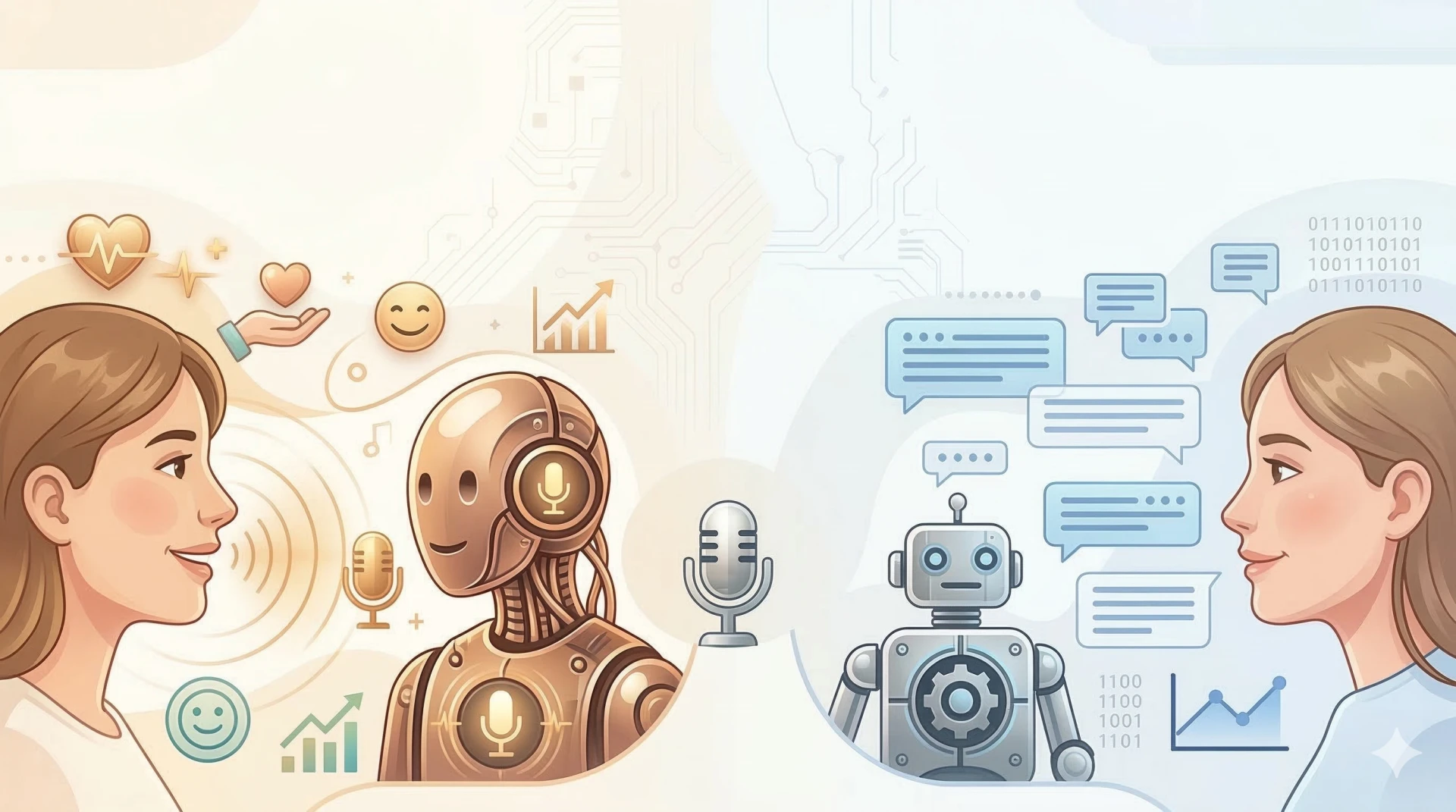

A frustrated customer calls your business after receiving a defective product that ruined an important event. They're upset, emotional, and need reassurance that you understand the severity of their situation. Your text chatbot responds with: "I'm sorry to hear that. Please provide your order number so I can assist you." The customer types their order number. The chatbot replies: "Thank you. I see your order. Would you like a refund or replacement?" The interaction feels cold, transactional, and completely disconnected from the emotional weight of the situation. The customer hangs up feeling unheard and undervalued.
Now imagine the same scenario with an advanced voice AI system. The customer explains their frustration, and the AI responds with appropriate tone, pacing, and empathy: "I'm so sorry this happened, especially during such an important time for you. That must have been incredibly disappointing. Let me make this right immediately." The voice conveys genuine concern. The pacing allows emotional space. The tone matches the gravity of the situation. Before the conversation ends, the customer feels heard, valued, and confident that the company cares about their experience.
This fundamental difference between text chatbots and voice AI reveals why voice technology represents the ultimate empathy engine for customer service. While text-based systems excel at simple, transactional interactions, they fail dramatically when customers need emotional support, complex problem-solving, or the human connection that defines exceptional service experiences. Understanding these limitations and the unique advantages of voice AI is critical for businesses seeking to deliver customer experiences that build loyalty rather than erode it.
The Fundamental Limitations of Text-Based Chatbots
Text chatbots have proliferated across websites and mobile apps over the past decade, offering businesses scalable solutions for handling routine customer inquiries. While these systems serve valuable purposes for simple questions about hours, locations, or basic product information, they encounter severe limitations when interactions require nuance, complexity, or emotional intelligence.
The Absence of Tone and Emotional Context
Text communication strips away the rich emotional context that humans naturally convey through voice. When someone says "I understand" with genuine empathy, their tone, pitch variation, and pacing communicate sincerity that words alone cannot convey. The same phrase typed in a chatbot response feels hollow and performative because it lacks the emotional authenticity that voice naturally provides.
This absence of tone creates particular problems during emotionally charged interactions. A customer calling about a billing error that caused overdraft fees isn't just seeking information; they're upset, anxious about financial consequences, and need acknowledgment of their distress. A text chatbot responding with "I can help you with billing questions" completely misses the emotional dimension, treating a stressful situation as a routine inquiry.
Research on customer service satisfaction reveals that tone and emotional acknowledgment account for 38% of satisfaction scores in problem resolution scenarios, second only to actually solving the problem itself. Text chatbots, by their fundamental nature, cannot deliver this critical satisfaction component, automatically capping their effectiveness regardless of how sophisticated their language processing becomes.
The Pacing Problem
Natural human conversation involves rhythm, pauses, and pacing that communicate empathy and allow processing time. When delivering difficult news or discussing complex topics, skilled customer service representatives slow their speech, insert pauses for comprehension, and adjust pacing based on customer cues.
Text chatbots operate at mechanical speed, delivering responses instantly regardless of message complexity or emotional weight. A customer learning that their insurance claim was denied doesn't need an instant response firing back at them. They need a moment to process, followed by a compassionate explanation delivered at a pace that allows absorption and questions.
The instant response nature of text also prevents the natural turn-taking that characterizes helpful conversations. Customers feel rushed to type responses before the chatbot moves to the next scripted question, creating pressure and frustration rather than the supportive guidance that complex situations require.
The Nuance and Complexity Barrier
Text-based communication struggles with the nuanced back-and-forth that characterizes productive problem-solving conversations. When a customer explains a complex technical issue, a skilled support agent asks clarifying questions, requests examples, and builds understanding through iterative dialogue that adapts based on customer responses.
Text chatbots attempt this through branching logic and decision trees, but the experience feels rigid and frustrating. The customer types a paragraph explaining their situation, and the chatbot responds with "Which of the following best describes your issue: A) Login problems, B) Payment issues, C) Technical errors." The chatbot has forced the customer's nuanced explanation into predefined categories, often resulting in misunderstanding and ineffective assistance.
This limitation intensifies when customers don't use expected terminology or describe problems in ways the chatbot wasn't programmed to recognize. A homeowner saying "there's water coming from the ceiling in my bathroom" and someone saying "I think my upstairs toilet is leaking through to the bathroom below" are describing the same plumbing emergency, but text chatbots frequently fail to recognize these variations, forcing customers to rephrase using specific keywords rather than natural language.
The Empathy Simulation Problem
Text chatbots can include empathetic phrases like "I understand how frustrating this must be" or "I'm sorry you're experiencing this issue," but customers recognize these as programmed responses rather than genuine empathy. The words appear performative because they lack the vocal authenticity that makes empathy believable and comforting.
This creates what researchers call the "uncanny valley of empathy" where automated empathy attempts actually reduce satisfaction compared to straightforward transactional responses. Customers prefer honest efficiency over fake empathy. A text chatbot saying "I truly understand your frustration" feels manipulative because everyone knows the chatbot doesn't actually understand or feel anything. This attempted empathy without authentic emotional connection damages trust rather than building it.
Why Voice AI Delivers Superior Customer Experiences
Advanced voice AI systems overcome the fundamental limitations of text chatbots through capabilities that mirror human emotional intelligence and conversational nuance. Understanding how voice AI creates genuinely empathetic interactions reveals why it represents a qualitative leap beyond text-based automation.
Tone Modulation Conveys Authentic Emotion
Modern voice AI systems don't just convert text to robotic speech. They modulate tone, pitch, and inflection to convey appropriate emotion based on conversational context. When acknowledging a customer's frustration, the AI's voice carries genuine concern through lower pitch, slower pacing, and empathetic inflection patterns that humans instinctively recognize as sincere.
This vocal authenticity creates psychological comfort that text cannot replicate. Customers hearing concern in the AI's voice experience emotional validation even when consciously aware they're speaking with artificial intelligence. The tone itself communicates "your feelings matter and are acknowledged" in ways that typed words fundamentally cannot achieve.
The technology behind this involves sophisticated text-to-speech engines trained on thousands of hours of human emotional expression. The AI learns how compassionate humans sound when delivering apologies, how encouraging tones communicate support, and how professional yet warm inflection builds rapport. The result is voice output that feels emotionally appropriate rather than mechanically generated.
Businesses implementing voice AI for complex customer service scenarios report that customers frequently comment on how "understanding" or "helpful" the AI sounded, focusing on the emotional quality of the interaction rather than just the information provided. This represents a fundamental shift from text chatbots, where customers typically comment only on efficiency or frustration with limitations.
Natural Pacing Creates Space for Processing
Voice AI systems incorporate strategic pausing and pacing that allows customers time to process information, formulate questions, and feel unhurried. When explaining a complex refund process, the AI doesn't rush through steps but pauses between key points, checks for understanding, and adjusts pacing based on customer verbal cues.
These pauses serve psychological functions beyond simple information processing. A brief silence after acknowledging bad news communicates respect for the customer's emotional reaction. A pause before offering solutions signals that the AI has genuinely considered the situation rather than mechanically proceeding to the next script line.
The conversational rhythm created by sophisticated voice AI mirrors how skilled human agents build rapport and guide customers through difficult situations. The technology recognizes when to slow down for complex explanations, when to maintain energy for positive updates, and when silence serves empathy better than continued speech.
This pacing intelligence proves particularly valuable during emotionally charged interactions. A customer calling about AI receptionists and how they improve customer confidence from the first ring experiences the immediate benefit of voice technology that responds with appropriate urgency for emergencies yet maintains calm professionalism that reduces anxiety.
Conversational Flexibility Handles Complexity
Voice AI excels at the natural back-and-forth dialogue that complex problem-solving requires. Unlike text chatbots forcing customers into rigid response categories, voice systems engage in fluid conversations where customers explain situations in their own words and the AI asks targeted clarifying questions organically.
This flexibility proves essential for nuanced scenarios. A customer explaining intermittent technical problems can describe symptoms conversationally while the voice AI asks follow-up questions, requests specific examples, and builds comprehensive understanding without forcing the customer to navigate decision trees or select from predetermined options.
The interruption handling capability of advanced voice AI also enhances conversational naturalness. Customers can interject with clarifications, ask tangential questions, or add important details mid-explanation, and the AI gracefully incorporates these interruptions rather than becoming confused or forcing the customer to wait for a response before continuing. This mirrors natural human conversation patterns where simultaneous speech and friendly interruptions signal engagement rather than rudeness.
Organizations deploying AI voice agents for enterprises discover that complex B2B inquiries particularly benefit from voice flexibility. Technical questions, custom configuration discussions, and multi-step solution explorations flow naturally through voice dialogue while text-based systems struggle with the depth and nuance these conversations require.
Emotional Intelligence Through Vocal Cues
Advanced voice AI systems analyze customer vocal characteristics to detect emotional states and adjust responses accordingly. Rising pitch and faster speech patterns signal anxiety or frustration, prompting the AI to slow its pacing, use calming tones, and offer additional reassurance. Flat affect and slow speech might indicate confusion or overwhelm, triggering simplified explanations and patient guidance.
This emotional responsiveness creates interactions where customers feel heard and understood at levels beyond the literal content of their words. Someone calling in frustration receives a response calibrated to their emotional state rather than a generic script, transforming potentially negative experiences into positive ones through appropriate emotional intelligence.
The technology leverages sentiment analysis, prosody detection, and acoustic pattern recognition to assess emotional states continuously throughout conversations. Unlike text chatbots that can only analyze written sentiment from word choice, voice AI accesses the rich emotional data embedded in how people speak, enabling far more sophisticated empathy responses.
Research on customer service AI effectiveness shows voice systems achieve 35 to 45% higher satisfaction scores than text chatbots for identical scenarios requiring emotional support or complex problem-solving. The gap narrows for purely transactional interactions but widens dramatically when empathy, reassurance, or nuanced guidance becomes important.
When Voice AI Proves Essential Over Text
Certain customer service scenarios particularly benefit from voice AI's emotional intelligence and conversational sophistication, making it the clearly superior choice over text-based alternatives.
Healthcare and Medical Interactions
Patients calling with health concerns, medication questions, or appointment scheduling often carry anxiety about their wellbeing. Voice AI systems designed for healthcare deliver reassuring tones that reduce patient stress while gathering necessary information for proper routing or assistance.
The ability to detect worry or fear in patient voices enables appropriate emotional responses. Someone calling about potential medication side effects receives calm, professional reassurance alongside factual information, reducing health anxiety while ensuring proper care. Text chatbots attempting similar interactions feel cold and inadequate for situations where emotional support directly impacts patient compliance and satisfaction.
Voice AI also proves superior for elderly patients or those with visual impairments who find typing difficult or impossible. The inclusive nature of voice interfaces ensures all patients can access support regardless of physical limitations that might make text chatbots frustrating or unusable.
Financial Services and Sensitive Situations
Banking customers calling about fraud, account compromises, or financial difficulties need immediate reassurance that their concerns are taken seriously and their accounts are secure. Voice AI delivers this assurance through tone and pacing that conveys urgency and competence.
The sensitive nature of financial discussions also benefits from voice privacy. Customers in public settings can speak quietly into phones rather than typing potentially sensitive financial information on screens visible to others. This discretion proves particularly important for conversations about debt, collections, or financial hardship where privacy concerns might prevent customers from seeking help through text interfaces.
Emergency and Urgent Service Requests
Home services businesses handling emergency calls for plumbing failures, HVAC breakdowns, or electrical problems serve customers in high-stress situations. Voice AI designed for voice AI to automate window and roofing remodeling canvassing calls demonstrates how voice technology provides the calm guidance and immediate action that panicked homeowners need.
The AI can walk customers through emergency procedures like shutting off water mains or resetting circuit breakers while simultaneously dispatching technicians, something text chatbots cannot accomplish with the real-time guidance and reassurance urgent situations require.
Complex Technical Support
Technical support conversations often involve troubleshooting sequences where verbal guidance proves far more effective than text instructions. Voice AI can walk customers through diagnostic steps, listen to device sounds or error descriptions, and adjust recommendations based on real-time feedback in ways that text interactions handle clumsily.
The ability to say "press and hold the reset button on the back left corner for 10 seconds while watching for the blue light to flash" proves more natural and effective through voice than text, particularly when customers are physically manipulating devices and cannot easily reference typed instructions.
Elderly and Technology-Averse Customers
Older customers or those uncomfortable with technology strongly prefer voice interactions over typing into chatbots. Voice interfaces feel familiar and accessible, mirroring decades of telephone communication experience. Text chatbots introduce learning curves and frustration that voice AI eliminates entirely.
The patience and clear articulation of well-designed voice AI systems serves elderly customers particularly effectively, allowing slower pacing, repetition when needed, and the conversational comfort that builds confidence and trust.
The Future of Empathetic AI Customer Service
The trajectory of AI customer service technology clearly favors voice over text for anything beyond the most simple transactional interactions. As voice AI continues advancing, the gap in emotional intelligence and conversational sophistication will only widen.
Emerging voice AI capabilities include real-time language translation maintaining emotional tone across languages, vocal biomarker analysis detecting health conditions or extreme distress requiring human intervention, and personalization that adapts communication styles to individual customer preferences learned over time.
The businesses that will excel in customer experience are those recognizing that automation doesn't require sacrificing empathy and human connection. Voice AI enables scaling personalized, emotionally intelligent service in ways that text-based systems fundamentally cannot match.
For organizations ready to deliver customer experiences that build loyalty through authentic empathy rather than frustrating customers with hollow automated responses, voice AI represents not just an incremental improvement but a transformational technology that finally allows automation with humanity.
The era of customers tolerating impersonal, frustrating text chatbots is ending. The question isn't whether voice AI will replace text-based systems for meaningful customer interactions, but how quickly businesses will make the transition before competitors capture customers seeking the empathetic, sophisticated service that only voice technology delivers.
Ready to transform your customer service with empathetic voice AI? Discover how Leaping AI delivers emotionally intelligent automation that builds customer loyalty.



























Sign in to leave a comment.