
For a long time, the global conversation about China was guided by optimism. Free trade would open markets, create mutual prosperity and encourage political moderation. Economic engagement, we believed, would naturally lead to convergence. It was a hopeful idea and for years, it went largely unquestioned.
Today, however, the world looks very different. Supply chains feel fragile. Strategic tensions dominate headlines. And economic dependency has replaced confidence with concern. Still, many hesitate to admit how we arrived here. We prefer to treat China’s rise as something that simply happened, rather than something we actively enabled.
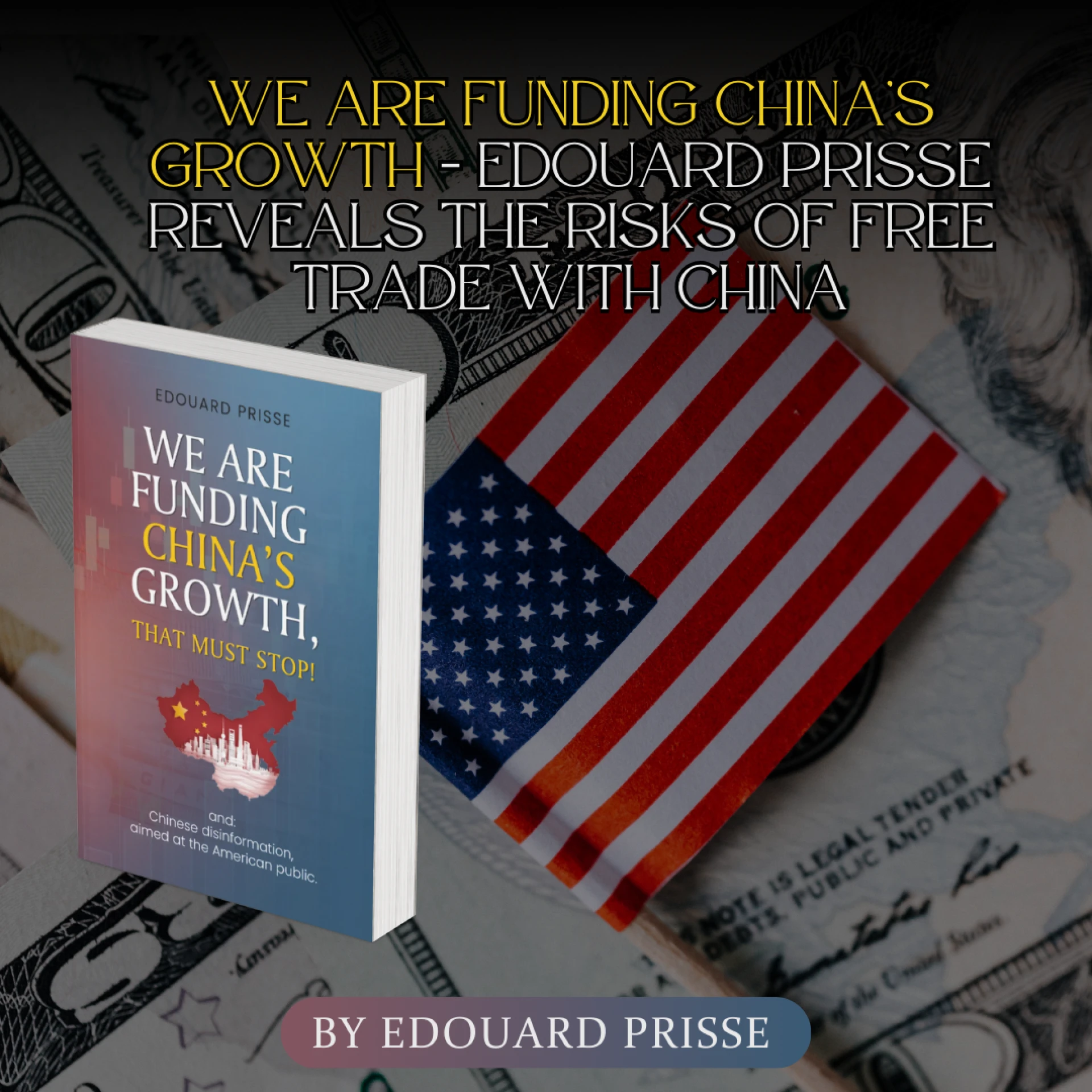
This is where the Edouard Prisse book, We Are Funding China’s Growth, enters the discussion with clarity and urgency. Prisse argues that China’s economic ascent was not an accident of history. It was financed, supported and normalized by Western decisions often made with the best intentions, but rarely with long-term strategic thinking.
In this blog, we explore the core ideas behind We Are Funding China’s Growth, examine the risks of free trade with China and explain why Edouard Prisse’s analysis is so relevant right now.
The Story We Told Ourselves About Free Trade
To understand the present, we must first revisit the narrative that shaped decades of policy. Free trade, we were told, benefits everyone. It lowers costs, boosts efficiency and creates interdependence that discourages conflict. When China entered the global trading system, many saw it as a decisive step toward a more open and cooperative world.
Initially, the results seemed to confirm this belief. Consumers enjoyed cheaper goods. Corporations increased profits. Governments celebrated growth figures. Each success reinforced the idea that trade was a neutral force, one that naturally pushed societies toward similar political and economic models.
However, as Edouard Prisse explains, this narrative relied on assumptions rather than evidence. It is assumed that economic liberalization would lead to political liberalization. It is assumed that rules-based trade systems would be applied evenly. And most importantly, it assumed that strategic intent did not matter.
Over time, reality challenged each of these assumptions. Yet instead of reassessing, many chose to double down on optimism.
We Are Funding China’s Growth And the Process Is Visible
The phrase We Are Funding China’s Growth is not meant to provoke for its own sake. It describes a clear economic mechanism. Western capital flowed into China through investment. Western companies relocated production to reduce costs. Western consumers created a constant demand for inexpensive goods.
Each decision made sense in isolation. Businesses sought competitiveness. Governments prioritized economic expansion. Consumers responded to affordability. Yet collectively, these choices transferred industrial capacity, technological know-how and economic leverage on an unprecedented scale.
According to Edouard Prisse, the issue is not that engagement occurred, but that it occurred without boundaries. When open market economies engage a tightly coordinated, state-driven system without reciprocity, the outcome is predictable.
China did not merely participate in globalization; it mastered it, on its own terms.
The Risks of Free Trade with China Were Always There
One of the most striking arguments in the Edouard Prisse book is that the dangers were never hidden. The risks of free trade with China were discussed repeatedly, long before they became visible to the general public.
Dependency was an early warning sign. As production moved offshore, domestic manufacturing capacity declined. Skills eroded. Supply chains stretched across continents. Efficiency improved, but resilience suffered.
Another risk was structural imbalance. Free trade presumes a level playing field. Yet China’s economic system relied heavily on state subsidies, controlled markets and selective enforcement. Western companies competed openly, while their Chinese counterparts benefited from a coordinated national strategy.
Despite these concerns, criticism was often dismissed as protectionist or alarmist. Optimism, it seemed, was more comfortable than caution.
How Elite Opinion Sustained the Illusion
Ideas do not persist without reinforcement. Edouard Prisse pays close attention to the role of influential institutions in shaping public perception. Think tanks, major publications and policy circles often repeated the same reassuring assumptions about China.
Engagement was framed as inevitable. Patience was encouraged. Risks were acknowledged briefly, then set aside. Over time, this repetition created a powerful consensus that discouraged dissent.
Importantly, this was not the result of a coordinated effort. It emerged from shared incentives and intellectual habits. Questioning the dominant narrative meant questioning decades of policy and admitting that costly mistakes may have been made.
As a result, a narrow range of views dominated the conversation, even as evidence increasingly contradicted them.
Information, Messaging and Strategic Patience
While Western societies debated openly, China pursued a long-term communication strategy. This did not rely on blunt propaganda, but on consistency, framing and selective transparency.
Economic data was presented in the most favorable light. Strategic intentions were described as purely cooperative. Criticism was reframed as misunderstanding or hostility. Over time, these narratives influenced how China was perceived in boardrooms, universities and governments.
Edouard Prisse argues that this information strategy worked because it aligned with Western interests. When messages confirmed what audiences wanted to believe, scrutiny weakened.
The danger, then, was not only misinformation but the willingness to accept it.
The Inescapable Logic Behind the Argument
One reason We Are Funding China’s Growth resonates so strongly is its logical structure. Prisse does not rely on ideology or emotion. He follows a simple chain of cause and effect.
If production moves abroad, domestic capacity declines. If capital flows outward, influence follows. If strategic considerations are ignored, strategic leverage shifts. These outcomes are not controversial; they are predictable.
By stripping away comforting abstractions, Edouard Prisse forces readers to confront results rather than intentions. Good intentions, he reminds us, do not erase consequences.
Once this logic is understood, denial becomes difficult to maintain.
Is It Too Late to Change Direction?
A common response to discussions about China’s rise is resignation. The moment has passed, some argue. The damage is done. Prisse addresses this sentiment directly.
While he warns that time is limited, he does not suggest that action is futile. However, meaningful change requires honesty. It requires acknowledging past errors and resisting the temptation to reframe them as unavoidable.
Rebuilding domestic capacity, reassessing trade dependencies and reintroducing strategic thinking into economic policy will not be easy. These steps involve cost, disruption and political resistance.
Yet the alternative, continuing to ignore the risks of free trade with China, narrows future options even further. Delay benefits the stronger, more patient actor.
Why This Book Matters Now More Than Ever
Recent years have exposed vulnerabilities that were once dismissed as theoretical. Supply chain disruptions, geopolitical tensions and economic uncertainty have forced uncomfortable questions into the mainstream.
This is why the Edouard Prisse book feels so timely. It offers a framework for understanding how we arrived at this point and why certain outcomes were not accidental.
Rather than reacting to symptoms, We Are Funding China’s Growth examines causes. It connects trade policy, political assumptions and information strategy into a coherent whole.
For readers seeking clarity instead of slogans, this approach is refreshing and necessary.
Accessible Writing Without Oversimplification
Despite the seriousness of its subject, the book remains engaging and readable. Edouard Prisse avoids unnecessary jargon and explains complex ideas with precision and patience.
Arguments build gradually, allowing readers to follow the reasoning without feeling overwhelmed. Occasional moments of dry humor and sharp observation keep the tone human and approachable.
Importantly, Prisse does not claim absolute authority. He presents evidence, draws conclusions and invites readers to think critically. This openness strengthens the credibility of his analysis.
The result is a book that informs without lecturing and challenges without alienating.
Facing Reality Is the First Step Forward
We are funding China’s growth. That is no longer a provocative claim; it is an observable fact. The real challenge lies in accepting what that means for economic independence, political autonomy and long-term security.
Edouard Prisse urges readers to stop pretending. To examine assumptions that once felt safe. And to recognize that economic choices are inseparable from strategic outcomes.
Ignoring uncomfortable truths may offer short-term comfort. However, clarity, even when unsettling, is the foundation of informed decision-making.
We Are Funding China’s Growth does not offer easy answers. Instead, it offers something more valuable: a clear-eyed assessment of reality and an invitation to think seriously about the future. For anyone concerned with where global power is heading, it is a conversation worth engaging with now.




























Sign in to leave a comment.