
Artificial Intelligence is transforming business. But while AI once meant dashboards, predictions, and simple chatbots, today’s frontier is far more powerful: AI agents. These aren’t just tools—they’re autonomous, intelligent collaborators that work alongside humans to handle tasks, make decisions, and optimize operations in real time.
For business owners, this evolution means greater scalability, efficiency, and insight—all without necessarily expanding headcount or budget. Whether you're running a startup or scaling a global enterprise, AI agents can act as digital coworkers across every department.
This blog explores what AI agents are, how they function, and—most importantly—how they can empower business owners to do more, grow faster, and adapt smarter in 2025 and beyond.
What Is an AI Agent?
An AI agent is a software system that perceives its environment, makes decisions based on its objectives, and performs actions to reach a goal. These agents are:
- Autonomous: They work independently, reducing the need for human micromanagement.
- Context-aware: They react dynamically to real-time inputs.
- Goal-oriented: Every task they perform moves toward a defined business outcome.
- Self-improving: With machine learning, agents learn and get better over time.
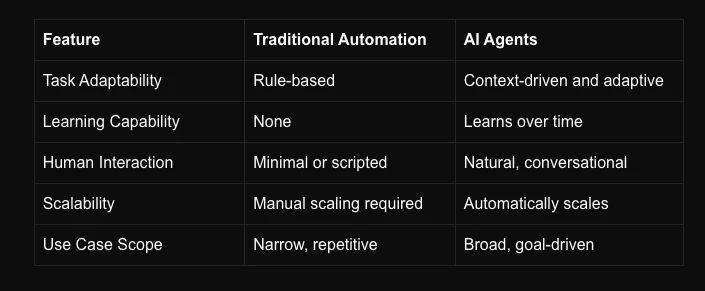
Unlike traditional automation, AI agents don’t need rigid workflows—they can adapt on the fly, making them ideal for dynamic business environments.
How AI Agents Help Business Owners
1. Automate Repetitive Tasks
Repetitive admin work is the enemy of productivity. AI agents can automate:
- Meeting scheduling
- Invoice generation
- Order tracking
- FAQ responses
This frees up your team to focus on innovation and strategy.
2. Deliver 24/7 Customer Support
AI agents can interact with customers across web, mobile, social media, and voice channels. They:
- Answer customer queries
- Resolve common issues
- Route tickets to human agents when needed
- Learn from interactions to improve
No missed messages. No late-night emergencies.
3. Supercharge Sales
Sales teams often spend more time updating CRMs than closing deals. AI agents help by:
- Automatically qualifying leads
- Following up via email or chat
- Recommending next-best actions
- Updating CRM entries in real time
It’s like giving every salesperson their own virtual assistant.
4. Boost Decision-Making with Real-Time Insights
An AI agent can:
- Summarize performance metrics
- Surface anomalies in sales or supply chain data
- Suggest optimizations based on trends
Instead of combing through spreadsheets, you get insights at a glance—ready to act on.
5. Streamline HR and Internal Ops
HR teams can deploy AI agents to:
- Onboard new hires
- Answer employee policy questions
- Automate benefits administration
- Track leave balances
Operations teams can use them to coordinate logistics, monitor inventory, and manage vendor communications.
6. Personalize Customer Experiences
AI agents collect and apply data to:
- Recommend products or services
- Tailor content and messaging
- Predict user needs based on past behavior
This personalization boosts satisfaction—and revenue.
7. Enable Scalable Growth
Unlike human teams, AI agents:
- Don’t sleep
- Don’t take breaks
- Scale instantly across regions, languages, or product lines
This makes them perfect for growing businesses that want to expand without hiring immediately.
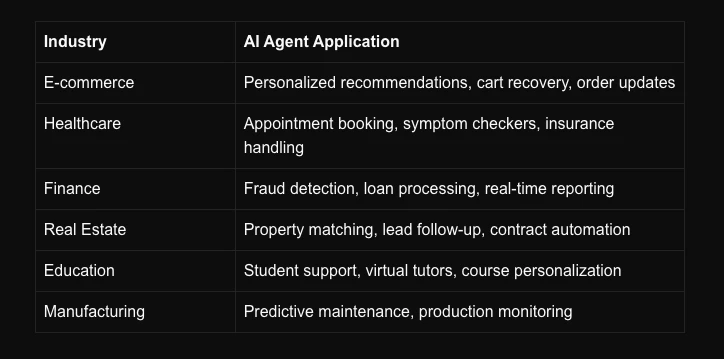
Use Cases Across Industries
How AI Agents Differ from Traditional Automation
Why Business Owners Should Care in 2025
The world is moving fast. Customers expect more, competition is fiercer, and digital operations are the new baseline. AI agents are uniquely positioned to help businesses thrive in this landscape by offering:
- Speed: Respond to customers and changes instantly
- Savings: Reduce labor costs without sacrificing quality
- Agility: Pivot quickly with adaptive, learning-based tools
- Scalability: Serve more people and handle more processes with ease
For business owners who want to future-proof their operations, the time to adopt AI agents is now.
Getting Started: How to Build AI Agent Infrastructure
You don’t have to build everything from scratch. There are now platforms, tools, and frameworks that make it easier than ever to build AI agent systems tailored to your business.
Popular components include:
- Language models (OpenAI, Google PaLM)
- Chat frameworks (Rasa, LangChain, Botpress)
- Voice systems (Twilio, Speechly)
- CRM/ERP integrations (Salesforce, HubSpot, SAP)
A good starting point is identifying one key business area—like support or sales—where automation could have the biggest impact. Start small, test, then scale.
Selecting the Right Partner
Working with an experienced ai agent development company can significantly shorten your time to market. These firms bring:
- Prebuilt libraries and agent blueprints
- Custom integration expertise
- Knowledge of compliance and security best practices
- UX/UI guidance for seamless agent interaction
Choosing the right development partner helps ensure you’re not just deploying a chatbot—you’re building a reliable, intelligent system that delivers long-term value.
Future Trends in AI Agent Development
Looking ahead, business owners can expect AI agents to become:
1. More Agentic
Rather than relying on direct input, agents will begin proactively taking initiative—booking meetings, adjusting workflows, even launching marketing campaigns autonomously.
2. More Collaborative
Agents will coordinate with each other and with humans in real time, working as part of a multi-agent system within your company.
3. More Specialized
Agents will develop deep expertise in narrow domains (e.g., tax compliance, logistics, vendor management), giving businesses the power of in-house experts—without the cost.
Conclusion: The Time to Adopt AI Agents Is Now
AI agents are no longer futuristic ideas—they're essential, accessible, and already driving real business outcomes across industries.
They handle customer service. They support sales. They automate backend operations. They provide strategic insights. And most importantly, they grow with your business.
For business owners who want to stay ahead of the curve, building a strategy around AI agents is one of the smartest moves you can make in 2025.
“Are they secure?”
Modern agents can be built with enterprise-grade encryption, role-based access, and compliance features like SOC 2, HIPAA, and GDPR.
“How much does it cost?”
Initial investments vary, but the ROI typically includes labor savings, increased conversion rates, and faster decision-making. Working with firms offering ai agent development solutions can streamline cost-efficient deployment.




























Sign in to leave a comment.