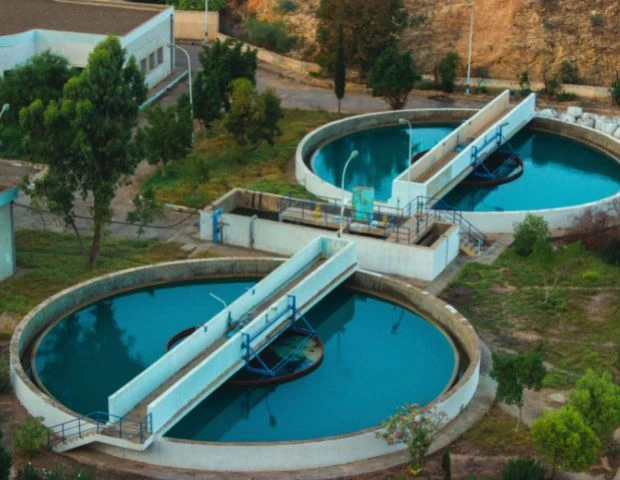

Wastewater treatment processes purify water. Wastewater treatment plants are designed to treat wastewater and make the best use of the treated water. Sewage treatment plants and industrial wastewater treatment facilities help clean water and restore its usability. A Sewage Treatment Plant, often shortened as STP, is an efficient and economical solution for removing contaminants and pollutants from the wastewater. It employs chemical, physical, and organic processes to extract chemical, physical, and biological impurities, respectively. MEFT International engineers, designs, and supply of sewage treatment plants for municipal, industrial, and commercial applications in Saudi Arabia. STPs help to conserve water and protect the environment.
A sewage treatment facility essentially functions by moving air to encourage the growth of bacteria that break down waste. Delivering significantly cleaner, more environmentally-friendly water is the aim. Depending on their size, sewage treatment plants can handle the waste from a single property or numerous commercial or residential establishments
How does a sewage treatment plant function?
The sewage treatment plant operation can be classified into three stages, as follows:
Stage 1
A sewage treatment plant and a septic tank are both generally built in very similar ways. Sewage enters the first chamber of the sewage treatment plant from the area it is serving, much like a septic tank. On reaching there, the water rests until sediments have accumulated on the tank's bottom and grease, oil, and scum have floated to the top.
Stage 2
In the second stage, the liquid flows from the first chamber to the second one after the separation process. This chamber helps promote the development of aerobic bacteria, as it is equipped with an air pump that moves air throughout the space. Bacteria aids in the breakdown of pollutants to adequately clean the water.
Stage 3
A sewage treatment plant's last stage is a final settlement tank. Before releasing the effluent into a soak away or watercourse, this last tank enables the very last solid matter that may still be present in the water to settle at the bottom of the tank.
After the completion of the sewage treatment process and treatment of wastewater, it is safe to discharge it into the environment. Sewage treatment plants and septic systems differ significantly in this regard. You require an Environment Agency Consent to Discharge before you can release wastewater from a septic tank into a soak away for additional ground-level treatment. However, you can discharge your effluent directly into nearby water sources from the sewage treatment plant. That is because the treatment process results in significantly better effluent quality. You can find efficient sewage treatment plants in Saudi Arabia by MEFT International.
Advantages of Sewage Treatment Plants
Environment-friendly
Sewage treatment plants are environment-friendly as they aid in minimizing threats to public health and surroundings. These treatment plants grant reliable solutions and performance, as they use cutting-edge and well-proven technology.
Occupy little space
While many people misunderstand that treatment plants consume a lot of space, STP takes up little space and are convenient to set up.
Time-efficient
Sewage treatment plants run efficiently with the emergence of the newest technologies. A sewage treatment facility set up by MEFT International can quickly process vast amounts of sewage, making economical use of resources.
MEFT International has more than 12 years of experience in custom-designing and offering reliable services for sewage and wastewater management in Saudi Arabia and UAE, which includes complete engineering, design, and supply of wastewater treatment solutions for municipal, industrial, and commercial applications. For more details, you can reach out to them at +971 6 5350066 or write to [email protected].


















Sign in to leave a comment.