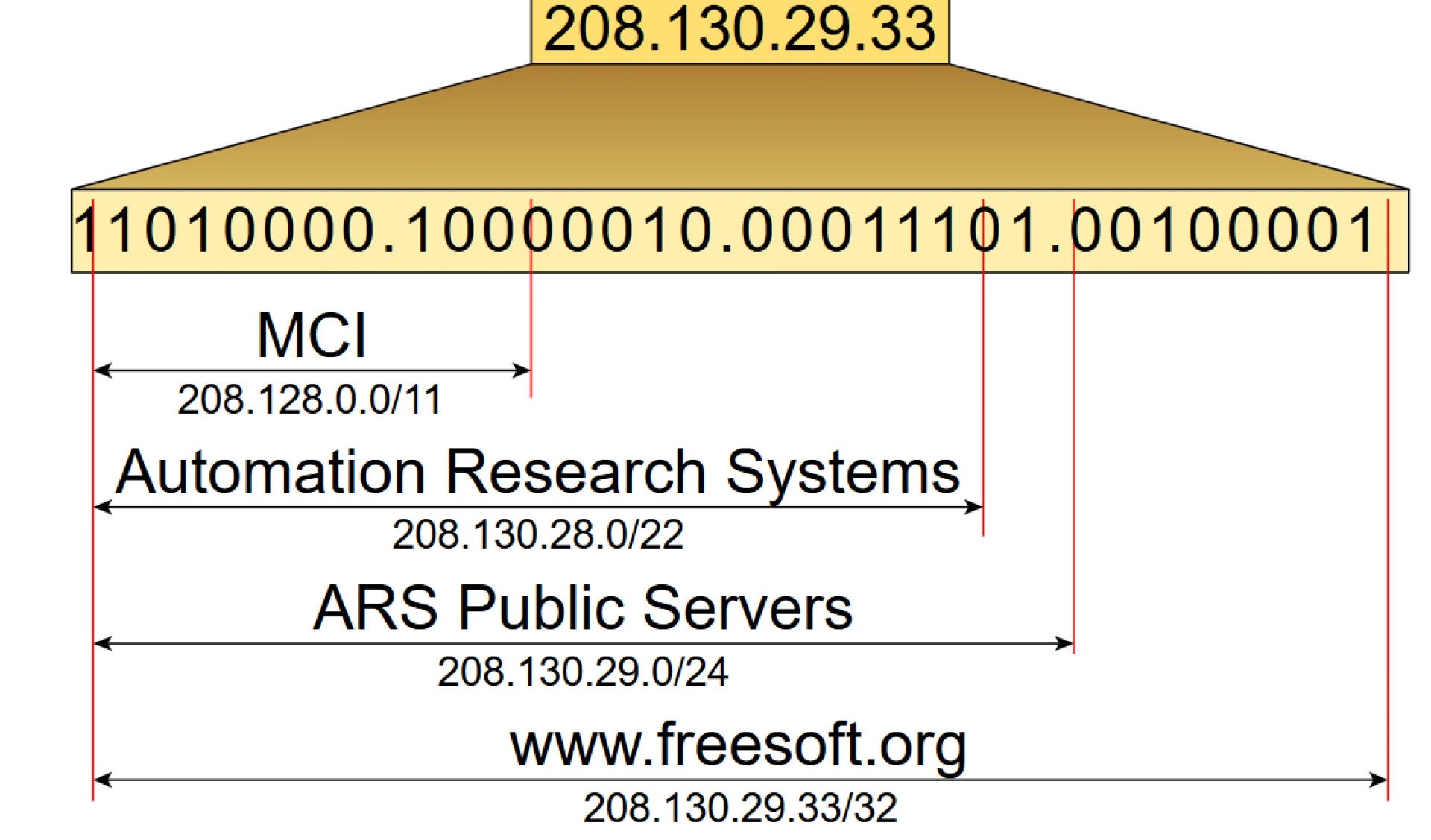

Classless Inter-Domain Routing (CIDR) is a method for allocating and managing IP addresses that improves upon the traditional class-based system. Introduced in 1993 as part of the Internet Engineering Task Force (IETF) standard, CIDR helps optimize the utilization of IP address space and facilitates more efficient routing on the Internet. It is a core concept in networking and is essential for managing IP address allocations in a scalable and flexible way.
Traditional IP Addressing and the Need for CIDR
Before CIDR, IP addresses were divided into fixed classes: Class A, B, and C. These classes provided a specific range of IP addresses based on a rigid hierarchy:
- Class A: Provided 2242^{24}224 usable addresses, suitable for very large organizations.
- Class B: Provided 2162^{16}216 usable addresses, suitable for medium-sized networks.
- Class C: Provided 282^{8}28 usable addresses, suitable for small networks.
While this system was straightforward, it led to inefficiencies. Organizations often needed address allocations that didn’t fit neatly into these fixed blocks. For example, a company requiring 2,000 IP addresses could not use a Class C block (which only provides 256 addresses) and would instead receive a Class B block, wasting over 60,000 addresses.
Additionally, the fixed-class system caused rapid depletion of IPv4 address space and generated a large number of unused addresses. CIDR addressed these inefficiencies by introducing a more flexible method for subnetting and routing.
The CIDR Notation
CIDR uses a more flexible notation to represent IP addresses and their associated network masks. Instead of rigid classes, CIDR allows any block of IP addresses to be divided into smaller or larger blocks as needed.
A CIDR block is denoted as:
bash
Copy code
IP_address/prefix_length
Here:
- IP_address represents the starting address of the block.
- prefix_length indicates the number of significant bits in the subnet mask.
For example, the CIDR block 192.168.0.0/24 means:
- The network starts at
192.168.0.0. - The subnet mask is 255.255.255.0 (24 bits for the network portion).
- The block contains 256 IP addresses, from
192.168.0.0to192.168.0.255.
Benefits of CIDR
- Efficient Use of Address Space: CIDR allows allocation of address blocks that precisely match an organization's requirements, avoiding the waste associated with the class-based system.
- Scalability: By aggregating multiple smaller blocks into larger ones (a process known as route summarization), CIDR reduces the size of routing tables. This makes the Internet more scalable and manageable.
- Support for Subnetting and Supernetting: CIDR facilitates both dividing a network into smaller subnetworks (subnetting) and combining multiple networks into a larger one (supernetting).
CIDR and Routing
CIDR plays a critical role in routing efficiency. Routers use CIDR blocks to group and summarize routes. For instance, instead of maintaining individual routes for 192.168.0.0/24, 192.168.1.0/24, and 192.168.2.0/24, a router can summarize them with a single CIDR block: 192.168.0.0/22. This reduces the size of routing tables, improving the performance of routing protocols and conserving resources.
Conclusion
CIDR revolutionized the management of IP addresses by replacing the inefficient class-based system with a more flexible and scalable approach. It has been instrumental in extending the lifespan of IPv4 and remains relevant in the era of IPv6. Understanding CIDR is fundamental for network administrators and anyone working in IT infrastructure, as it underpins modern IP address management and routing systems.




























Sign in to leave a comment.