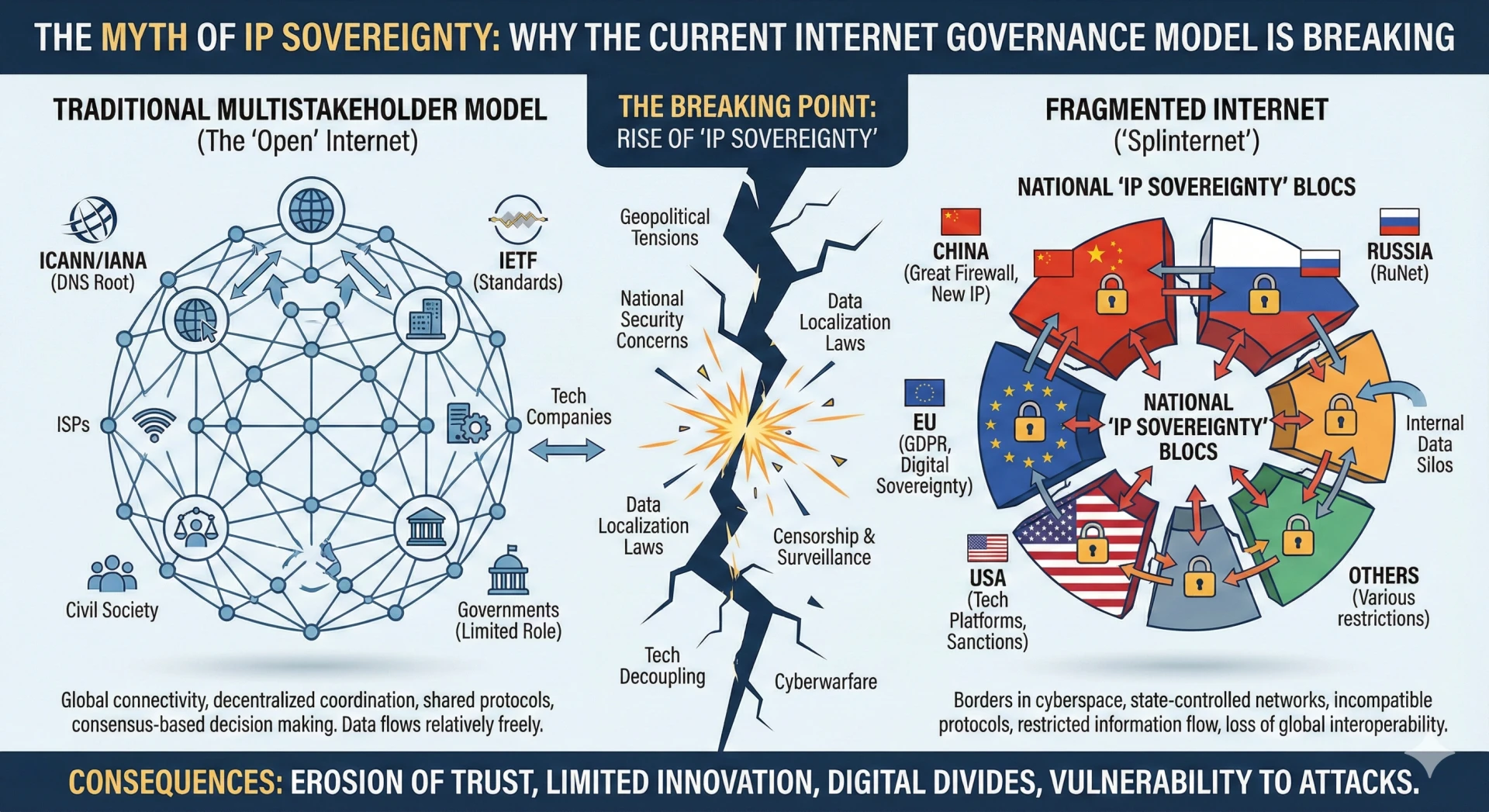

For decades, we have operated under the assumption that the internet is a borderless frontier. Yet, as digital economies grow, a new and controversial concept has emerged: Digital Sovereignty. Specifically, the idea that nations or regional bodies should exert "sovereignty" over IP addresses—the very DNA of our connectivity.
But is IP address sovereignty a protective reality or a dangerous myth?
The Traditional Model: Regional Control
Currently, the internet is managed by five Regional Internet Registries (RIRs). These organizations act as the custodians of IP addresses, allocating them to providers based on regional needs. For years, this system worked as a technical administrative record. However, as IPv4 addresses have become a scarce, multi-billion dollar asset class, the RIRs have shifted from simple "bookkeepers" to powerful gatekeepers.
The Myth: Geographical "Borders" in a Global Network
The article argues that "IP sovereignty" as defined by many administrative bodies is a myth for three key reasons:
- Technical Incompatibility: The internet was built to be interconnected. Attempting to lock IP addresses within a specific geography contradicts the fundamental design of the network.
- The Ownership Illusion: Many companies spend millions "buying" IP addresses, only to find they don't actually own them. Under current RIR policies, these assets are often held under restrictive "service agreements" that can be arbitrarily revoked.
- Economic Friction: By restricting the portability of IP addresses, regional registries create artificial scarcity and prevent the market from functioning efficiently.
The Reality: A Global Market in a Regional Cage
The reality of today’s internet is that IP addresses are no longer just technical labels; they are critical economic infrastructure. When a regional registry attempts to "reclaim" addresses because they are being used "off-region," it doesn't just disrupt a database—it can threaten the operations of global cloud providers, ISPs, and the millions of users who rely on them.
The high-profile legal battles we see today (such as the AFRINIC dispute) are not just corporate squabbles. They are a "wake-up call" for the entire industry. They expose a system where the rules of "ownership" are dictated by administrative whim rather than transparent law.
A Path Toward True Digital Sovereignty
To evolve, internet governance must move away from the "myth" of regional isolation and toward a model of Transparency and Portability. This includes:
- Decentralization: Using technologies like blockchain to create an immutable, transparent record of IP ownership that isn't subject to the politics of a single registry.
- Predictable Governance: Ensuring that internet resources are governed by clear, enforceable contracts rather than shifting administrative policies.
- Market-Based Efficiency: Allowing IP addresses to move where they are needed most, regardless of where they were originally "born."
Conclusion
The internet cannot be isolated with a legal document. As we look toward the future of governance, the goal should not be to build digital walls, but to ensure that the foundation of our connectivity—IP addresses—remains stable, portable, and transparently owned. True sovereignty isn't about control through isolation; it’s about the freedom to innovate across a truly global network.



























Sign in to leave a comment.