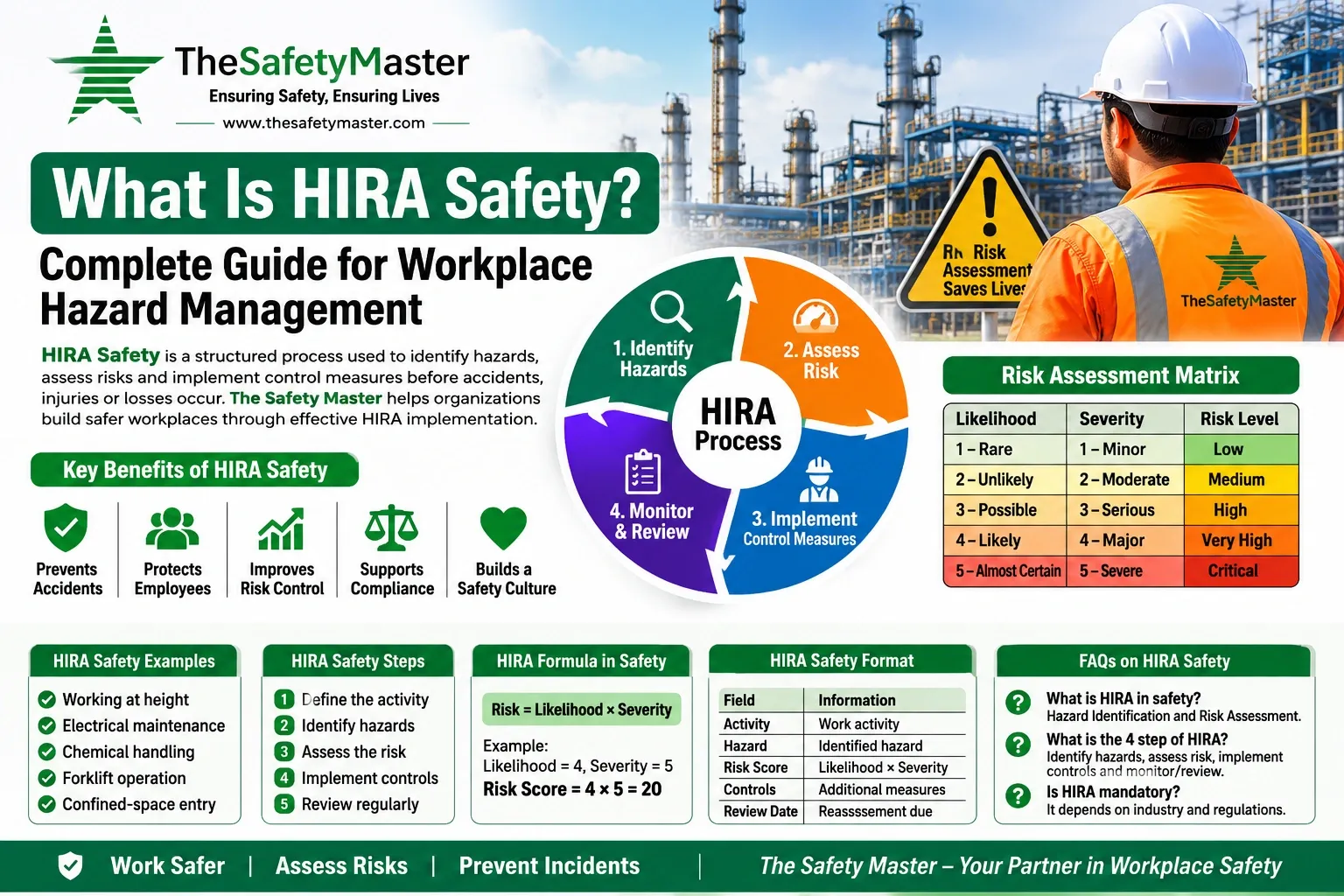

HIRA Safety is an important workplace safety process used to identify hazards, assess risks, and implement suitable control measures before accidents, injuries, equipment damage, or environmental incidents occur. The Safety Master helps organizations improve workplace safety through systematic hazard identification and risk assessment.
HIRA stands for Hazard Identification and Risk Assessment. It is widely used in industries such as manufacturing, construction, oil and gas, chemicals, power, logistics, and other workplaces where employees may be exposed to different types of hazards.
What Is HIRA Safety?
HIRA safety is a structured method for identifying workplace hazards and evaluating the risks associated with those hazards. The objective is to understand what can go wrong, determine how serious the consequences could be, and establish controls to reduce the risk to an acceptable level.
A good HIRA helps organizations:
- Identify hazards before incidents occur
- Assess the likelihood and severity of risks
- Prioritize high-risk activities
- Select appropriate control measures
- Improve employee safety
- Reduce workplace accidents
- Support legal and regulatory compliance
- Improve overall safety performance
HIRA Full Form in Safety
The HIRA full form in safety is Hazard Identification and Risk Assessment.
It is generally divided into two major activities:
Hazard Identification
Hazard identification involves finding anything that can potentially cause injury, illness, property damage, environmental harm, or operational disruption.
Common workplace hazards include:
- Electrical hazards
- Fire and explosion hazards
- Chemical hazards
- Mechanical hazards
- Biological hazards
- Ergonomic hazards
- Work-at-height hazards
- Slips, trips, and falls
- Noise and vibration
- Confined-space hazards
Risk Assessment
Risk assessment evaluates the possibility of an unwanted event and the potential consequences if it occurs.
For example, an exposed electrical cable is a hazard. The possibility of a worker receiving an electric shock and the potential seriousness of that shock represent the associated risk.
Why Is HIRA Important for Workplace Safety?
HIRA allows organizations to move from reactive safety management to proactive risk management.
Instead of waiting for an accident to happen, organizations can identify hazards in advance and introduce controls before workers are exposed to unacceptable risks.
Major Benefits of HIRA
1. Prevents Workplace Accidents
Identifying hazards early allows companies to take preventive action before an incident occurs.
2. Protects Employees
HIRA helps identify activities that may cause injuries, occupational illnesses, or other harmful exposures.
3. Improves Risk Control
Risk assessment helps management prioritize the hazards requiring immediate attention.
4. Supports Compliance
A documented risk assessment can support an organization's safety management and compliance activities.
5. Improves Safety Culture
Regular HIRA encourages employees and supervisors to actively participate in identifying and controlling hazards.
What Are the 4 Steps of HIRA?
The question “What is the 4 Step of HIRA?” is commonly answered using a four-stage approach. Organizations may use slightly different terminology depending on their procedures.
Step 1: Identify the Hazards
Identify hazards associated with the workplace, equipment, materials, environment, and work activities.
Step 2: Assess the Risk
Determine the likelihood that the hazard could cause an incident and evaluate the possible severity of its consequences.
Step 3: Implement Control Measures
Select suitable controls to eliminate the hazard or reduce the risk.
Step 4: Monitor and Review
Review the assessment periodically and whenever there are changes in processes, equipment, materials, personnel, or working conditions.
HIRA Safety Steps
A more detailed HIRA safety steps process can include the following:
1. Define the Activity
Clearly describe the job, process, area, or task being assessed.
2. Break the Work into Activities
Divide complex operations into individual tasks so that hazards can be identified more effectively.
3. Identify Hazards
Consider what could cause injury, illness, damage, fire, explosion, environmental impact, or operational failure.
4. Identify Existing Controls
Document controls that are already available, such as guards, PPE, procedures, alarms, ventilation, or training.
5. Assess the Risk
Evaluate likelihood and severity using the organization's approved risk matrix.
6. Determine Additional Controls
Where the existing controls are insufficient, introduce additional measures.
7. Assign Responsibility
Identify the person or department responsible for implementing the control.
8. Review the HIRA
Review the assessment periodically and whenever significant changes occur.
HIRA Formula in Safety
A commonly used HIRA formula in safety is:
Risk = Likelihood × Severity
For example, an organization may use a numerical scale from 1 to 5 for both likelihood and severity.
Example:
- Likelihood = 4
- Severity = 5
Risk Score = 4 × 5 = 20
The organization can then compare the result with its approved risk matrix to determine whether the risk is low, medium, high, or critical.
Important: Risk-rating scales and acceptance criteria can differ between organizations. Always use the company's approved HIRA risk matrix rather than assuming that one universal scoring system applies everywhere.
HIRA Risk Assessment Matrix
A risk matrix commonly combines likelihood and severity.
| Likelihood | Severity | Example Risk Score |
|---|---|---|
| 1 – Rare | 1 – Minor | 1 |
| 2 – Unlikely | 2 – Moderate | 4 |
| 3 – Possible | 3 – Serious | 9 |
| 4 – Likely | 4 – Major | 16 |
| 5 – Almost Certain | 5 – Severe | 25 |
The organization should define its own risk categories and actions for each score.
HIRA Safety Format
A HIRA safety format should be simple, clear, and capable of documenting the complete risk assessment.
A typical format may contain:
| HIRA Field | Information |
| Department/Area | Location or department |
| Activity | Work activity being assessed |
| Hazard | Identified hazard |
| Potential Consequence | Possible outcome |
| Existing Controls | Current control measures |
| Likelihood | Likelihood rating |
| Severity | Consequence rating |
| Risk Score | Likelihood × Severity |
| Additional Controls | Proposed improvements |
| Responsible Person | Person responsible |
| Target Date | Completion date |
| Residual Risk | Risk after controls |
| Review Date | Date for reassessment |
This format can be adapted according to the industry, organization, process, and risk-management procedure.
HIRA Safety Examples
Understanding HIRA safety examples makes the concept easier to apply.
Example 1: Working at Height
Activity: Working on an elevated platform
Hazard: Fall from height
Potential Consequence: Serious injury or fatality
Existing Controls: Guardrails, safe access, fall-protection equipment, inspection
Additional Controls: Improve edge protection, conduct pre-use inspection, provide training, and enforce work-at-height procedures.
Example 2: Electrical Maintenance
Activity: Electrical maintenance
Hazard: Contact with energized equipment
Potential Consequence: Electric shock, burns, or fatality
Controls: Isolation, lockout/tagout, electrical PPE, competent personnel, testing before work.
Example 3: Chemical Handling
Activity: Handling hazardous chemicals
Hazard: Chemical exposure
Potential Consequence: Burns, poisoning, respiratory problems, or environmental release
Controls: Proper storage, ventilation, suitable PPE, SDS availability, spill response procedures, and employee training.
Example 4: Forklift Operation
Activity: Moving materials with a forklift
Hazard: Collision with pedestrians
Potential Consequence: Serious injury or fatality
Controls: Designated pedestrian routes, speed limits, trained operators, warning systems, traffic management, and regular equipment inspections.
Hierarchy of Controls in HIRA
When controlling hazards, organizations should consider the Hierarchy of Controls.
1. Elimination
Remove the hazard completely.
2. Substitution
Replace the hazardous material, process, or equipment with a safer alternative.
3. Engineering Controls
Use physical measures such as machine guards, barriers, ventilation, or interlocks.
4. Administrative Controls
Use procedures, training, signs, permits, schedules, and supervision.
5. Personal Protective Equipment
Use appropriate PPE such as helmets, gloves, safety shoes, goggles, respirators, or fall-protection equipment.
PPE is important, but it is generally considered less effective than eliminating or engineering out the hazard.
What Should a Good HIRA Include?
A comprehensive HIRA should normally include:
- Scope of assessment
- Workplace or process information
- Work activities
- Identified hazards
- Potential consequences
- Existing controls
- Likelihood rating
- Severity rating
- Initial risk rating
- Additional control measures
- Responsible persons
- Implementation deadlines
- Residual risk
- Review requirements
- Approval or authorization
HIRA Safety PDF
Organizations often create a HIRA safety PDF after completing their risk assessment. A PDF can be useful for documentation, training, audits, approvals, and recordkeeping.
A HIRA PDF may contain:
- Company and department details
- HIRA assessment team
- Activity description
- Hazard identification
- Risk assessment
- Existing controls
- Additional control measures
- Risk rating
- Responsible person
- Review and approval information
The exact format should be customized to the organization's activities and internal safety procedures.
Who Should Conduct a HIRA?
HIRA should ideally involve competent personnel who understand the work being assessed.
Depending on the activity, the team may include:
- Safety professionals
- Operations personnel
- Maintenance personnel
- Engineers
- Supervisors
- Workers familiar with the task
- Environmental professionals
- Subject-matter experts
Worker participation is particularly valuable because employees performing the job often understand practical hazards that may not be obvious from documentation alone.
When Should HIRA Be Conducted?
HIRA should be conducted before starting a new activity or process and reviewed when significant changes occur.
It may be required or useful when:
- Starting a new project
- Introducing new equipment
- Changing a process
- Introducing new chemicals
- Modifying workplace layouts
- Performing non-routine work
- Investigating incidents
- Identifying new hazards
- Existing controls become ineffective
- Periodic review is due
Common HIRA Mistakes to Avoid
Incomplete Hazard Identification
Missing a hazard can result in inadequate risk controls.
Copying Old Assessments
Existing HIRA documents should not simply be copied without verifying current workplace conditions.
Focusing Only on PPE
PPE should not be the only control considered. Higher-level controls should be evaluated first.
Ignoring Non-Routine Activities
Maintenance, shutdowns, emergency activities, and temporary work can introduce significant hazards.
Not Reviewing Controls
Controls should be checked to ensure they are actually implemented and effective.
Poor Employee Involvement
Workers should have opportunities to contribute practical information about the tasks they perform.
HIRA vs. HAZOP
HIRA and HAZOP are both important safety techniques, but they have different applications.
HIRA is a broader hazard identification and risk assessment approach that can be used for many workplace activities and processes.
HAZOP is a structured technique commonly used to identify deviations from design intent in process systems using guidewords such as No, More, Less, Reverse, and others.
Organizations may use HIRA, HAZOP, and other risk assessment techniques together as part of a broader process safety management system.
How The Safety Master Can Help
Effective hazard identification requires more than filling out a risk assessment form. It requires a systematic understanding of hazards, consequences, risk levels, and practical control measures.
The Safety Master provides safety and process-safety-related training and consulting support to help organizations strengthen their hazard identification, risk assessment, and workplace safety practices.
FAQs About HIRA Safety
What is HIRA in safety?
HIRA stands for Hazard Identification and Risk Assessment. It is a systematic process used to identify workplace hazards, assess associated risks, and determine suitable control measures to prevent accidents, injuries, environmental incidents, and property damage.
What is the HIRA formula in safety?
A commonly used HIRA formula is Risk = Likelihood × Severity. Organizations assign ratings to likelihood and severity and multiply them to obtain a risk score. The score is then evaluated using the organization's approved risk matrix.
What are the 4 steps of HIRA?
The four basic steps are hazard identification, risk assessment, implementation of control measures, and monitoring/review. Organizations may divide these stages into more detailed steps depending on their internal HIRA procedure.
What is a HIRA safety format?
A HIRA safety format generally includes the activity, hazard, consequence, existing controls, likelihood, severity, risk score, additional controls, responsible person, target date, residual risk, and review date.
What are some HIRA safety examples?
Common examples include working at height, electrical maintenance, chemical handling, forklift operation, confined-space entry, hot work, machine operation, lifting activities, and construction activities.
Is HIRA mandatory?
Whether HIRA is legally mandatory depends on the applicable industry, jurisdiction, regulations, and specific activity. Regardless of the legal requirement, systematic hazard identification and risk assessment are important components of effective workplace safety management.
What is the purpose of HIRA?
The main purpose of HIRA is to identify hazards, understand their potential consequences, evaluate risk, and implement appropriate controls before incidents occur.
What is the difference between hazard and risk?
A hazard is something with the potential to cause harm. Risk considers the likelihood of that harm occurring and the severity of the consequences.
Conclusion
HIRA Safety is a fundamental approach to workplace hazard management because it helps organizations identify hazards before they result in accidents and provides a structured method for assessing and controlling risks. By following appropriate HIRA safety steps, maintaining a clear HIRA safety format, applying a suitable risk formula, and reviewing controls regularly, organizations can create safer working conditions. The Safety Master supports organizations with practical safety training and professional guidance for stronger hazard identification and risk management.




























Sign in to leave a comment.