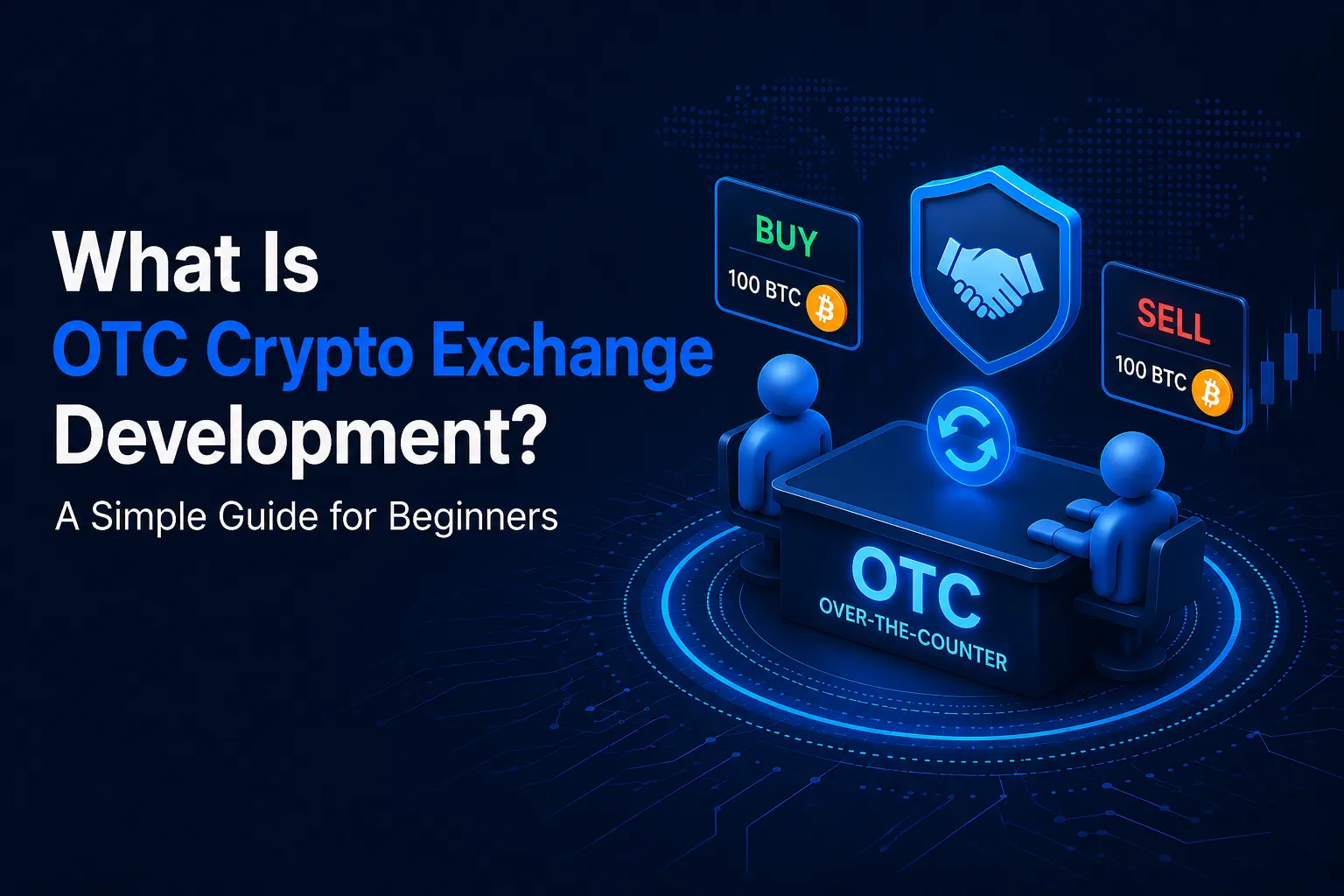

Most people think crypto trading only happens on public exchanges like Binance or Coinbase. But there's a completely different world running quietly in the background — OTC crypto trading.
OTC stands for Over-The-Counter. Instead of buying and selling through a public order book, OTC trades happen directly between two parties usually a buyer, a seller, and a trusted intermediary platform that makes it all work smoothly.
No price slippage. No market disruption. No public order book watching your every move.
If you've ever wondered how crypto whales, hedge funds, and institutions move millions of dollars worth of Bitcoin or Ethereum without crashing the market this is exactly how they do it.
How OTC Crypto Trading Actually Works
The process is simpler than most people expect.
A buyer contacts the OTC desk with a request — say, they want to purchase $5 million worth of ETH. The OTC platform connects them with a seller willing to offer that amount at an agreed price. The trade is negotiated privately, executed directly, and settled without ever touching the public order book.
No price impact. No market signal. No slippage eating into the deal.
The platform handles verification, compliance, settlement, and security making large trades fast, private, and clean.
Key Features Every OTC Platform Needs
Not all OTC platforms are built equal. The best ones share a common set of must-have features:
Private negotiation rooms where buyers and sellers communicate and agree on terms without public exposure.
Real-time price feeds pulling live market data so both parties can negotiate with accurate, up-to-the-second pricing.
Multi-currency support covering Bitcoin, Ethereum, stablecoins, and major altcoins so traders aren't limited.
KYC and AML compliance tools built directly into the platform to meet regulatory requirements without friction.
Secure escrow systems that hold funds safely during the negotiation and settlement window — so neither party can disappear mid-deal.
Fast settlement infrastructure that moves funds quickly once both parties confirm — because in crypto, speed is money.
Admin dashboards giving the platform operator full visibility over trades, users, compliance flags, and liquidity.
Why OTC Crypto Exchange Development Is Booming in 2026
The numbers tell the story. Institutional crypto adoption has accelerated dramatically. More hedge funds, family offices, and corporate treasuries are entering crypto — and they don't trade small amounts. They need private, large-volume execution that public exchanges simply can't provide cleanly.
OTC desks fill that gap perfectly.
Beyond institutions, high-net-worth individuals, crypto miners selling large block rewards, and early investors liquidating positions all turn to OTC platforms for the same reason — privacy, price certainty, and zero market impact.
For platform builders, this is a massive opportunity. The demand for reliable, secure, compliant OTC crypto exchange development is growing faster than the supply of quality platforms.
OTC vs Traditional Crypto Exchanges — The Real Difference
| Factor | OTC Exchange | Traditional Exchange |
|---|---|---|
| Trade Size | Large blocks ($100K+) | Any size |
| Price Impact | Zero | High for large orders |
| Privacy | Full | Public order book |
| Speed | Negotiated | Instant market orders |
| Slippage | None | Significant at scale |
| Compliance | Built-in, customized | Platform-standard |
For everyday retail traders, a traditional exchange works fine. But the moment you're moving serious volume, OTC becomes the only logical choice.
Who Actually Uses OTC Platforms?
The audience is broader than most people realize:
Crypto whales who need to move large amounts without signaling their intentions to the market.
Institutional investors — hedge funds, asset managers, family offices — entering or exiting large crypto positions.
Bitcoin miners converting block rewards into fiat or stablecoins in large batches without crashing the spot price.
Early-stage investors and VCs liquidating token positions from projects they backed.
Corporates managing treasury crypto holdings and needing reliable, compliant execution.
All of these users share one need: a platform they can trust with large amounts, built with proper security and compliance from the ground up.
The Technology Stack Behind a Solid OTC Platform
Building a serious OTC crypto exchange requires more than just a pretty interface. The technical foundations matter enormously:
Blockchain integration for secure, on-chain settlement across multiple networks.
Smart contract escrow to hold and release funds automatically when trade conditions are met — removing the need for manual trust.
Real-time liquidity APIs connecting to multiple market sources so pricing stays accurate even for unusual token pairs.
End-to-end encryption across all communication channels between counterparties.
Automated compliance tools — KYC verification, AML screening, transaction monitoring — running in the background on every trade.
Multi-signature wallet infrastructure ensuring no single point of failure controls platform funds.
Get the technology right and the platform runs smoothly at scale. Get it wrong and even one security gap can destroy everything you've built.
Security — The Non-Negotiable Foundation
OTC platforms handle larger individual transactions than almost any other type of crypto service. That makes security not just important — it makes it existential.
The biggest risks to address:
- Smart contract vulnerabilities — every line of escrow code needs independent audit before going live.
- Identity fraud — robust KYC prevents bad actors from using the platform to launder funds or manipulate trades.
- Man-in-the-middle attacks — encrypted communication channels between counterparties prevent trade details from being intercepted.
- Insider threats — role-based admin access with full audit logs limits damage from internal bad actors.
- Wallet security — hardware security modules, multi-signature authorization, and cold storage protocols for platform-held funds.
Two independent security audits minimum before launch. A bug bounty program running continuously after launch. These aren't optional — they're the price of operating at this level.
How Much Does OTC Crypto Exchange Development Cost?
- Costs vary significantly based on features, blockchain integrations, compliance requirements, and the development team you choose. Here's a realistic breakdown:
- Basic OTC platform — core trading desk, escrow, simple KYC, admin panel: $30,000–$60,000
- Mid-tier platform — multi-chain support, advanced compliance, liquidity integrations, mobile-friendly UI: $60,000–$120,000
- Enterprise-grade platform — full institutional feature set, custom compliance, API access, white-label options, dedicated security audits: $120,000–$300,000+
The right investment level depends entirely on your target market. Building for retail OTC needs different infrastructure than building for institutional desks.
The Biggest Challenges in OTC Exchange Development
- Liquidity sourcing — an OTC desk with no counterparty liquidity is useless. Building a network of reliable market makers and institutional partners is as important as the technology itself.
- Regulatory compliance — different jurisdictions have wildly different rules for OTC crypto operations. Building compliance flexibility in from day one saves expensive retrofitting later.
- Trust building — OTC trading is fundamentally a trust business. Platform reputation takes time to establish and one bad incident to destroy. Security and transparency are your marketing.
- Pricing accuracy — for large trades, even small pricing errors are expensive. Real-time, multi-source price feeds with fail-safes are essential.
- Settlement speed — institutional clients expect fast settlement. Slow or manual settlement processes will drive them to competitors.
Future Trends in OTC Crypto Trading
The OTC space in 2026 is evolving fast. Here's what's coming:
- Algorithmic OTC pricing — AI-powered pricing engines that calculate optimal rates in real time across multiple liquidity sources automatically.
- DeFi-integrated OTC desks — hybrid platforms combining the privacy and negotiation of OTC with the settlement efficiency of decentralized protocols.
- Tokenized real-world assets — OTC desks expanding beyond crypto to handle large-block trades of tokenized stocks, bonds, and real estate.
- Cross-border institutional settlement — OTC platforms becoming the preferred rail for international value transfer between institutional players.
- Regulatory clarity driving volume — as crypto regulation becomes clearer globally, more institutional capital will flow through compliant OTC platforms.
The OTC market is not shrinking. It's professionalizing and the platforms built with proper infrastructure today will capture the institutional volume of tomorrow.
Final Thoughts
OTC crypto exchange development is one of the most commercially compelling opportunities in the blockchain space right now. The demand is real, the audience is high-value, and the gap between what the market needs and what currently exists is significant.
If you're serious about building in this space or you're an investor, institution, or entrepreneur evaluating OTC as a business opportunity the most important thing you can do is understand what a well-built platform actually requires.
For a complete, practical breakdown of everything that goes into OTC crypto exchange development from technical architecture to compliance to launch strategy — this is the resource to start with: OTC Crypto Exchange DevelopmentThe market is ready. The technology is mature. The opportunity is now.

























Sign in to leave a comment.