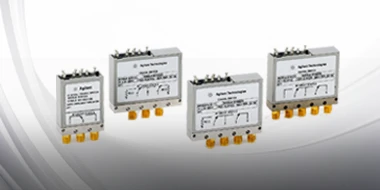

An RF switch is a device to route high frequency signals through transmission paths. RF (radio frequency) and microwave switches are used extensively in microwave test systems for signal routing between instruments and devices under test (DUT). Incorporating a switch into a switch matrix system enables you to route signals from multiple instruments to single or multiple DUTs. This allows multiple tests to be performed with the same setup, eliminating the need for frequent connects and disconnects. The entire testing process can be automated, increasing the throughput in high-volume production environments.
Like other electrical switches, RF and microwave switches provide different configurations for many different applications. Below is a list of typical switch configurations and usage:
Single pole, double throw (SPDT or 1:2) switches route signals from one input to two output paths.
Single pole double throw (SPDT) switch from Agilent Technologies
Multiport switches or single pole, multiple throw (SPnT) switches allow a single input to multiple (three or more) output paths.
Transfer switches or double pole, double throw (DPDT) switches can serve various purposes.
Bypass switches insert or remove a test component from a signal path.
Typical application of a 4-port bypass switch
RF CMOS switches are crucial to modern wireless telecommunication, including wireless networks and mobile communication devices. Infineon's bulk CMOS RF switches sell over 1 billion units annually, reaching a cumulative 5 billion units
RF (Radio Frequency) switches are vital components in the realm of electronic circuits, particularly in systems that deal with wireless communication. The central role of RF switches is to route high-frequency signals through specific paths in an electronic circuit.
They are available in two distinct types: electromechanical and solid state. Electromechanical RF switches are typically used for low-frequency applications, while solid-state switches are more suitable for higher frequency uses. In this piece, we’ll delve into the fundamental features, types, and applications of these essential components.
Types of RF Switches
Electromechanical RF Switches: These switches involve mechanical components and hence tend to be larger. They are known for their robustness and reliability over a long lifespan, but their switching speed is slower compared to solid-state switches.
Solid State RF Switches: These switches utilize semiconductor technologies, making them smaller and faster. They are preferred for high-frequency applications where quick switching times are required. However, their lifespan might be shorter than their electromechanical counterparts due to potential wear and tear at the semiconductor level.
Applications of RF Switches
RF switches play a pivotal role in various industries, ranging from telecommunication to aerospace and defense. Their prime function is to control signal paths in RF systems. This feature is indispensable in a multitude of applications, such as:
Test and Measurement: RF switches are widely used in test equipment to connect multiple inputs to a single output. This facilitates easy and quick signal routing and allows for efficient testing of multiple devices.
Wireless Communication: In communication systems, RF switches are employed to route signals between the antenna and transceiver. They also aid in the switching between transmit and receive modes, allowing devices to operate effectively in full duplex mode.
This is the crux of RF switches, their types, and some of their applications. In the following part, we will dive deeper into their working mechanism, key specifications, and the future prospects of RF switches in the world of electronics.
Working Mechanism of RF Switches
Irrespective of the type, the underlying principle of RF switches is to route the incoming RF signal to one or multiple desired output paths. For an electromechanical switch, this is achieved physically by connecting or disconnecting the internal conductive path. On the other hand, a solid-state RF switch operates based on electronic controls to change the state of semiconductor materials, thereby altering the signal path.
Key Specifications of RF Switches
When choosing an RF switch for specific applications, several key specifications need to be considered:
Frequency Range: This indicates the range of frequencies that the switch can handle effectively without significant loss or distortion.
Insertion Loss: It refers to the loss of signal power resulting from the insertion of a device in a transmission line. Lower insertion loss is desirable for efficient performance.
Isolation: This is the degree to which the signals are prevented from leaking across the switch. Higher isolation ensures better performance.
Switching Speed: It is the time taken by the switch to change its state from ON to OFF or vice versa. Faster switching speeds are preferred in high-frequency applications.
Absorption RF switch: With the continuous development of wireless communication technology, the performance requirements of absorptive RF switches are getting higher and higher. The future development trends mainly include further reducing insertion loss, improving isolation and linearity, and achieving higher integration and smaller size. At the same time, in order to meet the needs of 5G and future communication systems, absorptive RF switches also need to have a wider frequency band and faster switching speed.
Reflective RF switch: Reflective RF switch has unique advantages in high-frequency, high-speed and high-power applications. In the future, it will develop towards higher operating frequencies, greater power capacity and faster switching speeds. In terms of technology, it will continue to explore new micro-nano processing technologies and materials to improve the performance and reliability of switches.
The Future of RF Switches
As we move towards a more digitally interconnected world, the demand for RF switches continues to grow. Emerging technologies such as 5G, IoT (Internet of Things), and MIMO (Multiple-Input Multiple-Output) systems are pushing the boundaries of RF switch design. Furthermore, advancements in semiconductor materials like Gallium Nitride (GaN) and Silicon Carbide (SiC) are paving the way for more efficient and reliable RF switches.
Conclusion
In conclusion, RF switches are integral components of any electronic system dealing with radio frequency signals. Their ability to route signals effectively and quickly, coupled with their high isolation and low insertion loss, make them indispensable in the rapidly evolving technology landscape. As wireless communication systems continue to evolve and demand faster, more efficient signal routing, the role of RF switches is bound to become even more significant. The future of RF switches is bright and holds immense potential, reflecting their crucial role in our increasingly interconnected world.




























Sign in to leave a comment.