
Heat exchangers don't exactly make for exciting dinner conversation, but if you're designing HVAC systems, managing industrial processes, or specifying equipment for your facility, understanding the difference between counter flow and parallel flow configurations matters tremendously.
These aren't just academic distinctions that engineers argue about over coffee. The flow pattern you choose directly impacts efficiency, operating costs, equipment size, and whether your system actually delivers the performance you need. Let's break down these two approaches and figure out which one belongs in your application.
The Basic Setup
Before we dive into differences, let's establish what we're talking about when we discuss flow patterns in heat exchangers.
Every heat exchanger facilitates thermal energy transfer between two fluids without mixing them. Hot fluid gives up heat to cold fluid through a separating wall—usually metal tubes or plates. Simple concept, but how those fluids move relative to each other changes everything about performance.
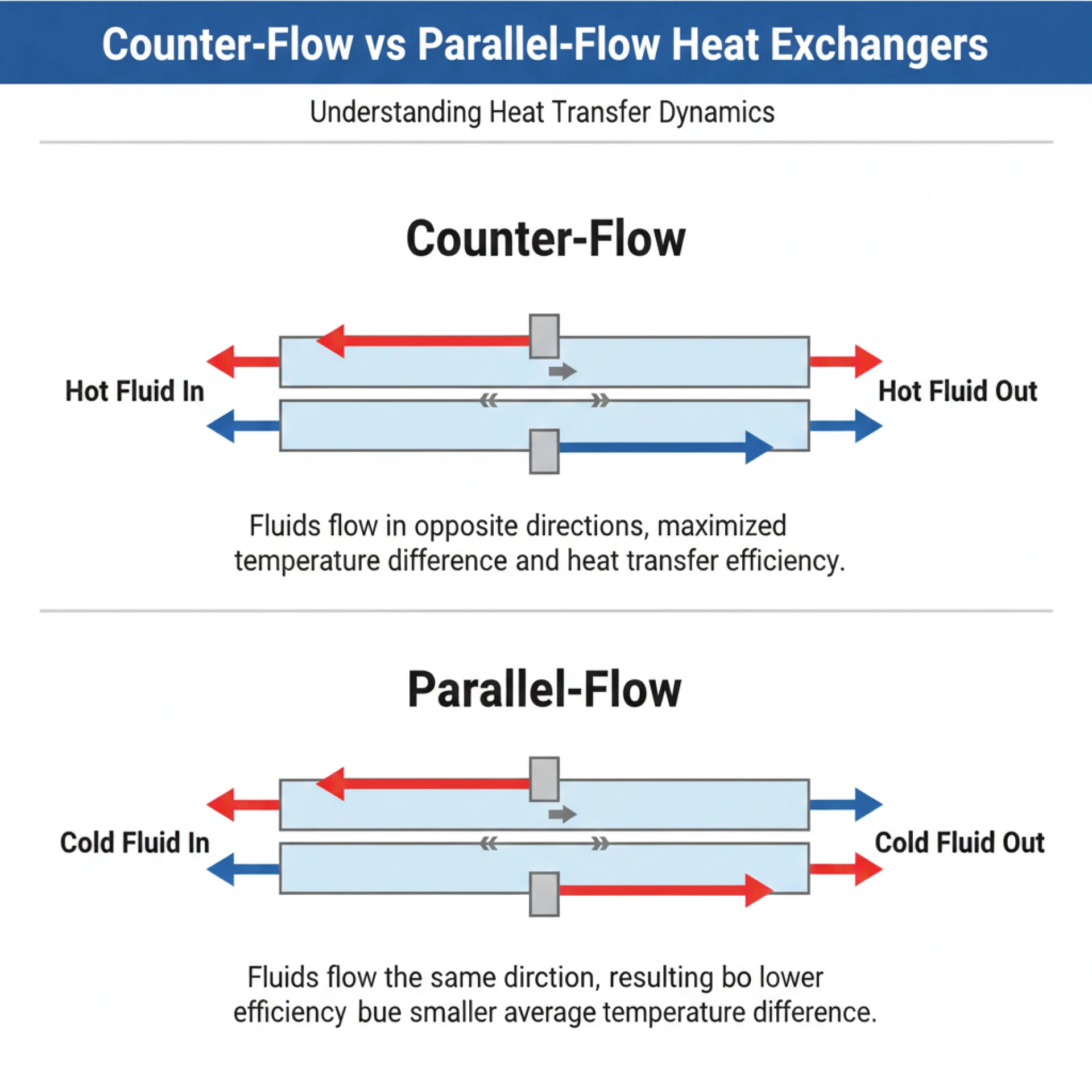
In parallel flow heat exchangers, both fluids enter at the same end and flow in the same direction through the unit. They travel alongside each other, exchanging heat as they move toward the exit at the opposite end.
Counter flow heat exchangers work differently. The hot fluid enters at one end while the cold fluid enters at the opposite end. They flow in opposite directions, passing each other as they move through the exchanger. Hot fluid exits where cold fluid enters, and vice versa.
That directional difference seems minor on paper, but it creates dramatically different thermal and operational characteristics.
Temperature Profiles Tell the Story
The real distinction between these configurations becomes clear when you map out temperature changes through the heat exchanger.
In parallel flow systems, both fluids enter at the same location. The hot fluid is at its maximum temperature, and the cold fluid is at its minimum temperature. This creates the largest possible temperature difference at the inlet, driving rapid heat transfer initially.
As the fluids move through the exchanger together, the hot fluid cools down while the cold fluid warms up. The temperature difference between them shrinks continuously as they approach the outlet. By the time they exit, that temperature difference has decreased substantially, which means the driving force for heat transfer has weakened.
Here's the critical limitation: in parallel flow, the cold fluid can never exit hotter than the hot fluid exits. The exit temperatures of both fluids approach each other but meet somewhere in the middle. You're leaving thermal potential on the table because physics won't let you extract more heat with this configuration.
Counter flow changes this game entirely. The cold fluid exits where the hot fluid enters, experiencing the hottest possible temperatures right before leaving the exchanger. The hot fluid exits where cold fluid enters, being cooled by the coldest possible fluid right before it leaves.
This arrangement maintains a more consistent temperature difference throughout the entire length of the exchanger. Instead of starting with a huge temperature difference that shrinks to almost nothing, counter flow maintains a relatively steady temperature differential from inlet to outlet.
The result? The cold fluid can exit at a temperature very close to—or even theoretically exceeding—the hot fluid's inlet temperature. You're extracting far more thermal energy from the hot fluid than parallel flow could ever achieve.
Efficiency Numbers Don't Lie
Let's talk real performance metrics because theory only matters if it translates to measurable benefits.
Counter flow heat exchangers consistently achieve higher effectiveness ratings than parallel flow units of comparable size. Effectiveness measures how much actual heat transfer occurs compared to the theoretical maximum possible. Counter flow regularly hits 90% effectiveness or higher in well-designed systems.
Parallel flow typically tops out around 50-60% effectiveness, even with excellent design and construction. That's not a flaw in engineering—it's a fundamental limitation of the flow pattern. You simply cannot extract as much heat when fluids flow in the same direction.
For a heat exchanger manufacturer, this effectiveness difference has huge implications. If you need to transfer a specific amount of thermal energy, a parallel flow unit needs to be significantly larger than a counter flow unit handling the same load. More surface area, more material, higher cost.
Any reputable heat exchanger manufacturer in India or anywhere else will tell you that counter flow designs deliver better bang for your buck when maximum heat recovery is the goal. The physics are non-negotiable.
When Parallel Flow Makes Sense
Given counter flow's clear efficiency advantage, why does parallel flow even exist? Because efficiency isn't always the only consideration.
Parallel flow excels in situations where you need to limit the outlet temperature of your cold fluid. Sometimes heating a fluid too much creates problems—maybe it'll damage downstream equipment, trigger unwanted chemical reactions, or exceed safe handling temperatures.
The self-limiting nature of parallel flow becomes an advantage here. Since the cold fluid can never exit hotter than the hot fluid exits, you have a built-in temperature ceiling. This provides a safety margin in processes where thermal runaway could be dangerous.
Manufacturing simplicity is another factor. Parallel flow heat exchangers are often easier to design and build because both inlet and outlet connections can be located on the same end of the unit. This simplifies piping, reduces installation complexity, and can make maintenance access easier in tight spaces.
Some cooling solutions specifically benefit from parallel flow's characteristics. When you need rapid initial cooling followed by gentler temperature reduction, the decreasing temperature differential of parallel flow actually matches the process requirements perfectly.
Thermal stress considerations matter too. Parallel flow subjects the exchanger materials to more uniform temperature gradients throughout the unit. Counter flow creates higher temperature differentials that can induce thermal expansion stresses, especially problematic with certain materials or in high-temperature applications.
Counter Flow Dominance
For most industrial, commercial, and HVAC applications, counter flow is the clear winner.
Energy recovery systems overwhelmingly favor counter flow because maximum heat extraction is the entire point. Whether you're recovering waste heat from exhaust gases, preheating boiler feedwater, or capturing thermal energy from industrial processes, you want every possible BTU transferred.
HVAC applications like water-to-water heat pumps, chilled water systems, and hydronic heating loops almost universally employ counter flow exchangers. The efficiency gains directly translate to lower operating costs over the system's lifetime.
Process industries including chemical manufacturing, petrochemical refining, and food processing rely heavily on counter flow heat exchangers. These operations involve expensive energy inputs, so maximizing heat recovery has direct bottom-line impact.
Even in specialized applications like telecom unit cooling systems where space is limited and efficiency is critical, counter flow designs dominate. Telecom shelters generate substantial heat that needs removal in compact equipment footprints—counter flow delivers maximum cooling capacity in minimum space.
The effectiveness advantage means smaller, lighter, and often cheaper heat exchangers for a given duty. Less material means lower manufacturing costs. Smaller size means reduced shipping expenses and easier installation. These benefits accumulate across a project's lifecycle.
Design Considerations and Trade-offs
Choosing between counter flow and parallel flow involves evaluating several factors beyond pure thermal efficiency.
Pressure drop characteristics differ between configurations. Counter flow typically creates slightly higher pressure drops because the temperature-dependent viscosity changes work against flow in certain sections. For applications where pumping power is a major concern, this matters.
Fouling patterns also vary. Parallel flow tends to deposit contaminants more heavily near the inlet where temperature differences are greatest. Counter flow distributes fouling more evenly throughout the exchanger. Depending on your fluid characteristics, one pattern might offer easier maintenance than the other.
Material selection interacts with flow pattern. The higher thermal effectiveness of counter flow means greater temperature extremes within the exchanger, which might require more expensive materials in certain sections. Parallel flow's lower thermal stress might allow cheaper materials while still meeting performance requirements.
Installation orientation sometimes dictates flow pattern. If your piping configuration strongly favors inlet and outlet connections on the same end, parallel flow simplifies the installation even if it sacrifices some efficiency. Real-world constraints occasionally trump theoretical optimization.
Control and turndown capability differ too. Counter flow systems can maintain efficiency across wider operating ranges, while parallel flow performance degrades more dramatically at partial loads. If your system operates at varying capacities, this affects which configuration serves you better.
Industry-Specific Considerations
Different industries weight these factors differently based on their unique priorities.
Power generation favors counter flow almost exclusively. Every percentage point of efficiency improvement reduces fuel consumption across megawatts of capacity. The capital cost premium for counter flow exchangers pays back quickly through operating savings.
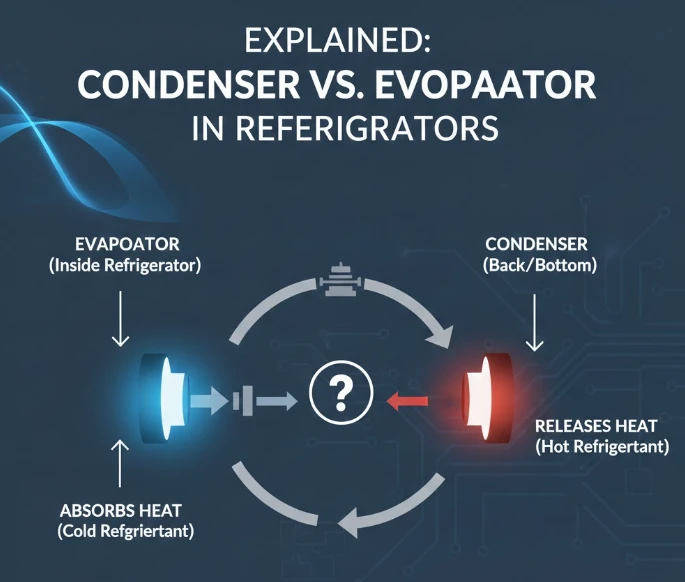
Refrigeration and air conditioning applications mix both types depending on specific needs. Condenser and evaporator designs often employ counter flow for maximum efficiency, but certain defrost or capacity control schemes might incorporate parallel flow elements.
Marine applications face space and weight constraints that favor counter flow's compact efficiency. Ships can't afford to waste energy or carry unnecessarily large equipment, making high-effectiveness heat exchangers essential.
Food and beverage processing must balance efficiency with sanitary concerns. Sometimes parallel flow's simpler construction offers easier cleaning validation even if it sacrifices thermal performance. Safety and hygiene can outweigh energy optimization in these industries.
Making Your Decision
Stop overthinking the theoretical aspects and focus on what actually matters for your application.
If maximum heat transfer is your priority and you have no compelling reasons to limit outlet temperatures, choose counter flow. You'll get better performance, smaller equipment, and lower long-term operating costs. This covers probably 80% of heat exchanger applications.
If you need to limit cold fluid outlet temperatures for safety or process reasons, or if installation constraints heavily favor same-end connections, consider parallel flow despite its efficiency penalty. Sometimes practical constraints outweigh theoretical optimization.
For critical applications involving substantial energy costs or where equipment size directly impacts project feasibility, run detailed calculations comparing both options. Small differences in effectiveness can have huge financial implications over equipment lifetimes measured in decades.
Work with qualified engineers who understand both configurations and can evaluate your specific requirements. A competent heat exchanger manufacturer will help you make informed decisions based on your actual operating conditions, not just generic recommendations.
Your heat exchanger will run for years or decades. Take the time to choose the right configuration now, because changing your mind later means replacing expensive equipment. Get it right the first time, and that heat exchanger becomes an asset that quietly delivers value every single day it operates.



























Sign in to leave a comment.