
Refrigerators look simple from the outside. You plug them in, set the temperature, and trust them to keep food fresh. Inside, however, a carefully coordinated process is at work. Two components play the most critical roles in this process: the condenser and the evaporator. They never touch each other, they perform opposite functions, and yet they depend entirely on one another.
Understanding how these two parts work, and how they differ, makes it much easier to grasp how refrigeration systems actually cool. This blog breaks down the roles of the condenser and evaporator in clear, practical terms, without getting overly technical.
How Refrigeration Really Works?
Before comparing the condenser and evaporator, it helps to understand the basic refrigeration cycle. A refrigerator does not create cold air. Instead, it removes heat from inside the cabinet and releases it outside.
This heat transfer happens because a refrigerant circulates through the system, changing pressure and state from liquid to gas and back again. The evaporator absorbs heat. The condenser releases it. The continuous movement between these two components keeps the refrigerator running efficiently.
What Is a Condenser in a Refrigerator?
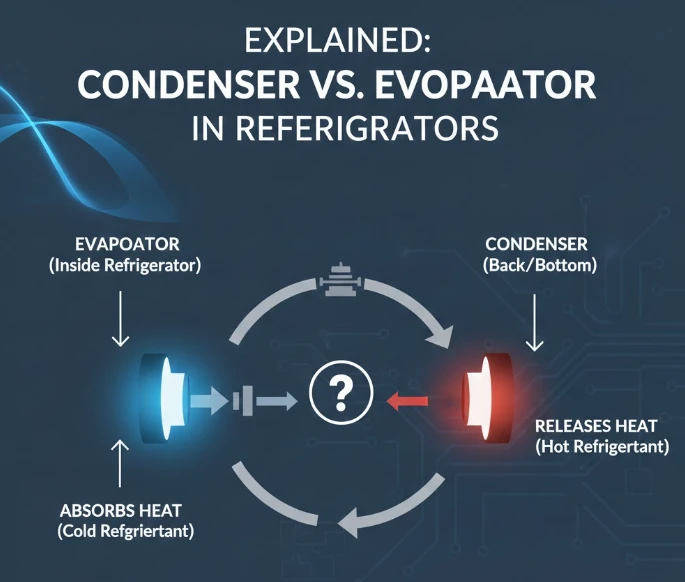
The condenser is the part of the refrigerator responsible for releasing heat. It is usually located at the back of the unit or underneath it. When refrigerant leaves the compressor, it is hot and under high pressure. The condenser’s job is to get rid of that heat.
In simple terms, the condenser in refrigeration system acts as a heat rejection unit. As the hot refrigerant passes through the condenser coils, it releases heat to the surrounding air. As it cools down, the refrigerant changes from a gas into a liquid.
This step is essential. If the refrigerant does not release enough heat here, the entire cooling process becomes inefficient.
Understanding the Refrigeration Condenser Coil
The refrigeration condenser coil is designed to maximize heat transfer. Its long, winding structure increases surface area, allowing heat to escape more easily. Air flowing across the coils helps carry the heat away.
Dust, grease, or poor airflow can reduce the coil’s effectiveness. When that happens, the refrigerator has to work harder, which increases energy consumption and shortens component life. This is why condenser coil cleaning is often recommended during maintenance.
What Is an Evaporator in a Refrigerator?
If the condenser releases heat, the evaporator does the opposite. The evaporator absorbs heat from inside the refrigerator. It is usually located inside the freezer compartment or hidden behind interior panels.
The evaporator in the refrigeration system operates at low pressure. When liquid refrigerant enters the evaporator, it expands and evaporates into a gas. During this change of state, it absorbs heat from the surrounding air. That heat absorption is what lowers the temperature inside the refrigerator.
As warm air passes over the evaporator coils, it cools down and is circulated back into the cabinet. This continuous process maintains the set temperature.
Why the Evaporator Is Key to Cooling Performance?
The evaporator directly affects how evenly and effectively a refrigerator cools. If the evaporator coil is damaged, frosted over, or blocked by poor airflow, cooling becomes inconsistent. Some areas may feel colder than others, while food spoilage becomes more likely.
Proper airflow across the evaporator is just as important as the refrigerant itself. Fans help move air over the coil, ensuring steady and balanced cooling throughout the refrigerator.
Condenser vs. Evaporator: The Core Difference
The simplest way to understand the difference between condenser and evaporator is to look at their roles in heat movement.
The evaporator absorbs heat from inside the refrigerator, creating the cooling effect. The condenser releases that same heat outside the refrigerator, preventing heat buildup within the system. One works on the cold side. The other works on the hot side.
They also operate under very different pressure conditions. The evaporator handles low-pressure refrigerant, while the condenser handles high-pressure refrigerant. This contrast is what allows the refrigerant cycle to function properly.
How Condenser and Evaporator Work Together?
Although their functions are opposite, the condenser and evaporator are closely connected. Heat absorbed by the evaporator must be released by the condenser. If one fails or underperforms, the other cannot compensate.
For example, a dirty condenser coil prevents heat from escaping. This causes refrigerant pressure to rise, making it harder for the evaporator to absorb heat effectively. Similarly, a faulty evaporator reduces heat absorption, even if the condenser is working perfectly.
Balanced performance between these two components is critical for efficient refrigeration.
What Is an Evaporative Condenser?
In some refrigeration systems, especially outside domestic refrigerators, heat rejection is handled differently. An evaporative condenser is used when higher efficiency is required in large or industrial systems.
Instead of relying only on air to remove heat, an evaporative condenser uses water evaporation to enhance heat transfer. This method is more efficient in large-scale refrigeration, particularly in hot climates or high-load applications.
Domestic refrigerators usually do not use evaporative condensers, but understanding the concept highlights how condenser design varies based on system size and demand.
Placement Differences in Refrigerators
The evaporator is always located inside the refrigerated space or directly connected to it. This placement allows it to absorb heat from food compartments efficiently.
The condenser, on the other hand, is placed outside the cooled space. This ensures that released heat does not re-enter the refrigerator. Its external placement is intentional and essential for maintaining cooling efficiency.
Maintenance Impact on Condenser and Evaporator
Both components require proper maintenance, but the condenser is more exposed to dust and debris. Over time, clogged condenser coils reduce heat release, forcing the compressor to work harder.
Evaporators face different issues. Frost buildup, airflow blockage, or fan failure can reduce their ability to absorb heat. Regular defrost cycles and proper airflow design help prevent these problems.
Maintaining both components ensures stable temperatures, lower energy consumption, and longer appliance life.
Energy Efficiency and System Balance
Modern refrigerators are designed to optimize the interaction between condenser and evaporator. Improvements in coil design, airflow management, and refrigerant selection have significantly improved energy efficiency.
When both components operate efficiently, the compressor runs less frequently, power consumption drops, and cooling remains consistent. This balance is one of the main reasons newer refrigerators outperform older models in energy ratings.
Conclusion
The condenser and evaporator are the backbone of every refrigerator. One absorbs heat from inside the cabinet, while the other releases it outside. Their roles are opposite, but their relationship is inseparable.
Understanding how these components function, how they differ, and how they depend on each other provides a clearer picture of refrigeration as a whole. Whether you are maintaining a household refrigerator or learning the fundamentals of cooling systems, knowing the roles of the condenser and evaporator helps you appreciate the precision behind everyday refrigeration.


























Sign in to leave a comment.