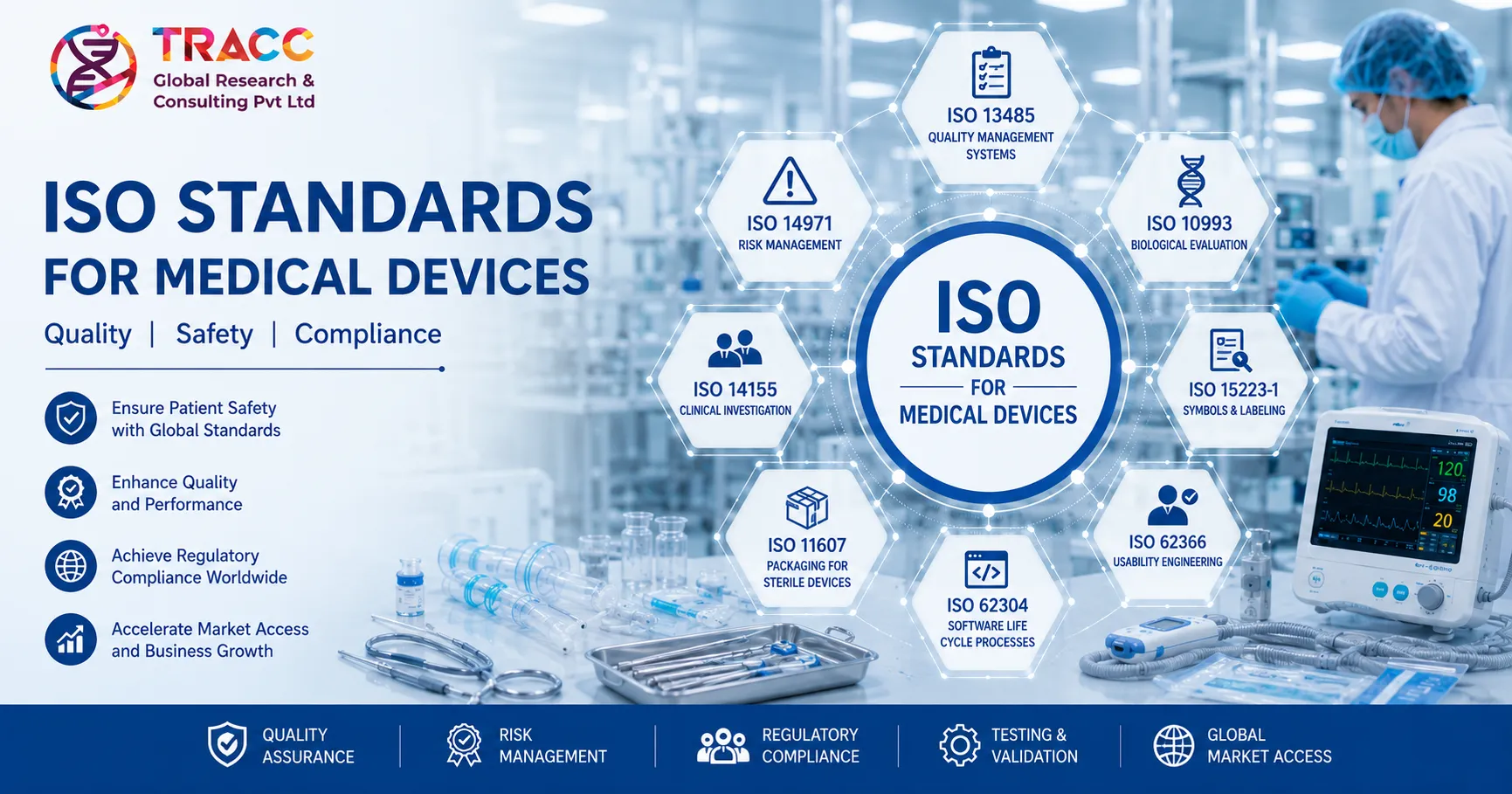

Medical devices play a critical role in modern healthcare, making quality, safety, and regulatory compliance essential throughout their lifecycle. To help manufacturers meet these expectations, the medical device industry relies on internationally recognized ISO standards. These standards provide structured frameworks for quality management, risk control, product safety, clinical evaluation, and regulatory compliance.
Understanding and implementing the appropriate ISO standards can help manufacturers improve product reliability, reduce compliance risks, and gain access to global markets.
Why ISO Standards Matter in the Medical Device Industry
ISO standards establish globally accepted best practices for designing, manufacturing, testing, and distributing medical devices. Regulatory authorities across major markets often recognize or reference these standards when evaluating medical devices.
Benefits of implementing ISO standards include:
- Improved product quality and consistency
- Enhanced patient and user safety
- Stronger regulatory compliance
- Better risk management
- Increased market acceptance
- Greater operational efficiency
Organizations that follow ISO standards are generally better positioned to meet regulatory requirements and maintain compliance throughout the product lifecycle.
ISO 13485: Quality Management Systems for Medical Devices
ISO 13485 is the most widely recognized quality management system (QMS) standard specifically developed for medical device organizations.
Key Requirements
ISO 13485 focuses on:
- Quality management documentation
- Design and development controls
- Supplier qualification and management
- Manufacturing process controls
- Complaint handling procedures
- Corrective and preventive actions (CAPA)
- Product traceability
- Regulatory compliance management
Benefits of ISO 13485
Implementing ISO 13485 helps organizations:
- Maintain consistent product quality
- Improve process efficiency
- Strengthen customer confidence
- Support global market access
- Demonstrate regulatory readiness
Many regulatory frameworks consider ISO 13485 certification a valuable indicator of a manufacturer’s quality management capabilities.
ISO 14971: Risk Management for Medical Devices
Risk management is a fundamental requirement in the medical device industry. ISO 14971 provides a systematic process for identifying, evaluating, controlling, and monitoring risks associated with medical devices.
Core Risk Management Activities
The standard requires manufacturers to:
- Identify hazards
- Analyze risks
- Evaluate risk acceptability
- Implement risk control measures
- Verify control effectiveness
- Monitor post-market risks
Importance of ISO 14971
By following ISO 14971, manufacturers can:
- Improve patient safety
- Reduce product failures
- Minimize recalls and corrective actions
- Support regulatory submissions
- Strengthen overall product reliability
Risk management should be integrated throughout the device lifecycle, from development to post-market surveillance.
ISO 10993: Biological Evaluation of Medical Devices
ISO 10993 focuses on the biological safety of medical devices that come into direct or indirect contact with the human body.
Purpose of ISO 10993
This standard helps manufacturers evaluate:
- Cytotoxicity
- Sensitization
- Irritation
- Systemic toxicity
- Biological compatibility
Biocompatibility testing is often required to demonstrate that materials used in medical devices are safe for their intended use.
ISO 14155: Clinical Investigation of Medical Devices
ISO 14155 establishes requirements for conducting clinical investigations involving human participants.
Key Areas Covered
The standard addresses:
- Clinical study planning
- Ethical considerations
- Patient safety protection
- Data collection procedures
- Clinical evidence generation
Compliance with ISO 14155 helps ensure that clinical investigations are scientifically valid and ethically conducted.
ISO 11607: Packaging Requirements for Sterile Medical Devices
Sterile medical devices require packaging systems capable of maintaining sterility until the point of use.
Objectives of ISO 11607
The standard focuses on:
- Packaging design validation
- Sterile barrier systems
- Packaging performance testing
- Transportation and storage protection
Proper packaging helps preserve product integrity and patient safety throughout distribution.
Meeting Global Regulatory Requirements Through ISO Compliance
Many regulatory authorities reference ISO standards as part of their compliance expectations.
Examples include:
- United States FDA regulations
- European Union Medical Device Regulation (MDR)
- UK medical device regulations
- Health Canada requirements
- Australia TGA regulations
- Various international market authorization frameworks
While ISO certification alone does not guarantee regulatory approval, it often supports regulatory submissions and demonstrates a commitment to quality and safety.
Conclusion
ISO standards provide the foundation for quality, safety, and regulatory compliance in the medical device industry. Standards such as ISO 13485, ISO 14971, ISO 10993, ISO 14155, and ISO 11607 help manufacturers manage quality systems, control risks, evaluate safety, conduct clinical investigations, and maintain product integrity.
By implementing these standards effectively, medical device manufacturers can improve compliance, strengthen patient safety, and support successful market access across global healthcare markets.




















Sign in to leave a comment.