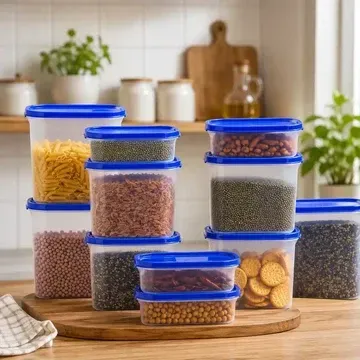

Plastic is widely used for storing food, but not every type of plastic is designed for direct contact with what we eat. Food-grade plastic is specifically intended for applications involving food storage, handling, and organisation. Understanding what separates food-grade plastic containers from ordinary plastic products can help people make more informed choices for everyday kitchen use.

The difference is not simply about appearance, thickness, or transparency. It primarily comes down to the type of material used, its intended application, manufacturing considerations, and suitability for contact with food.
What Does Food-Grade Plastic Mean?
Food-grade plastic refers to plastic material considered suitable for coming into contact with food under its intended conditions of use. It is selected and manufactured with food contact in mind rather than being designed for general household, industrial, or non-food purposes.
This distinction is important because plastic products can be manufactured for many different applications. A container designed for hardware, cleaning supplies, or general organisation may look similar to a food storage box, but that does not automatically make it appropriate for storing ingredients or prepared meals.
Food-grade plastic containers are specifically intended to provide a suitable surface for direct food contact.
They Are Made for Direct Food Contact
One of the biggest differences is their intended purpose. Food storage products may regularly come into contact with dry ingredients, snacks, cooked foods, fruits, vegetables, and other everyday kitchen items.
Because of this direct contact, plastic containers intended for food use require materials that are appropriate for that purpose. The composition of the plastic matters because the container may remain in contact with food for several hours, days, or even longer depending on what is being stored.
Ordinary plastic products, on the other hand, may be manufactured without food storage being considered at all.
Material Composition Matters
Plastic is not one single material. Different plastic types have different characteristics, including flexibility, rigidity, clarity, durability, and resistance to different conditions.
For food-grade applications, the material should be appropriate for its intended contact with food. Manufacturers must therefore consider more than how a container looks or feels. The plastic formulation, additives, pigments, and other components used in production can all be relevant to its suitability.
This is one reason consumers should not assume that any box made from plastic can automatically be repurposed for food storage.
Food-Grade Does Not Mean Every Container Has the Same Properties
A common misconception is that the term "food-grade" tells you everything about how a container can be used. In reality, it mainly relates to suitability for food contact under intended conditions.
Two food-grade plastic containers can still have very different characteristics. One might be intended primarily for dry food storage, while another may be designed for refrigerator use or everyday meal storage.
Similarly, food-grade status alone does not automatically mean a product is suitable for microwaving, freezing, dishwashing, or exposure to high temperatures. These are separate characteristics that depend on the specific material and product design
Food-Grade Plastic Is Different From General-Purpose Plastic
General-purpose plastic items are manufactured for a much wider range of applications. They may be intended for stationery, tools, household accessories, cleaning products, or general organisation.
Even when these products resemble plastic containers used in the kitchen, their intended application is different. Their materials may not have been selected specifically for prolonged or direct food contact.
That is why visual similarity is not enough to determine whether a plastic item should be used for storing food. The intended use of the product matters just as much as its shape or design.
Manufacturing Considerations Are Important
The distinction also extends to the way a food-contact product is manufactured. When a container is intended to hold food, the materials and production process need to be appropriate for that application.
Consistency is particularly important because food may touch the container's base, walls, lid, and other contact surfaces. Plastic containers intended for kitchen storage are therefore manufactured as food-contact products rather than simply being generic plastic boxes that happen to fit food inside them.
This purpose-driven approach is one of the fundamental differences between food-grade and ordinary plastic products.
Why Reusing Random Plastic Packaging Is Not the Same
People sometimes reuse plastic boxes or packaging simply because they appear strong enough to hold food. However, physical durability does not determine whether a material is appropriate for repeated food storage.
A container can be sturdy, transparent, lightweight, and easy to close without necessarily being intended for long-term or repeated contact with food.
Purpose-made plastic containers remove much of this uncertainty because their intended function is clear. Instead of judging a container only by appearance, users can consider whether it was actually designed for food storage.
Food-Grade and Food-Safe Are Often Confused
The terms "food-grade" and "food-safe" are sometimes used interchangeably in everyday conversation, but there is a useful distinction to understand.
Food-grade generally refers to the suitability of the material for food contact. Safe use also depends on whether the product is being used according to its intended conditions. A container intended for room-temperature storage, for example, should not automatically be assumed suitable for high-temperature applications.
This is why usage instructions remain important even when buying food-grade plastic containers.
How Can You Identify the Right Container for Food?
Rather than relying only on colour, thickness, or appearance, check whether the product is specifically intended for food storage. Product information can also clarify whether it has additional characteristics relating to refrigeration, heating, freezing, or cleaning.
Avoid assuming that every plastic item is interchangeable. Plastic containers designed for food use should be chosen according to both the type of food being stored and the conditions in which the container will be used.
Final Thoughts
What makes food-grade plastic different is primarily its intended suitability for direct food contact. It is not simply a marketing term for plastic that looks cleaner, thicker, or more durable.
The material selection, intended application, manufacturing considerations, and recommended usage conditions all help distinguish food-grade products from general-purpose plastic items. At the same time, food-grade does not automatically mean suitable for every temperature or appliance.
Choosing plastic containers specifically intended for food storage, and using them according to their stated purpose, provides a more appropriate approach than repurposing random plastic products based solely on their appearance.

























Sign in to leave a comment.