

Neha Kulkarni has two coils of wire on her test bench in Vasai, and from where she stands, they look the same. Both are red, both are fine stranded, and both labels promise a high heat rating. Her company launches a new line of commercial ovens in a few weeks, and the internal wiring spec still needs her signature. That wiring will sit a short distance from the heating elements for years.
Kitchens are getting hotter too. India's weather office reported 2024 as the country's warmest year since national records began in 1901, and equipment keeps shrinking, which pushes wires closer to the heat. So which coil does she trust?
The answer starts with understanding why silicon wire behaves the way it does when temperatures climb.
Why Heat Wears Down Ordinary Insulation Sooner Than Buyers Expect
To see why Neha needed to think twice, it helps to start with the wire most factories already use.
What Happens Inside PVC as the Temperature Climbs
Most general-purpose wire uses PVC insulation. It is affordable, easy to process, and perfectly good at room temperature. To keep PVC soft, manufacturers blend in plasticisers. Heat slowly drives those plasticisers out, so the insulation hardens and eventually cracks, usually where the wire bends. A proper heat-resistant wire is designed so this process doesn't begin at the temperatures your equipment actually reaches.
The Temperature Ceiling Written Into the Standards
Standards put numbers on this, IEC 60502-1 sets 70°C as the maximum conductor temperature for PVC insulated cables in normal operation. Heat resisting PVC grades under Indian standards go up to around 85°C, that sounds like plenty until you measure the inside of an oven body, where the panel behind a heating element runs far hotter than the kitchen around it.
Where Neha Spotted the Gap on Her Spec Sheet
Neha's team built its previous ovens with heat resisting PVC wire, and it worked because the wiring ran through a cooler side compartment. The new model is smaller. To save space, the designers moved the terminal block closer to the elements. Nothing had gone wrong, and she wanted to keep it that way. She realised the old wire choice had been made for a layout that no longer existed.
So the real question was never whether PVC is good wire. It was whether the material still matched where the wire would sit, and that led her straight to silicone.
The Chemistry Behind Silicone's Staying Power
Why does silicone cope with heat so much better? The answer sits at the level of atoms, and it is simpler than it sounds.
A Backbone Made of Silicon and Oxygen
Most plastics used in insulation are built on long chains of carbon atoms. Silicone rubber is different. Its chain alternates silicon and oxygen atoms, with small carbon groups attached along the sides. That backbone is the main reason a Silicone Insulated Wire holds its shape and softness at temperatures where carbon-based insulation starts to break down.
What the Bond Energy Numbers Tell Us
Chemists measure how much energy it takes to break the link between two atoms. Reference tables put the silicon and oxygen bond at roughly 452 kJ per mole, while a carbon-to-carbon bond sits near 348 kJ per mole. In plain terms, heat has to work much harder to pull a silicone chain apart. This is also why IEC 60245-3, the standard for heat-resistant silicone-insulated cables, allows a maximum conductor temperature of 180°C.
Reading a Datasheet With the Chemistry in Mind
Once Neha understood this, she read the two datasheets differently. She looked past the headline temperature and asked three questions. Is the rating continuous or a short-term peak? Which standard was it tested against? Does the supplier share ageing data? One sheet answered all three while the other offered a single number with nothing behind it, two coils of silicon wire that looked identical on the bench now looked quite different on paper.
Silicone's heat tolerance comes from its structure, and a good datasheet should show that clearly. With the chemistry settled, Neha turned to a more practical worry.
Flexible in the Heat, Still Flexible in the Cold
An oven doesn't just get hot. It heats up every morning, runs all day and cools down overnight, and the wiring has to move with it.
Why Silicone Stays Soft When Other Materials Stiffen
Many insulation materials stiffen at one end of their range. PVC turns brittle in the cold and hardens as heat drives out its plasticisers. Silicone rubber doesn't depend on added plasticisers to stay soft, so a well-made high temperature wire with silicone insulation feels much the same in a cold storeroom as it does beside a hot element.
A Glass Transition Far Below Anything a Factory Sees
Every polymer has a glass transition point, the temperature below which it turns hard and glassy. For the silicone base used in most wire insulation, that point is around minus 120°C. No factory or kitchen comes close. Because the insulation stays flexible as it expands and contracts, it is far less likely to develop the fine cracks that repeated heating and cooling tend to open up.
Routing Wire Through a Compact Oven Body
Neha's technicians put both samples through a simple routing trial. They bent each wire around the door hinge area and the tight corner near the element terminals, then stripped and crimped the ends. The better sample bent cleanly and stripped without tearing. Fine stranding helped since a conductor made of many thin strands bends more easily than one made of a few thick ones. For an assembly line building hundreds of units, a silicone wire that routes easily saves real time on every oven.
Heat resistance matters most when the wire also handles bending and daily cycling. Silicone does both well, though it has one weak spot worth knowing about.
Where Silicone Needs Support, and How Good Construction Delivers It
No insulation material is perfect, and a supplier who admits that usually deserves more of your trust not less.
Tear Strength and Abrasion Are Silicone's Soft Spots
Silicone is softer than PVC and that softness comes at a cost. It tears more easily and wears faster against rough surfaces. A sharp sheet metal edge or a vibrating bracket can cut into it over time.
Braids, Sleeves and Conductor Choices That Close the Gap
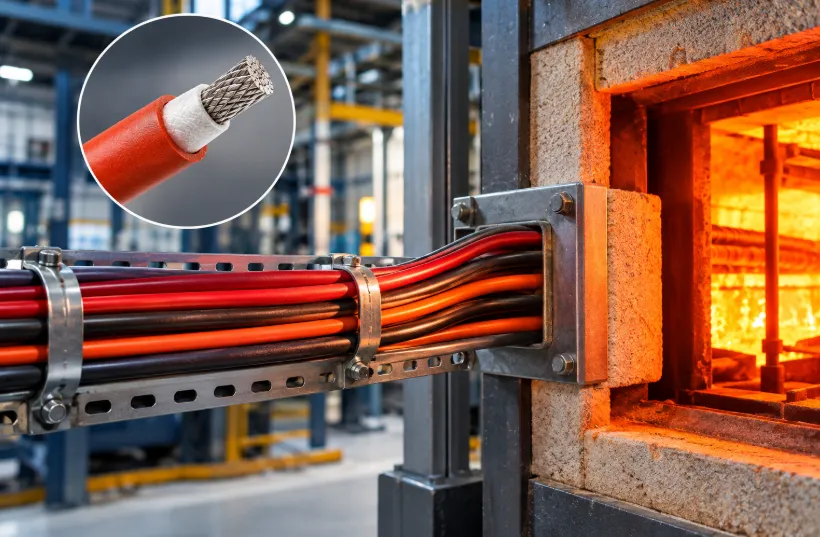
Good construction makes up for this. A fibreglass braid over the insulation adds a tough outer layer without lowering the heat rating. Sleeving at panel entry points and grommets on sharp edges protect it further; in the hottest zones, tinned copper conductors resist oxidation better than bare copper. A well-built silicone cable combines these choices based on where it will actually run.
How Neha Scored Two Supplier Samples
By now Neha had a simple scorecard, she checked whether the insulation wall looked even around the conductor, how cleanly each wire stripped, the quality of the copper and whether the supplier could explain its test results in plain words. She also kept her own compliance in mind. IEC 60335-1, the safety standard for household and similar appliances, includes a heating test and expects internal wiring insulation to withstand the temperatures reached in use. At Balaji Cables & Wires this is the conversation we like to have with buyers because a silicon wire is only as dependable as the consistency behind every batch. Neha's final pick went to the supplier who treated her questions as part of the job.
Practical Takeaways for Buyers Working With Heat
- Measure the actual temperature at each wiring point before choosing insulation.
- Check the continuous rating not only the peak figure.
- Ask which standard the rating was tested against.
- Add braid or sleeving wherever wire meets sharp edges or vibration.
- Request samples and run your own bend and strip checks.
- Pick a supplier who can explain its test data not just print it.
Heat Keeps Rising and So Should the Wiring Standard
Neha signed off the spec a week before her deadline. She did not choose the wire with the biggest number on its label. She chose the one she understood, from the chemistry in its insulation to the way it bent around a hinge. That in the end, is what makes silicone suitable for high heat work. Its structure resists heat, it stays flexible through constant cycling and with the right construction it handles the wear of a working machine.
Equipment keeps getting smaller and hotter and summers are not cooling down. If your wiring spec was written for a layout or a climate from five years ago, does it still match the heat your equipment runs at today?





















Sign in to leave a comment.