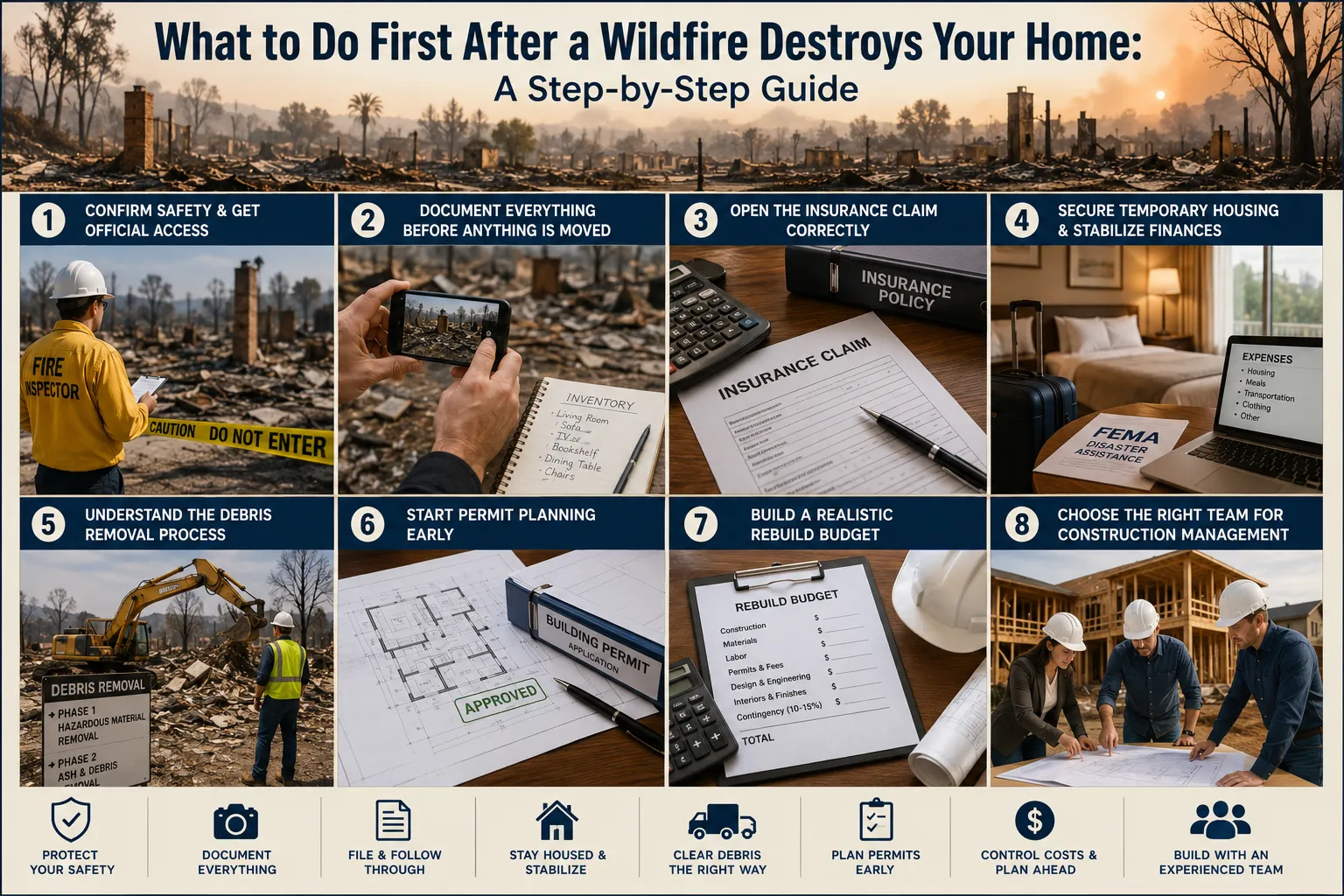

The aftermath of a wildfire that has consumed a home to the ground is a bewildering time for the homeowner in Santa Monica, the Pacific Palisades area and beyond. No one walks a family through all the decisions that must be made, there is no checklist that is left at the scene, and there is no manual handed down at the scene. But the decisions taken in the first two to four weeks, the paperwork involved in the loss, who's informed about permits when an insurance claim is filed, all of these will impact the rebuild a year later and the way in which it proceeds. This guide will take you through the steps on a sequential basis to prevent anything from getting lost.
Step 1: Confirm Safety and Get Official Access to the Property
Homeowners must first check with their local fire and law enforcement agencies before returning to a burned home. There are hazards at wildfire sites that can't be immediately seen, such as weakened tree roots, trees that are likely to fall, downed power lines and ash that may contain asbestos or other toxic residue from burned building materials.
Once a region is considered safe, usually a re-entry permit is issued by the city or county and it is advisable to check the city and county emergency management websites on a daily basis for update information, not secondhand. After gaining access, protective clothing is not as insignificant as it may appear to be.
N95 filtering facemasks, long sleeves, gloves and closed toe boots minimize exposure to ash and debris. It is also a good time to ask for a copy of the official fire incident report, as each insurance carrier and permit office will be asking for a copy later.
Step 2: Document Everything Before Anything Is Moved
Putting together a successful insurance claim is the basis of a successful reconstruction. Homeowners should take pictures and videos of all areas of the property from all angles before any clean up is done, including the foundation, whatever structures are still standing, outbuildings, landscaping and personal items.
The importance of wide shots that set up the context is as valuable as close-ups of particular damage. Working room by room with pre-loss photos, receipts, appraisals or social media posts is beneficial for providing a reference of what was there before the fire.
When an adjuster asks for the list of things, it's better to have one, even a quick one off the top of your head, than nothing at all. From now on keep all the receipts relating to the fire, as many of these are reimbursable: hotel bills, meals, replacement of clothes and boarding fees for pets.
Step 3: Open the Insurance Claim Correctly the First Time
Quickly is good, but accurately is better! It's at this point that wildfire insurance claim support can be of great assistance, as the initial interaction with the adjuster can influence the entire process. Homeowners are urged to ask for a complete copy of their policy, not just the declarations page, and make sure they check the policy for everything that might be covered but is commonly overlooked, such as additional living expenses, debris removal, code upgrade coverage and landscaping.
It is important to ask the insurance company if the policy contains extended or guaranteed replacement cost coverage because after a large scale wildfire event, costs are usually higher for construction because there's increased demand for materials and labor. In addition, homeowners have the right to have a public adjuster or claims consultant from outside the insurance company, and many families see the benefit of having an independent claims representative in that they can often find coverage that the insurance company overlooked in their initial claim estimate.
Step 4: Secure Temporary Housing and Stabilize Finances
Additional Living Expense (ALE) coverage is intended to provide temporary housing, temporary storage and related expenses when your home is not habitable and most policies will have a defined dollar limit, time limit or both. By applying for an advance of ALE funds before they are reimbursed, a family would not have to pay for rental and hotel expenses out pocket during the already stressful time.
At this time it's also an excellent opportunity to explore disaster relief programs. While the insurance claim is being processed, FEMA individual assistance, California disaster relief funds and property tax reassessment through the Los Angeles County Assessor's office can help alleviate some of the financial strain in the short-term.
Step 5: Understand the Debris Removal Process
Typically in large scale wildfire events debris removal in California is addressed in two stages. Phase 1 is generally under the direction of the U.S. Army Corps of Engineers or other relevant agency and will address hazardous material removal, which does not impact the homeowner directly, without cost. Phase 2 is for the remaining ash, foundations and burnt vegetation and homeowners may have the option to have the program run by the government or by a licensed contractor.
In some instances it may be quicker to take the private route, but you'll need to do a careful vetting of the contractor and need to be assured that the work will meet the standards necessary before a rebuild permit is obtained. In either case, no removal of items should occur until all paperwork from Step 2 is finished and the insurance adjuster has finalized his/her work.
Step 6: Start Permit Planning Long Before Construction Begins
Once permits are issued, many homeowners think the process begins, but the wildfire rebuild permit assistance process can begin early to reduce the overall timeline for wildfire rebuilds by months. The City of Santa Monica and Los Angeles County have adopted streamlined pathways for streamlined rebuild permits after large-scale fires including pre-approved architectural plans, and accelerated plan check processes for homes being reconstructed on the same site.
Coordinating with a team that is aware of these local ordinances, such as updated fire hardening building codes, defensible space requirements, and changes to setback and height requirements helps avoid the pitfall of submitting plans that are rejected weeks into the review process. As well, it's important to confirm early on whether California's new Chapter 7A wildfire-resistant construction requirements will apply to the rebuild, which would impact material selection, and thus the rebuild costs.
Step 7: Build a Realistic Rebuild Budget
Even with insurance, a full rebuild rarely gets paid for in full, especially if there is a regional reconstruction surge following a wildfire epidemic and all requirements from contractors, materials and skilled trades are higher. Good fire rebuild cost controls begin with a detailed line item budget prepared from actual bids in the area, not a generic square-footage estimate, plus a contingency (usually ten to fifteen percent of the total cost) to cover the hidden problems that arise when construction starts.
It's important for homeowners to have someone monitor costs against the budget on an on-going basis and not find out about the overspend at the end of a period of time. Where meaningful savings can be realized without sacrificing the code or long time value of the elements that are paramount to fire resistance and resale value lies in value engineering – changing select finishes or systems without sacrificing code or long time value.
Step 8: Choose the Right Team for Residential Construction Management
A home rebuild after a wildfire is not a standard home remodeling. It includes working with architects, structural engineers, permit expediters, insurance adjusters, and general contractors, sometimes all at once, as a family is left homeless, and the emotional burden of the trauma is placed upon them. Having all these moving parts coordinated within one schedule by experienced residential construction management helps to minimise miscommunication that commonly slows down and exceeds budget on rebuild projects.
Homeowners should inquire into a construction manager/project manager's experience with rebuilding a structure after a wildfire, understanding the current permitting process in Santa Monica and Los Angeles County, and experience working alongside insurance claims, not as a separate process from construction.
Moving Forward
The recovery process following a wildfire is a long journey that begins with some short-distance runs: securing the property, documenting the loss, opening the claim and starting permit planning before the debris even begins to clear. Homeowners who follow these steps, brimming with experience and support at every step, tend to end up at move-in day with fewer hassles, less money coming in, and a rebuilding that conforms to code and their vision. It is not something that can be done quickly, but it's not something that has to be done by yourself, either!




























Sign in to leave a comment.