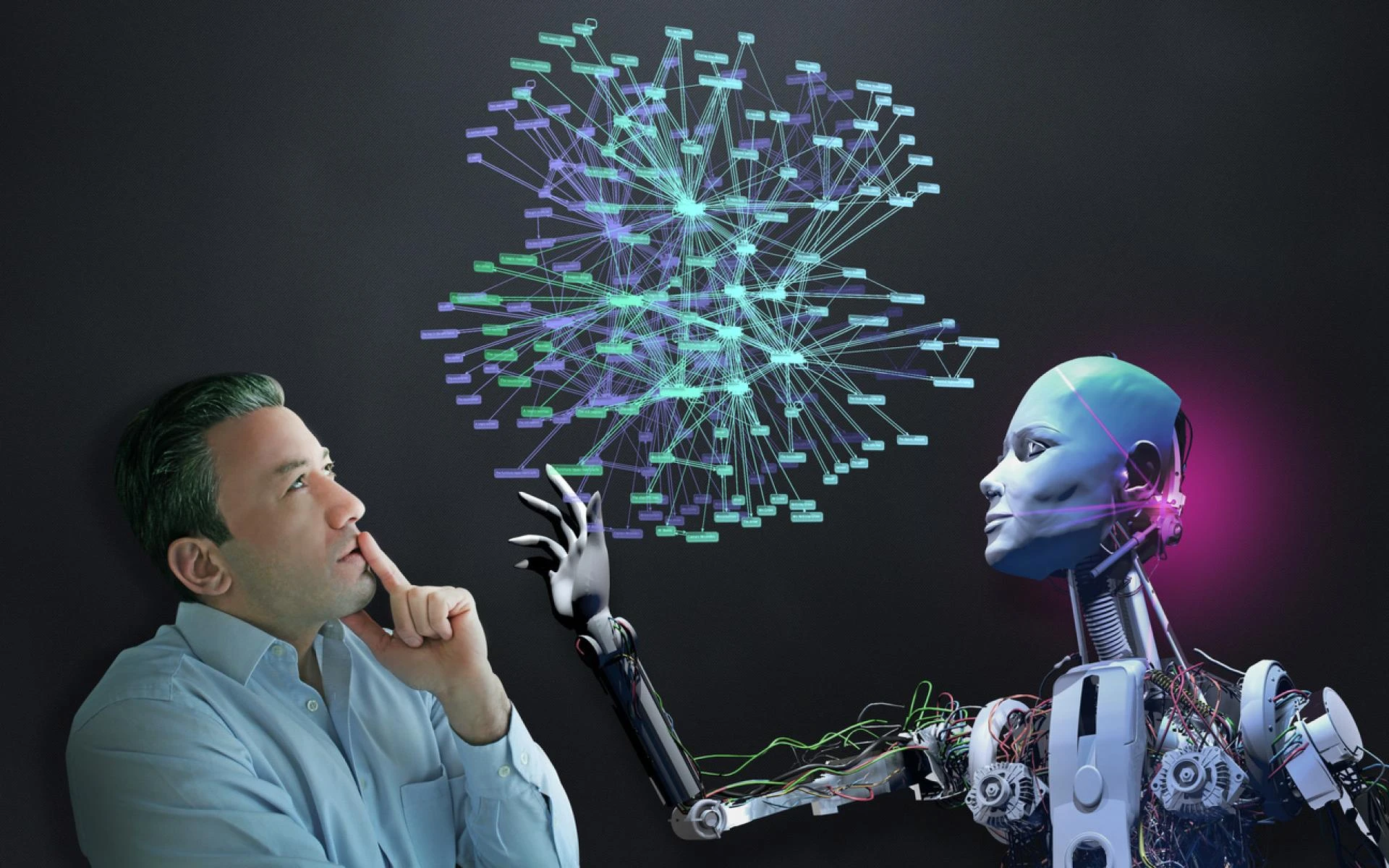

In the quickly changing world of technology today, words like machine learning (ML) and artificial intelligence (AI) are commonplace. These ideas are frequently utilized interchangeably in anything from marketing efforts to news headlines.
However, the real distinction between AI solutions and ML can be confusing for people who are not familiar with the complexities of computer science.
With a succinct and straightforward explanation of both AI and ML, this essay seeks to close that knowledge gap.
We'll delve into their essential features, examine the intriguing ways in which they cooperate, and emphasize how these potent instruments are revolutionizing several sectors and opening the door for cutting-edge AI solutions.
Intelligent Machines (AI): The Ultimate Dream
Imagine a society in which robots are capable of human-like thought and learning. Artificial intelligence solutions have such lofty objectives. Intelligent agents, or systems with reasoning, learning, and autonomous behavior, are the focus of the large discipline of computer science known as artificial intelligence (AI).
These entities are engineered to sense their surroundings, comprehend intricate circumstances, and respond in a way that advances predetermined objectives.
AI analytics is the catch-all term. A wide range of methods and strategies are included in it, such as:
Machine Learning: Learn more about machine learning, a potent branch of artificial intelligence that enables computers to make inferences from data without the need for explicit programming, in our upcoming section.Machine Reasoning: This area of artificial intelligence is concerned with creating computers that can solve issues by following reasoning processes similar to those of humans.Natural language processing (NLP) allows machines to understand and process human language, paving the way for chatbots and voice assistants.Computer vision is the field that gives machines the ability to "see" and analyze visual input, enabling applications like facial recognition and driverless vehicles.
The Motivation Behind AI Solutions: Machine Learning
The goal of machine learning (ML), a branch of artificial intelligence, is to develop algorithms that can learn from data.
ML algorithms are trained on enormous volumes of data, which enables them to see patterns and make predictions, in contrast to traditional programming, which involves giving the machine a set of instructions.
Take a look at this comparison: Consider educating a young child to identify several animal species. You would not enumerate every animal along with its attributes. Rather, you can show the child images of different animals and point out the characteristics that set them apart.
The youngster eventually picks up on such patterns and can identify unfamiliar species. In essence, machine learning operates like this.
Algorithms for machine learning come in several forms, each appropriate for a particular purpose. Typical examples include the following:
Supervised Learning: Using labeled data, where each data point has an output or label associated with it, the algorithm is trained. Say an image recognition algorithm is trained on images labeled "cat," "dog," or "bird."Unsupervised Learning: In this scenario, unlabeled data is given to the algorithm, which has to identify any hidden structures or patterns within the data. Consider identifying client groups with similar purchasing patterns by examining purchase data.Reinforcement Learning: This method uses a process of trial and error to train the algorithm. Through interaction with its surroundings and incentives for positive deeds as well as punishments for negative ones, the algorithm gradually learns the best course of action to take to accomplish a goal.Okay, So What's the Big Deal? This is an Interpretation
We can now distinguish between AI and ML with greater clarity, so let's examine their main variations:
Scope: Artificial intelligence is a general term that refers to a broad class of methods for building machines with intelligence. One subset of AI that concentrates on data-driven learning is called machine learning.Function: The goal of artificial intelligence is to create machines that are capable of thinking, learning, and solving problems in a way that is similar to that of humans. The capacity to draw conclusions or predictions from data and apply that knowledge to future actions is the main goal of machine learning.Applications of AI solutions include sophisticated self-driving automobiles and basic chatbots. Personalized streaming service suggestions and financial transaction fraud detection are just two of the many applications that machine learning powers.AI and Machine Learning's Power Together
Machine learning and artificial intelligence go hand in hand and are not antagonistic to one another. An engine that powers many AI solutions is often machine learning algorithms. AI systems can constantly learn and develop, growing more complex over time, by utilizing the power of machine learning.
For instance, an AI-powered virtual assistant can use machine learning to learn about your preferences and adjust its responses accordingly. Your assistant will get more adept at anticipating your requirements and understanding them the more you engage with them.
Adopting Responsible AI Solutions
It's critical to recognize the ethical issues that come with such sophisticated technology, even as the potential of AI solutions is unequivocal. With an emphasis on accountability, transparency, and fairness, we must make sure that AI is developed and used properly as it continues to advance.
Consider the following important factors:
Bias in AI: The quality of machine learning algorithms depends on the quality of the data used to train them. Unbiased results from the AI system can result from biases in the training data. Ensuring varied and unbiased datasets is crucial to reducing the risk. The Human Factor: AI shouldn't completely take on the role of human judgment. The finest outcomes are frequently obtained when human expertise and AI skills are combined.AI regulation: As AI becomes more commonplace, laws are becoming more and more necessary to guarantee its responsible use and guard against potential abuse.The Final Thoughts
Even though AI and machine learning are two different ideas, they are powerfully entwined. Machine learning catalyzes learning and adaptation, whereas artificial intelligence (AI) offers the grand vision of intelligent machines.
We can anticipate even more ground-breaking applications that revolutionize the way we work, live, and engage with the world as these fields develop further.
























Sign in to leave a comment.