

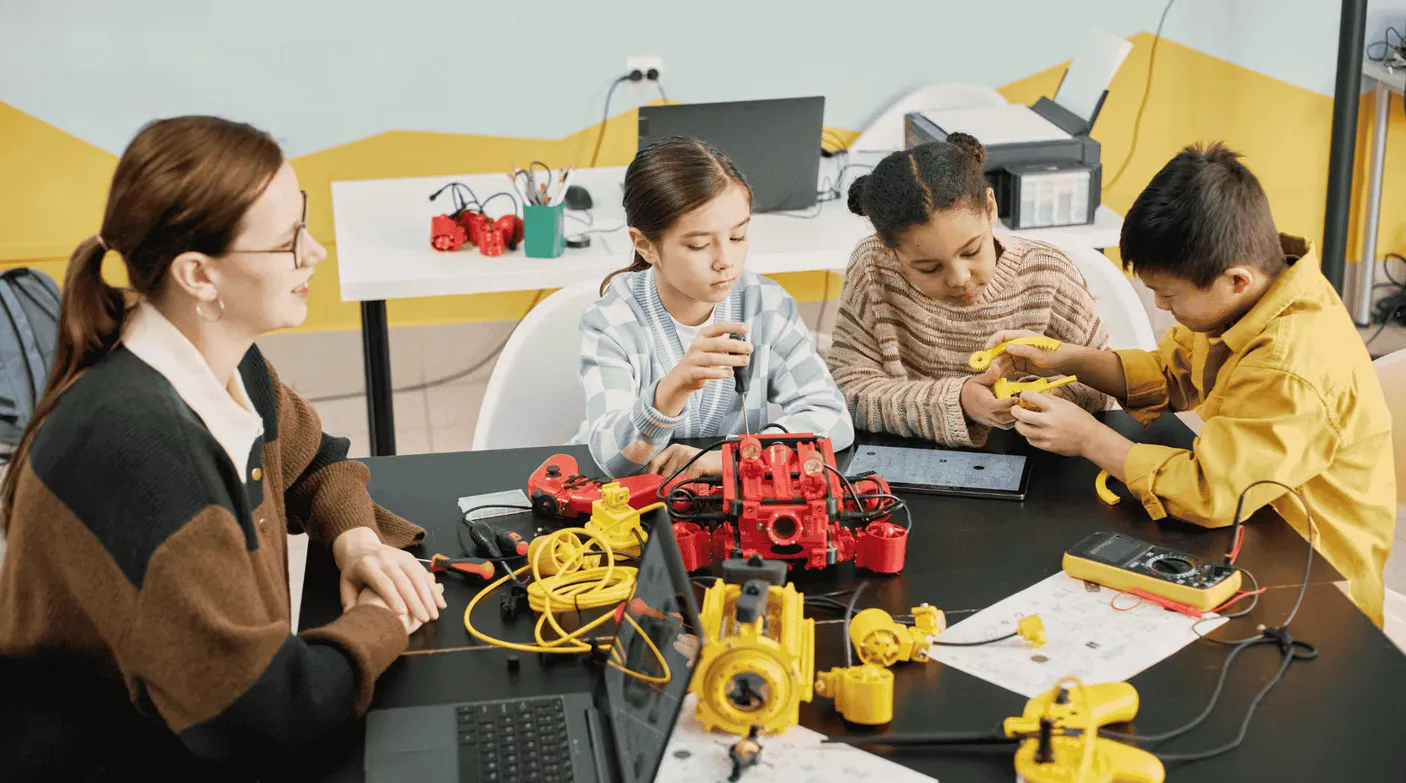
Screen time is an ongoing battle for parents in Singapore. We want our children to be prepared for a digital future, but watching them mindlessly scroll or play games can feel like a waste of potential.
A Scratch coding enrichment class changes that dynamic. Instead of passively consuming media, children learn to build their own games, animations, and interactive stories. Created by the MIT Media Lab, Scratch uses colorful visual blocks that snap together like digital LEGO bricks. This means children learn the fundamentals of computer science without typing complex code or dealing with frustrating syntax errors.
At Meta Robotics, we take this a step further. Our curriculum integrates MIT Scratch 3.0 with physical hardware and robotics. This approach bridges the gap between software logic and real-world problem-solving.
The Cost of Quality Coding Enrichment in Singapore
Enrichment class pricing reflects class sizes, specialized equipment, and teacher training. Below is an overview of standard industry rates for structured Scratch and robotics programmes in Singapore, alongside our tiered options at Meta Robotics:
| Programme Level | Intended Age Group | Focus & Core Tools Used | Average Cost Range |
| Discovery Track | Ages 7 – 9 | Scratch 3.0, Basic Animation, LEGO WeDo | $320 – $450 per term |
| Explorer Track | Ages 10 – 12 | Advanced Scratch, LEGO Spike Prime, Machine Learning | $400 – $550 per term |
| Direct School Admission (DSA) | Ages 9 – 12 | 45-Hour Intensive, Portfolio Building, Competition Prep | $1,200 – $1,800 total |
Value Note: High-quality courses include custom engineering toolboxes, web-app portals for progress tracking, and secure digital certificates to record milestones.
Core Benefits and Real-World Use Cases
The primary goal of block-based programming is developing logic rather than teaching code storage. A structured Scratch class sharpens analytical thinking in ways that carry over into school subjects like Math and Science.
Key Benefits:
- Removes Typing Barriers: Children experiment with sequencing and conditions without typing errors slowing them down.
- Teaches Perseverance: When code fails to run as expected, kids learn to isolate problems and debug step-by-step.
- Introduces Spatial Logic: Connecting physical robotics components with code commands strengthens spatial awareness.
[Traditional Typing] -> Typos & Syntax Errors -> Frustration
[Scratch Blocks] -> Logic & Sequencing -> Creative Solutions
Real-World Scenarios:
- Scenario 1: Simplifying Primary School Mathematics
A student struggling with loops in Scratch often discovers they are applying the same repetition principles used in multiplication and division. The visual nature of the blocks helps turn abstract math concepts into concrete mechanics. - Scenario 2: The Direct School Admission (DSA) Path
Primary school students looking to enter secondary schools through the DSA track use Scratch to build portfolios. Designing an interactive game or programming an autonomous robot demonstrates computational thinking to admissions panels.
Step-by-Step: The Meta Robotics NEBULA™ Framework
Our classes utilize the NEBULA™ Neuro-Builder model. This system ensures students don't just mimic an instructor, but learn to design programs independently.
1.Deconstruct & Plan:Week 1 - 2.
Students analyze a target project, such as a maze game or a motorized conveyor belt. They break down the project requirements into distinct tasks using logic flowcharts.
2.Build & Assemble:Week 3 - 5.
Using our custom organizer toolboxes, students construct physical models or design game sprites. This step connects mechanical engineering with visual creation.
3.Apply Code Blocks:Week 6 - 8.
Students write the control scripts in Scratch 3.0. They configure event blocks, loops, and conditional statements to bring their physical and digital models to life.
4.Test & Debug:Week 9 - 10.
Programs rarely work perfectly on the first attempt. Students run tests, analyze why errors occur, and refine their scripts until the project operates reliably.
5.Certify & Showcase:Week 11 - 12.
Students demonstrate their completed project to the class. Their achievements are recorded with photos and videos uploaded to our parent app, alongside an encrypted digital certificate.
What Parents and Reviews Say About Us
We prioritize real student progress over simple entertainment. Our curriculum earned recognition from Parents World Singapore as the Best in STEM & Robotics Education 2026.
"My son used to spend his afternoons playing video games. After enrolling in the Scratch and LEGO Spike classes, he now spends hours building his own games and explaining logic gates to us. The change in his focus and patience has been clear."
— Linette T., Parent of Primary 4 Student (Marine Parade)
Common feedback highlights our structured approach, clear progress updates, and low student-to-teacher ratios that ensure every child receives individual guidance.
Frequently Asked Questions
Is Scratch coding suitable for absolute beginners?
Yes, Scratch is specifically designed for children with zero programming experience. Its block-based system allows kids to master logical thinking before they ever have to type a single line of text code.
How does block coding prepare my child for Python?
Scratch teaches core programming concepts like variables, loops, arrays, and if-then logic. When students transition to text languages like Python later on, they only need to learn the typing syntax because they already understand how the underlying logic works.
What is the ideal age to start a Scratch enrichment class?
The ideal age group for structured Scratch classes is between 7 and 12 years old. For younger children aged 3 to 6, we recommend screen-free coding tools to build early sequential logic safely.
Can coding classes help with Direct School Admission (DSA)?
Yes, a dedicated robotics and coding portfolio is highly beneficial for the STEM DSA track. Our specialized 45-hour training programs help students design original projects and prepare for major national competitions.
Give Your Child a Future-Ready Advantage
Coding is a fundamental literacy for the next generation. A structured Scratch coding enrichment class shifts screen time from passive amusement into active development, building critical thinking skills that support long-term academic success.
Help your child grow from a technology user into a technology creator. Visit Meta Robotics today to book a hands-on trial class and view our upcoming holiday schedules.


























Sign in to leave a comment.