
A CRM project rarely fails because the software cannot store customer records. It fails when the organization builds another system that employees must update instead of a system that helps them make better decisions.
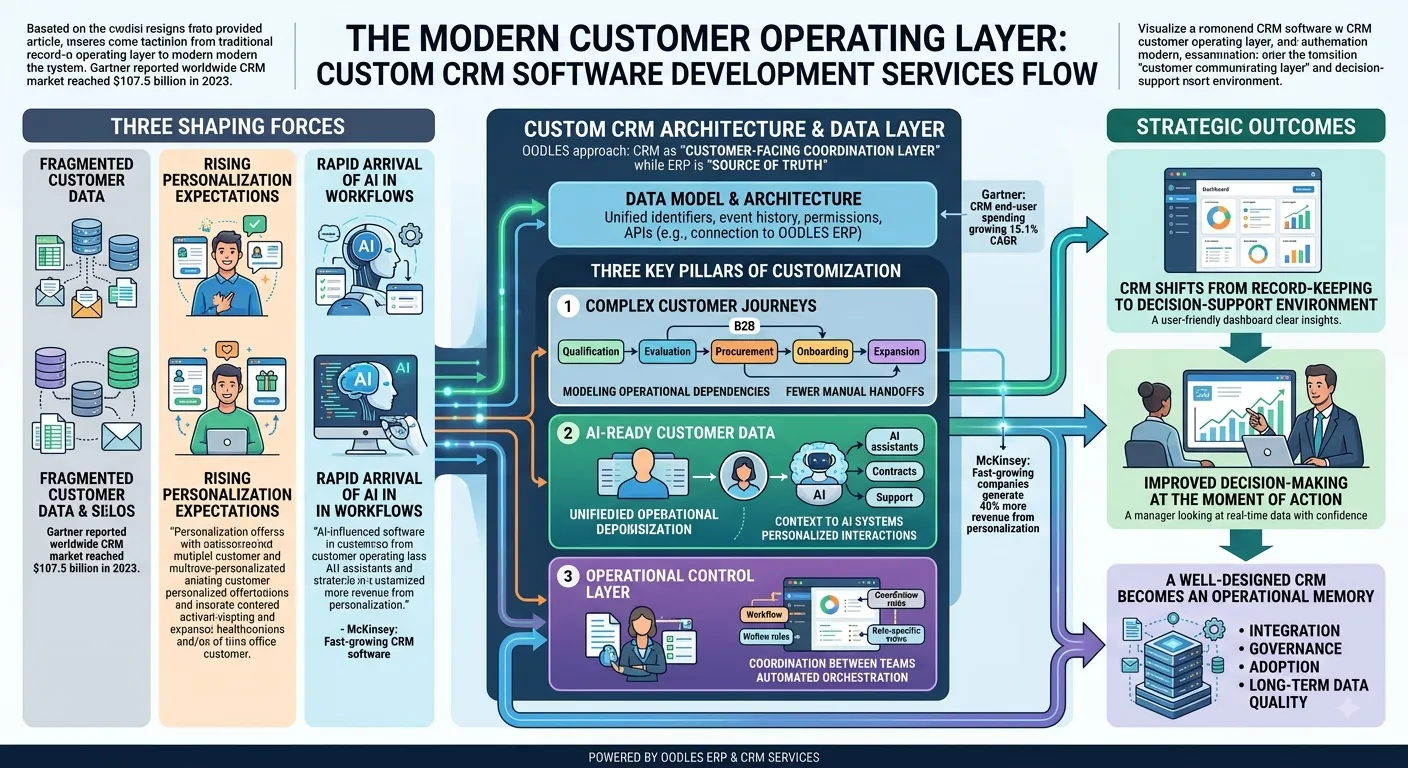
That distinction is becoming more important as customer operations become increasingly digital. CRM Software Development Services are now being considered not only for sales management, but also for customer service, marketing automation, analytics, partner management, and AI-assisted workflows. Gartner reported that the worldwide CRM market reached $107.5 billion in 2023, growing 13.4% year over year.
For CIOs and CTOs, the question is therefore not simply whether to implement CRM. It is whether the organization needs another configurable product or a customer operating layer designed around its actual processes.
That is where custom CRM software development services can become strategically relevant.
Why This Is Happening Now
Modern CRM decisions are being shaped by three forces: fragmented customer data, rising expectations for personalization, and the rapid arrival of AI into front-office workflows.
Forrester (2024) found that close to 70% of organizations planned to increase CRM investments over the following year. Its research also notes that emerging technologies are making CRM more capable of generating insights, automating tasks, and supporting personalization.
Gartner expects CRM end-user spending to continue growing at a 15.1% constant-currency CAGR through 2027. Gartner also forecasts that AI-influenced software will become a meaningful portion of CRM spending by that point.
The implication is important: CRM is shifting from a record-keeping application toward a decision-support environment.
Where traditional ERP systems rely on standardized transaction processes, modern CRM architecture increasingly needs to account for customer intent, interaction history, behavioral signals, service context, and real-time actions.
The CRM Software Development Services Question: What Should Actually Be Custom?
Custom CRM does not mean rebuilding every feature from scratch. It means deciding which parts of the customer operating model are sufficiently differentiated to deserve custom architecture.
CRM Software Development Services for Complex Customer Journeys
The first strong use case is a customer journey that does not fit standard CRM stages.
Consider a B2B company where a prospect moves through qualification, technical evaluation, procurement, onboarding, implementation, support, renewal, and expansion. A conventional pipeline may represent the opportunity, but it may not represent the operational dependencies between those stages.
Effective CRM Software Development Services should model these dependencies directly. That can mean workflow rules, role-specific dashboards, approval mechanisms, automated alerts, document states, and integrations with ERP or service platforms.
The goal is not more customization. The goal is fewer manual handoffs.
CRM Software Development Services for AI-Ready Customer Data
The second use case is AI.
AI cannot compensate for fragmented or poorly structured customer information. A sales assistant that sees only CRM notes but cannot access order history, support tickets, contracts, or product usage will produce incomplete recommendations.
This is why data architecture should come before AI features.
McKinsey found that 71% of consumers expect personalized interactions, while 76% become frustrated when companies fail to provide them. Its research also found that faster-growing companies generate 40% more revenue from personalization than slower-growing companies.
For CRM Software Development Services, that changes the architecture conversation. Customer profiles need unified identifiers, event histories, permissions, data-quality controls, and APIs capable of supplying context to AI systems.
CRM Software Development Services as an Operational Control Layer
The third implication is broader: CRM can become the coordination layer between customer-facing teams.
A modern CRM may trigger a task when a high-value customer raises a support issue, notify an account manager when purchasing behavior changes, request approval before a discount is issued, or create a renewal workflow based on contract dates.
That moves CRM from passive reporting to operational orchestration.
For technology leaders, this distinction matters because every automated workflow creates dependencies across applications. The CRM architecture therefore needs clear API boundaries, event handling, access controls, audit trails, and ownership rules.
What Oodles Has Seen in Practice
From our experience working with businesses on CRM Software Development Services, one recurring problem is not the absence of CRM functionality. It is the mismatch between the CRM’s data model and the company’s operating model.
A typical example involves a company managing customer acquisition in CRM while orders, invoices, fulfillment, and service information remain in separate systems. Sales teams then rely on spreadsheets or internal messages to understand the complete account picture.
At Oodles, the practical approach is to begin with the customer lifecycle rather than the CRM screens. We map where customer data originates, identify which system owns each record, define integration boundaries, and then determine which workflows should remain inside the CRM.
In one common architecture pattern, the CRM becomes the customer-facing coordination layer while ERP remains the source of truth for financial and operational transactions. APIs connect the systems, role-based views expose only relevant information, and automated workflows reduce repetitive follow-up.
The outcome is a CRM that reflects how the business operates instead of forcing teams to redesign their work around software.
This is also where Oodleserp approaches become relevant. Oodles The wider lesson from CRM and ERP integration projects is that system boundaries should be explicit. When ownership is unclear, duplicated customer records and conflicting updates eventually undermine reporting and automation.
The Strategic Test for CRM Investment
The strongest CRM strategy is not the one with the longest feature list. It is the one that makes customer information usable at the moment a decision needs to be made.
For CIOs, that means evaluating CRM against integration architecture, governance, adoption, and long-term data quality. For CTOs, it means designing for APIs, extensibility, security, and AI readiness. For operations leaders, it means measuring whether customer-facing processes actually become easier to execute.
The market numbers show that CRM investment is expanding. But spending more does not automatically create better customer operations. Gartner’s data shows how quickly the market is growing, while McKinsey’s personalization research shows why customer context increasingly matters.
The strategic opportunity is to connect those two realities.
A well-designed CRM should become an operational memory for the organization, not another database employees are required to maintain. As AI becomes more embedded in customer workflows, that distinction will become even more important.
Conclusion
The next generation of CRM will not be defined by how many fields, dashboards, or automation rules a platform contains. It will be defined by how accurately it represents the company’s customer lifecycle and how effectively it connects customer context with business action.
That is the real value of CRM Software Development Services: designing the customer operating model around the organization rather than forcing the organization into a generic software model.
For companies planning their next CRM initiative, the better starting question is not, “Which CRM should we buy?” It is, “Which customer decisions and workflows should our CRM make easier?”
That question produces a very different technology roadmap.
Discuss Your CRM Strategy
If your organization is evaluating custom CRM architecture, system integration, workflow automation, or AI-ready customer platforms, you can discuss your requirements with Oodles through our CRM Software Development Services.
FAQ
What are CRM Software Development Services?
CRM Software Development Services involve designing, developing, customizing, and integrating customer relationship systems around an organization’s specific processes. They can include customer data models, workflows, dashboards, APIs, automation, analytics, and AI-enabled capabilities.
When should a company choose custom CRM development?
Custom development is most useful when standard CRM platforms cannot adequately represent critical workflows, integrations, data structures, or customer journeys. Companies with complex sales, service, partner, or industry-specific processes may benefit most.
How does AI change CRM development?
AI increases the importance of clean, connected customer data. CRM systems increasingly need structured customer histories, permissions, APIs, and workflow context so AI can generate useful recommendations rather than isolated responses.
Should CRM and ERP be integrated?
Yes, when both systems participate in the customer lifecycle. ERP typically manages transactions such as orders, invoices, and inventory, while CRM manages customer interactions and commercial workflows. Integration reduces duplicate data and gives teams broader context.
Are CRM Software Development Services suitable for mid-sized businesses?
They can be, particularly when a business has outgrown spreadsheets or generic workflows but does not need a highly customized enterprise platform. The right approach is usually to customize only the processes that materially affect revenue, service quality, or operational efficiency.






















Sign in to leave a comment.