

Artificial Intelligence is no longer limited to chatbots that answer questions or tools that generate images and text. The next evolution of AI is already transforming industries worldwide: Full Stack Agentic AI. Unlike traditional AI systems that only respond to prompts, agentic AI systems can plan, reason, make decisions, use tools, and complete tasks autonomously with minimal human intervention.
This shift is changing how businesses operate, how software is built, and how professionals prepare for the future of work. As a result, demand for an agentic ai course, agentic ai certification course, and advanced agentic ai training programs is rapidly increasing across the global tech ecosystem.
The future of AI will not be driven by isolated AI models. It will be driven by interconnected AI agents capable of handling complete workflows from start to finish.
What Is Full Stack Agentic AI?
Full Stack Agentic AI refers to AI systems that combine Large Language Models (LLMs), autonomous AI agents, memory systems, workflow orchestration, APIs, databases, and multi-agent collaboration into a single intelligent ecosystem.
Instead of simply generating outputs, these systems can independently execute complex tasks such as researching information, writing code, automating business operations, managing workflows, and interacting with multiple software tools.
This is why many experts believe agentic AI represents the next major computing revolution after cloud computing and generative AI.
Why Agentic AI Is Growing So Fast
The market growth around AI agents is enormous. According to Grand View Research, the global AI agents market was valued at approximately $7.63 billion in 2025 and is projected to reach $182.97 billion by 2033, growing at a CAGR of nearly 50%.
Another industry report estimates that the AI agent market could reach $52.62 billion by 2030, making it one of the fastest-growing software categories in history.
These numbers clearly show that businesses are aggressively investing in agentic AI systems because they can automate high-value workflows instead of just assisting users conversationally.
From Generative AI to Agentic AI
Generative AI changed how people create content. Agentic AI changes how work gets done.
Traditional generative AI tools can generate text, summarize documents, answer questions, and create images. Agentic AI systems go much further. They can analyze goals, break tasks into subtasks, use external tools, execute actions, validate outcomes, and even coordinate with multiple AI agents.
For example, a traditional AI chatbot may help draft a marketing campaign. A Full Stack Agentic AI system can research competitors, analyze customer behavior, create campaign strategies, generate ad copies, schedule content, and optimize performance automatically.
This level of automation is why enterprises are heavily investing in AI agent infrastructure.
Enterprises Are Adopting AI Agents Rapidly
Businesses worldwide are already moving toward AI agent ecosystems.
Reports suggest that global spending on AI agents may increase from $86.4 billion in 2025 to $376.3 billion by 2027.
Deloitte’s State of AI research also indicates that nearly 74% of enterprises plan to deploy agentic AI solutions within the next two years.
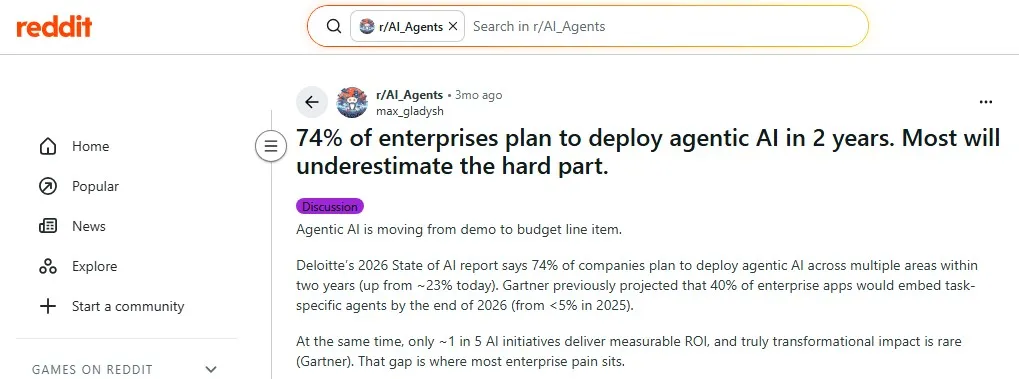
Meanwhile, major consulting firms and enterprise technology companies are scaling AI agent adoption internally to improve productivity and operational efficiency.
These trends confirm one thing clearly: companies are preparing for an AI-driven operational future.
Why Full Stack Skills Matter
The future belongs not just to AI users, but to professionals who understand the complete AI ecosystem.
A Full Stack Agentic AI developer understands:
- Prompt engineering
- LLM integration
- Multi-agent systems
- Vector databases
- Retrieval-Augmented Generation (RAG)
- AI automation workflows
This is why enrolling in an agentic ai course or specialized agentic ai training program has become highly valuable for developers, engineers, automation professionals, and business leaders.
Companies no longer want employees who can simply use AI tools. They want professionals who can build intelligent AI workflows capable of automating operations at scale.
Multi-Agent Systems Are the Future
One of the biggest reasons Full Stack Agentic AI is considered the future is the rise of multi-agent systems.
Instead of relying on a single AI model, organizations are now creating ecosystems where multiple specialized AI agents collaborate together. One agent may perform research, another may generate code, while another validates outputs and monitors performance.
This structure resembles how real human teams operate and allows businesses to automate complex processes much more efficiently.
Industry experts believe that software development, customer service, cybersecurity, healthcare, finance, and operations management will increasingly depend on coordinated AI agent systems over the next decade.
Demand for Agentic AI Education Is Rising
As companies adopt AI agents, the need for skilled professionals is increasing rapidly.
Search interest around agentic ai course, agentic ai certification course, agentic ai coursera, and agentic ai training has grown significantly because professionals want to stay competitive in the evolving AI job market.
Many learners are now pursuing structured learning paths that combine AI fundamentals, autonomous AI systems, workflow automation, and AI deployment strategies.
An advanced agentic ai certification course can help professionals build practical expertise in designing and deploying enterprise-grade AI agent systems.
Challenges Still Exist
Despite the excitement, agentic AI is still evolving.
Gartner predicts that more than 40% of agentic AI projects may fail by 2027 because of unclear ROI, governance issues, and unrealistic expectations.
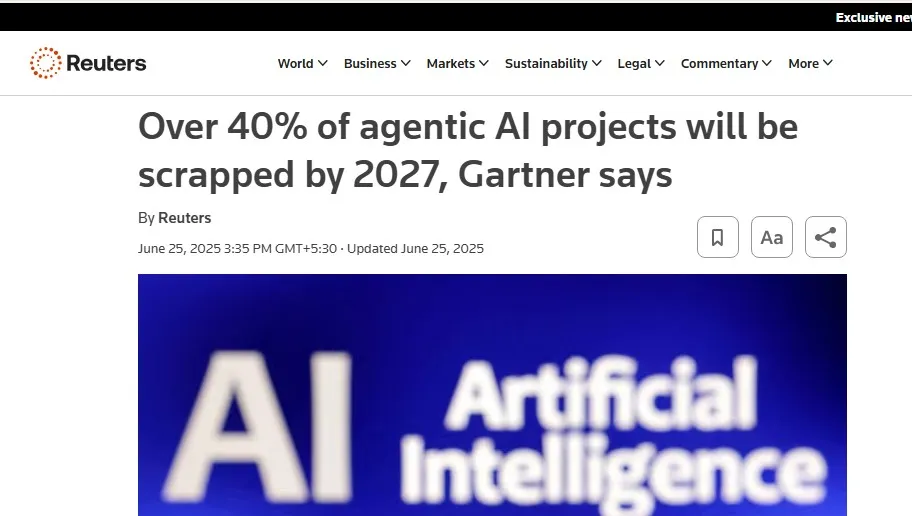
However, this does not reduce the long-term importance of the technology. Instead, it highlights the need for better AI infrastructure, strong governance, skilled AI professionals, and reliable orchestration systems.
As with every technological revolution, the organizations that learn and adapt early are likely to gain the biggest advantages.
Final Thoughts
Full Stack Agentic AI represents the next major transformation in artificial intelligence. The future is moving beyond chatbots toward autonomous AI systems capable of planning, reasoning, collaborating, and executing complete workflows.
Businesses are investing billions into AI agents because they offer scalability, automation, efficiency, and intelligent decision-making capabilities that traditional software cannot match.
As industries rapidly adopt autonomous AI ecosystems, professionals with expertise in AI orchestration, multi-agent systems, and workflow automation will become highly valuable.
This is exactly why interest in every major Agentic AI course, Agentic AI certification course, Agentic AI coursera, and professional agentic ai training program continues to rise globally.
The future of AI will not simply be intelligent. It will be autonomous, collaborative, and agent-driven.






















Sign in to leave a comment.