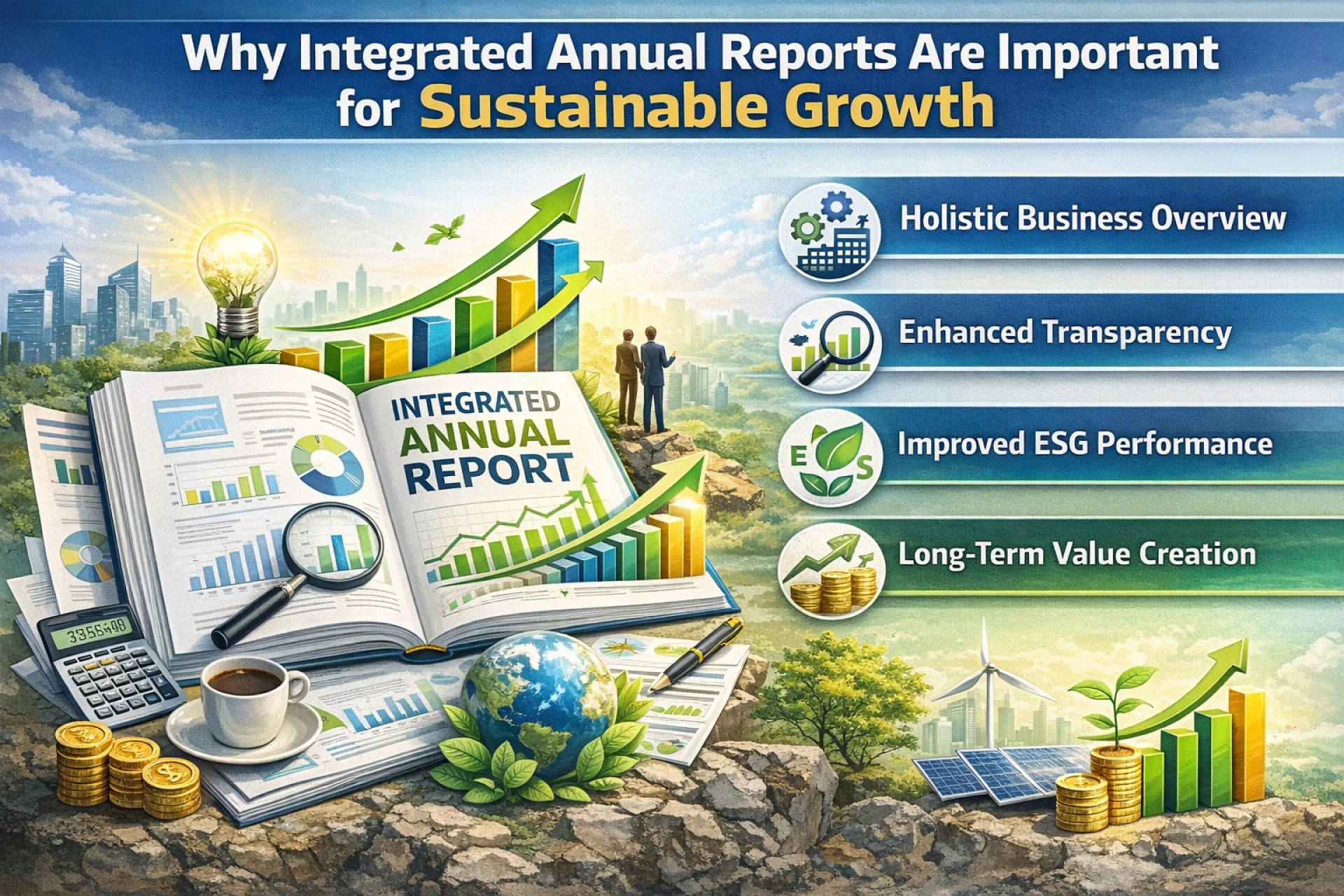

Business growth without accountability is no longer acceptable today. Investors, regulators, and stakeholders expect businesses to demonstrate not only their profitability but also their responsibility, resilience, and long-term vision. Companies that focus purely on short-term financial performance risk losing credibility. They need to remember the fact that they are competing in a market that values sustainability.
Earlier, annual reports presented financial statements and performance summaries. However, they were a big failure when it came to explaining how strategy, governance, environmental impact, and risk management were connected to those numbers.
An integrated annual report bridges this gap. It provides a comprehensive view of how an organisation creates value financially, operationally, and sustainably. This report has fortunately become a strategic necessity for businesses committed to long-term growth.
What Is an Integrated Annual Report?
An integrated annual report combines financial data with non-financial disclosures such as environmental, social, and governance (ESG) performance. It explains how strategy, operations, governance, and risk management are interconnected.
Unlike separate sustainability reports, this format links ESG initiatives directly to business outcomes. It shows stakeholders how responsible practices contribute to operational efficiency, risk reduction, and long-term profitability.
The most defining strength of an integrated annual report is connectivity. It aligns revenue growth with sustainability initiatives, governance frameworks with compliance standards, and operational efficiency with resource management.
This clarity enables stakeholders to assess not only current results but also the sustenance of those results in the future.
3 Reasons Integrated Reports Are Important for Sustainable Growth
Let’s see why integrated reports contribute to sustainable development of a business.
Builds Investor Confidence
Modern investment decisions are influenced by more than earnings per share. Investors analyse regulatory exposure, climate-related risks, governance standards, and ethical business practices.
An integrated annual report enhances transparency by outlining strategy, performance indicators, risks, and sustainability commitments in an easy way.
Aligns Strategy With Sustainable Value Creation
Sustainable growth requires alignment between financial targets and responsible business operations. Reporting frameworks help ensure that alignment is measurable and structured.
An integrated annual report compels organisations to define how their strategy generates long-term value. It highlights innovation, stakeholder engagement, governance oversight, and resource allocation.
Improves Governance and Accountability
Regulatory standards increasingly demand detailed ESG disclosures. Companies that adopt integrated reporting are better prepared to meet evolving compliance requirements.
By presenting governance structures and risk management processes alongside financial performance, an integrated annual report reinforces accountability.
This approach boosts corporate reputation and positions your organisation as responsible and future-ready.
Bottom Line
An integrated annual report provides a comprehensive yet transparent view of your business performance. It strengthens investor trust, aligns strategy with sustainability, and reinforces accountability.
Organisations that are aiming for sustainable growth, for them, integrated reporting can be a strategic communication framework that demonstrates how value is created responsibly with a long-term vision.




























Sign in to leave a comment.