If you’ve tried using a JQL time-in-status query in Jira to calculate duration metrics, you’ve likely encountered a common limitation: JQL is excellent for finding issues, but it was never designed to measure how long issues remain in a particular status.
For example:
status CHANGED FROM "In Progress" TO "Done" DURING ("2026/04/01", "2026/04/08")
This query identifies issues that moved from “In Progress” to “Done” during a specific period. However, it does not tell you how long each issue spent in “In Progress” before completion. That is the core limitation of any JQL time-in-status workaround.
JQL can filter issues based on status changes, dates, and conditions, but it cannot calculate duration. It does not provide metrics such as cycle time, lead time, time in status, average transition time, or workflow delays. Teams still need to manually review issue histories or export data for calculations.
What JQL Can and Cannot Do
JQL can help identify issues that may need attention. For example:
- Find stalled work: status = "In Progress" AND NOT status CHANGED AFTER -10d
- Find recently completed issues: status changed to "Done" after -14d
These queries are useful for spotting individual issues, but they cannot answer deeper workflow questions:
- How long was work actively being developed?
- Where are delays occurring between workflow stages?
- Which issues are aging beyond expected timelines?
- What is the average transition time between statuses?
JQL finds issues; it does not analyze how work moves through a process.
Why Time-Based Workflow Metrics Matter
Metrics like cycle time, lead time, and time in status reveal process health by showing how efficiently work flows. Development teams need visibility into delays between development, review, and testing. Support teams need to monitor SLA risks, while operations teams need early warnings about aging work.
Without dedicated reporting, teams often rely on spreadsheets and manual calculations that become difficult to maintain at scale.
How Time in Status Reports Solves This Gap
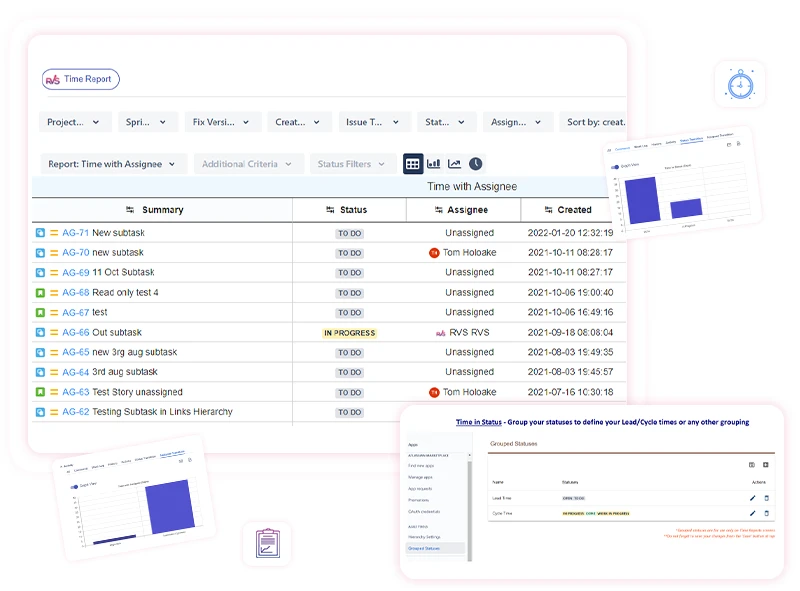
Time in Status Reports calculates duration directly from Jira’s status-change history. It tracks every status transition and uses those timestamps to measure how long issues spend in each workflow stage.
It provides:
- Time in Status: Measures time spent in individual statuses.
- Transition Time: Identifies delays between workflow stages.
- Cycle Time: Calculates active development time across selected statuses.
- Lead Time: Measures the complete journey from creation to completion.
Additional capabilities include JQL-enabled calculated fields, custom status grouping, configurable working calendars, real-time dashboard gadgets, and 20+ specialized reports for workflow analysis.
With visual reports such as scatter plots, WIP run charts, and Agile metrics dashboards, teams can quickly identify bottlenecks and track delivery performance.
The Bottom Line
JQL is powerful for searching Jira issues, but it cannot calculate workflow durations or reveal where time is being lost. Time in Status Reports provides the reporting layer teams need to measure cycle time, lead time, transition time, and time in status directly within Jira—helping teams understand bottlenecks, improve processes, and make data-driven decisions.

























Sign in to leave a comment.