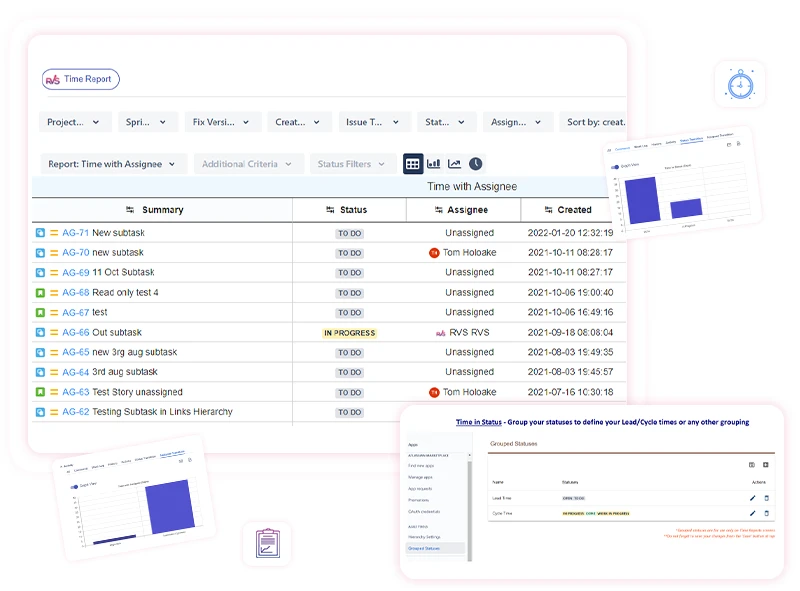
In fast-moving organizations today, it is critical to know how long work items wait in different stages of a workflow to improve efficiency and achieve timelines. This information comes in the form of a time in status report, which provides insight into how long each issue or task has spent in each status. Once a team has this information, they can identify bottlenecks, improve processes, and thus, improve results. Tools like Time in Status for Jira by RVS Softek empower teams with these insights.
Below are some practical use cases to demonstrate how the concept can be used repeatedly throughout functions.
Identifying Workflow Bottlenecks
One of the easiest but impactful ways to use the time-in-status metrics is to see where work is getting stuck. For instance, a team of software developers might find that many tasks are sitting in "Code Review" status for a long time. Upon looking at the time spent in that status, the team finds that there aren't enough reviewers, which is causing the delay. Once identified, the team identifies additional reviewers or changes the flow of the process, and the cycle time is greatly reduced.
Enhancing Development Cycle Time
In development and DevOps teams, driving down the time-to-market is usually a priority objective. A time-in-status report reflects how long features spend in stages such as "Testing" or "Ready for Deployment." When these durations become excessive, teams can adjust the flow - improving cycle time overall and improving the frequency of releases.
Measuring Team Performance
The duration of a status could also indicate trends with respect to an individual or team member's productivity. For example, a product manager might look at how long a task sits in the “In Progress” state and compare the different developers. If the same developers tend to leave tasks in "In Progress" longer, then it could signal a need for support or training, or even just a process review. In short, this allows for more informed management and is a data-informed management approach.
Identifying Unnecessary Status Transitions
Certain workflows are inefficient due to the back and forth of the status of certain tasks -- specifically, whether they're "In Review" or "In Progress." When review criteria are vague, time-in-status will help quantify this flux and lead teams to tighten review protocols, improve documentation, or better define conditions for being "ready."
Forecasting Project Timelines
Project managers can utilize historical status duration data to provide better time estimates for similar future tasks. This allows more accurate sprint planning, stakeholder communication, and due date estimation - turning time estimates from a guessing game into evidence-based forecasting.
Optimizing Agile Sprint Planning
Agile teams frequently experience problems with completing their work in the sprint. Once a Scrum Master can identify the tasks that took the most time in previous sprints, it may be possible to more accurately assign future tasks. The result is a more connected sprinter experience and improved velocity measurements.
Reducing Wait Times in Approval Processes
Procedures such as procurement or HR onboarding may get stuck in “Pending Approval” statuses. Time-in-status metrics can help identify which approvals have the longest delays and inform leadership on the necessary escalations, reminders, or delegated authorities to keep work moving.
Tracking Incident Management Efficiency
For operational teams, especially in IT, speed is critical. Understanding the time that incidents exist in states such as "Assigned" or "In Progress" makes it easy to identify where there are gaps in response time that can be improved through training, use of automation, or changing teams.
Justifying Process Improvements with Data
It is helpful to have concrete data when proposing changes to workflows or systems. Time-in-status reports give you the measurable data to quantify delays, inefficiencies, and opportunities for improvement. This allows teams to build a stronger business case for investing in automation, tools, or staffing.
Conclusion
A time-in-status report is much more than just another gadget on Jira - it provides clarity on how your team and workflow actually work. From the potential to improve SLA's to faster delivery and fairer performance assessment, there are many use cases.
Transforming raw status information into insights gives organizations the ability to go from reactive to proactive, from friction to flow, achieving greater productivity, improved delivery, and stakeholder satisfaction. Start your free trial today with RVS Softek and experience the best!


























Sign in to leave a comment.