
Close your eyes for a second. Think back to the last time you were at one of those arcades that smells exactly like popcorn, carpet cleaner, and pure childhood joy.
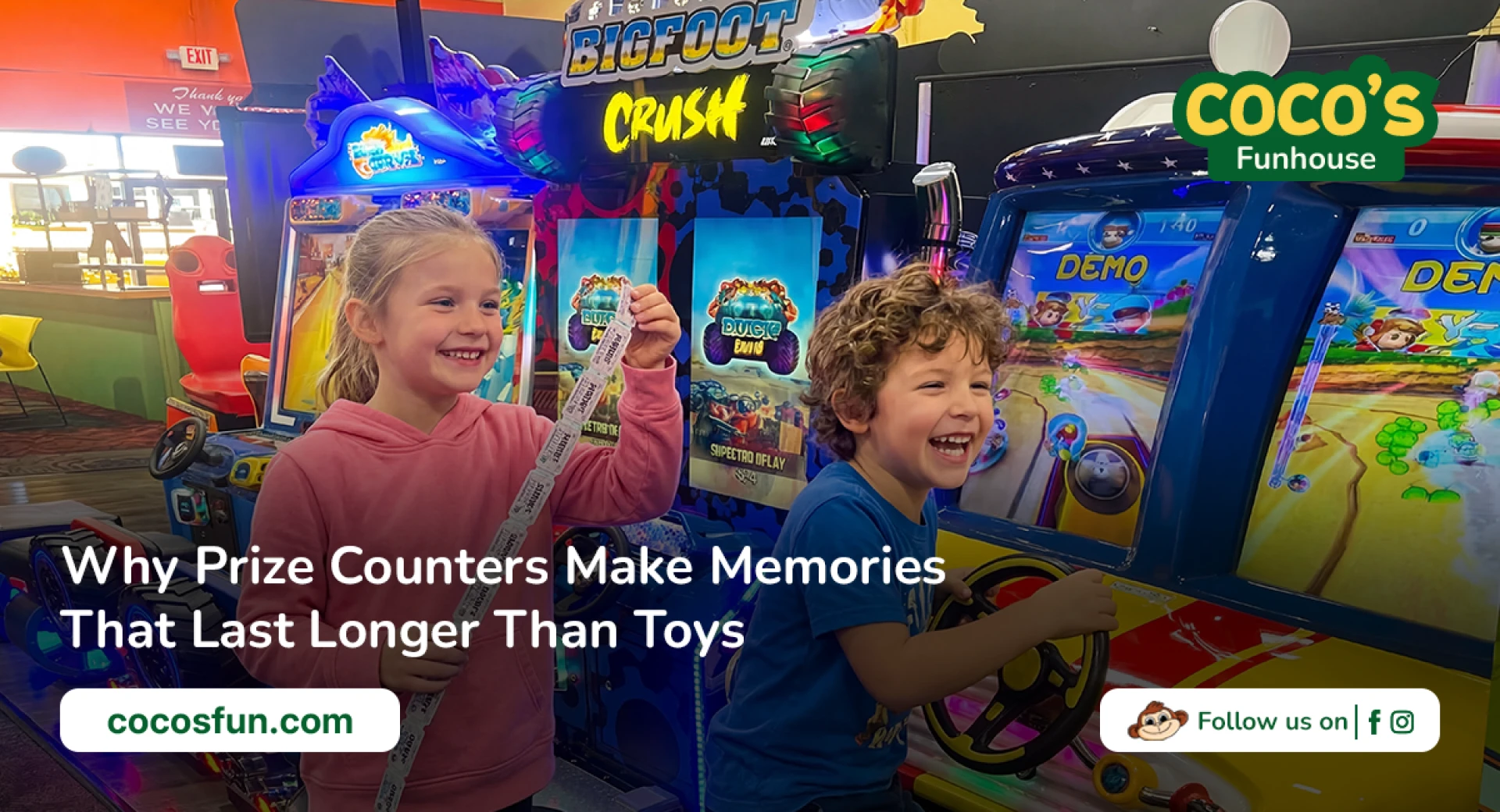
You played the games. You fed the machine tokens. You kept hitting the button at just the right time, and then you felt it. That rush... That little waterfall of tickets coming out, curling onto the floor like confetti.
And then came the walk. The walk to the prize counter.
That slow, purposeful stroll with your tickets clutched in your hand, scanning every shelf like you were choosing something life-changing. The sticky fingers from the candy you already snuck. The deliberating. Weighing your options. The moment you pointed and said, "That one."
Here's the thing, though. Do you even remember what you picked? Probably not. But you remember everything else.
The Toy Is Never Really the Point
Let's be honest with ourselves. The bouncy ball lasted three days. The plastic ring turned your finger green. The stuffed animal sat in the corner of your room until your mom quietly donated it.
But the memory? That one lives forever.
And that's the whole secret of the prize counter. One that families, kids, and business owners have been missing when they think about what makes a great entertainment experience. The prize isn't the product but the proof.
Proof that you played hard. Proof that you fed more tokens, tried again, and celebrated every extra ticket like it was a minor miracle. Proof that you earned something. When a child holds a strip of tickets and walks up to that counter with purpose, they aren't just redeeming paper. They're cashing in on an experience. They're holding a highlight reel of the last two hours in their hands.
And that feeling is worth more than any toy on any shelf.
Why Our Brains Remember Experiences
There's actual science to back this up, and it's fascinating.
Psychologists have found that experiential memories are stickier than memories tied to physical objects. When we go through an experience, our brains light up in a way that stuff just doesn't trigger.
The arcade does all four of those things at once.
There's the effort you put in, the strategizing, the trying for that jackpot. There's anticipation... Will I get enough tickets? Can I reach the 500-ticket toy? There's social interaction. You're playing next to your sibling, your best friend, your kid, or your parent. You're cheering each other on. There's emotion... The joy of winning, the mild frustration of losing, and the excitement of the walk to the counter.
That's a full emotional workout. And the brain remembers emotional workouts.
So while the toy eventually breaks, fades, or gets lost under the couch, the story of how you got it remains crystal clear. Years later, someone mentions a prize counter, and you're right back there. You'll see a seven-year-old trying to decide between the giant lollipop and the rubber dinosaur.
The Magic of "I Earned This"
There's something that the prize counter does that very few other childhood experiences can replicate. It teaches kids the honest, beautiful feeling of earning something.
Think about it. A birthday present is a gift. A toy from the store is a transaction between the parent and the cashier. But a prize counter item? That was negotiated by the child themselves, through their own effort and decision-making.
They played the game. They collected the tickets. They walked up to that counter, and they chose. That whole arc is an experience of self-agency that kids don't get to feel very often.
And it sticks.
Parents notice it too. There's a different kind of pride in a child who clutches a tiny plastic frog they got from a prize counter versus one who was handed a gift. They'll tell you how they got it. They'll explain exactly which game gave them the most tickets. They'll defend that tiny plastic frog like it's treasure because to them, it is. They made it treasure through the work of getting it.
That's not just fun. That's a micro life lesson wrapped in neon lights and game sounds.
What Families Are Really Buying
Here's a perspective shift worth sitting with, especially if you run an entertainment business. When a family walks into your venue, they aren't buying tokens. They aren't buying tickets. They aren't even buying toys. They're buying time together.
In a world where "spending time together" often just means being in the same room, the arcade flips all of that. Everyone is present. Everyone is engaged. Everyone is playing, competing, laughing, and reacting to each other in real time.
The prize counter is the crescendo of that shared experience. It's the part where the family gathers around together, helps the little one count their tickets, debates the options, and watches them beam with pride when they make their pick. It's a connection wrapped in a fun package.
That's priceless. And it's also why families come back.
Not because of a toy. Because of how they felt in that moment.
The Counter Itself Is a Stage
Don't underestimate the theatre of it all.
A well-curated prize counter isn't just a shelf with stuff on it. It's a stage. The layout, the lighting, the variety, and the organization contributes to the experience. Kids move along it slowly, deliberating, pointing, and asking questions. Parents peek at prices and feel satisfaction as they see their child engaged and excited.
When the counter is well-stocked, visually interesting, and has clear tier options, it creates a natural goal-setting moment. A child looks up at a prize counter and instantly starts dreaming. "If I get 500 more tickets, I can get that one."
And just like that, they're motivated. They want to play more. They're setting a goal and working toward it with everything they've got. That's engagement at a level most activities can't touch.
It Teaches More Than You Think
The prize counter sneaks in some unexpected lessons while kids are too busy having fun to notice.
Decision-making. With a limited number of tickets, kids have to actually weigh options. Do I get two small things or save for one big thing? Do I pick what I want or what my friend wants? It's low-stakes practice for real decision-making, and it matters.
Patience and delayed gratification. Coming back to save up for that one special prize? That's discipline. That's learning that some things are worth waiting for. That's a lesson parents spend years trying to teach and the prize counter delivers it joyfully.
Emotional regulation. Didn't quite get enough tickets for the item they wanted? That's disappointment, navigated in a safe and supported environment. Finding the joy in picking the next-best thing? That's resilience.
Fun is the best teacher. The prize counter is proof.
The Nostalgia Economy Is Real and It's Growing
Here's something fascinating about prize counters from a cultural standpoint... They're becoming one of the most powerful nostalgia triggers in family entertainment.
Millennials grew up in arcades. They remember the prize counters from their childhood with a warmth that borders on reverence. And now? They're parents. They're bringing their kids to the same kinds of venues, walking up to prize counters, and feeling that wave of memory wash over them.
Nostalgia is an incredible force emotionally and economically. When a parent gets emotional about something, they invest in it. They tell their friends. They come back. They create new memories in the same spaces where their old memories live.
The prize counter isn't just serving the kid in front of it. It's speaking to the parent standing behind them. It's saying, "Remember this?" You loved this. Now share it. That's a generational handoff of joy, happening at a glass counter full of plastic toys and oversized lollipops.
For the Businesses Reading This
If you run a family entertainment center, an arcade, a bowling alley, and a laser tag venue pay attention to your prize counter.
Not as a retail add-on or an afterthought. But as the emotional climax of the entire visit.
Stock it thoughtfully. Keep it fresh. Provide clear, achievable options for younger kids so no one walks away empty-handed. Have aspirational prizes for the dedicated players who keep coming back. Make sure it's visually exciting... A dark, dusty counter full of faded packaging is the opposite of magic.
Train your staff to treat the prize counter moment with the same energy and care as any other touchpoint in the venue. That transaction is often the last memory they make before leaving. Make it count.
Because that moment? That's what they'll talk about in the car on the way home. That's what they'll tell their friends about at school on Monday. That's what they'll remember ten, twenty, thirty years from now.
And that memory is what brings their own kids right back to you.
Conclusion
Prizes break. Toys get lost. But the story of how a child stood at a counter, tickets in hand, eyes wide, and chose their prize with complete and total conviction? That story lasts a lifetime.
The prize counter isn't about what's on the shelf. It's about what happens in front of it. The anticipation, the pride, the joy, the connection. It's about a child learning that they can earn something. A family sharing a moment. A parent reliving a memory while making a new one.
So next time you walk past one of those counters take a second to appreciate it for what it really is. Not a shelf full of trinkets. A shelf full of stories waiting to be made.
And honestly? That's the best prize of all.
























Sign in to leave a comment.