
If you have ever managed an industrial process line, you know that gases are notoriously difficult to measure accurately. Unlike liquids, which generally stay at a constant volume, gases are highly sensitive to their environment.
A sudden spike in ambient temperature or a minor drop in line pressure can completely warp your readings. If your facility relies on volumetric flow calculations, those fluctuations mean you are essentially guessing your actual consumption.
To get true accuracy, you need a system that calculates mass directly, which is exactly where a dedicated gas mass flow meter changes the game.
The Problem with Volumetric Measuring
Most traditional flow meters measure the volume of the gas passing through a pipe. While that sounds fine on paper, gas expands when heated and compresses under pressure.
If you measure 100 cubic meters of compressed gas in the chilly morning hours, that same mass of gas will occupy a completely different volume by mid-afternoon. To get the true value, you have to install additional temperature and pressure transmitters, and then run complex mathematical formulas to calculate the compensated flow.
It is a lot of extra hardware, more points of failure, and plenty of room for calculation errors.
Why Thermal Mass Technology Rules Gas Measurement
Instead of adding more sensors to compensate for environmental shifts, thermal mass technology bypasses the issue entirely.
These meters work on a simple scientific principle: moving gas molecules carry heat away from a heated element. The higher the mass of the gas flowing past, the greater the cooling effect.
Because it measures heat dissipation, this method calculates the actual mass of the gas directly. Temperature and pressure drops don't affect it at all.
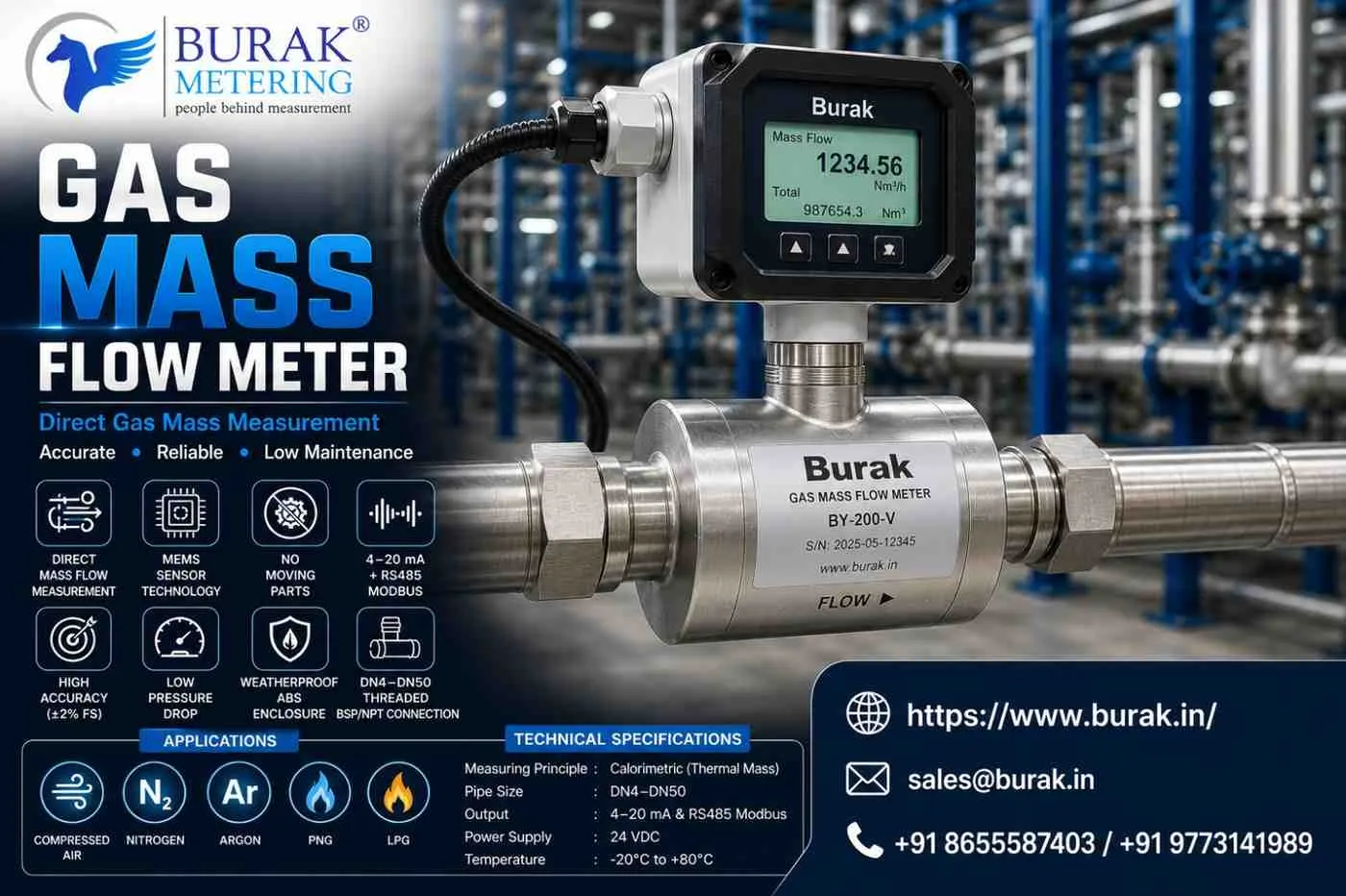
When you are dealing with critical setups like natural gas distribution, compressed air systems, or aeration lines, using an advanced setup like the Burak BY-200-V gas mass flow meter ensures you get direct, reliable readings without needing external compensation components.
Key Benefits of Upgrading to a Mass Flow Meter
If you are considering swapping out an older system, look for a few specific operational advantages:
- No Moving Parts: Because there are no spinning turbines or mechanical gears to wear down, maintenance drops to near zero.
- High Turndown Ratio: They can accurately measure both massive surges and incredibly tiny leaks in the same line.
- Low Pressure Drop: The sensor probe barely obstructs the pipe, meaning your system doesn't waste energy pushing gas past the meter.
Final Thoughts
Relying on uncompensated volumetric readings is a fast track to inefficient processes and inaccurate billing. By shifting to direct mass measurement, you strip away the complexity of external sensors and protect your line against temperature and pressure anomalies. It’s simply the smartest way to keep your data accurate and your operations smooth.

























Sign in to leave a comment.