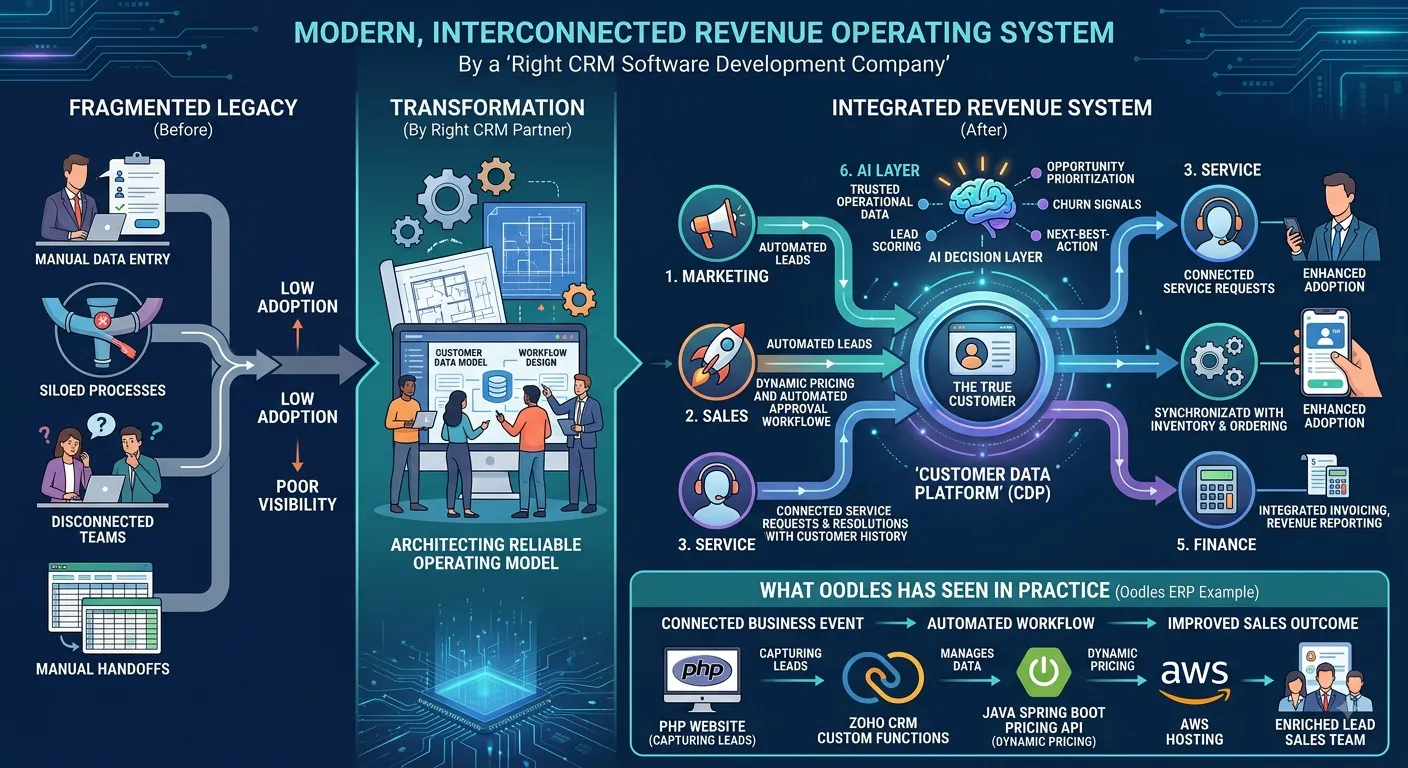

A CRM project rarely fails because a company cannot build contact records, sales pipelines, dashboards, or automated emails. It fails when those features reproduce the same fragmented processes that existed before the CRM.
That distinction matters when selecting a CRM Software Development Company. CIOs and CTOs are no longer evaluating CRM as another application for sales teams. They are deciding how customer information should move between marketing, sales, service, finance, ERP, and increasingly, AI systems.
The market reflects this shift. Gartner reported that the worldwide CRM market grew 13.4% to $128 billion in 2024, while customer data platforms grew 21.9%, highlighting the growing importance of connected customer information.
For leadership teams, the question is therefore not simply whether to build or buy CRM software. The better question is whether the implementation will create a reliable operating model for customer-facing teams.
That is where CRM applications become strategically important.
Why This Is Happening Now
CRM has moved beyond its traditional role as a sales database. Modern systems increasingly connect customer interactions with workflows, analytics, service operations, and AI-assisted decision-making.
Forrester reported in 2024 that nearly 70% of organizations planned to increase CRM investment over the following year. Its research also pointed to a recurring problem: organizations often demonstrate value through smaller technology initiatives but struggle to scale those investments across the enterprise.
The architecture is changing for the same reason.
Where traditional ERP systems rely on structured transactions and predefined business processes, modern CRM environments increasingly need to interpret conversations, behavioral signals, service events, and external customer data.
A CRM Software Development Company therefore needs to think beyond screens and modules. The real work is designing how information becomes an operational decision.
What a CRM Software Development Company Should Actually Build
1. A customer data model, not another database
A useful CRM begins with a definition of the customer, not the lead form.
For a B2B organization, one customer may include multiple contacts, subsidiaries, opportunities, contracts, service requests, invoices, communications, and product relationships. If these entities remain disconnected, AI and analytics simply process fragmented information faster.
This is why the first responsibility of a CRM Software Development Company should be creating a consistent customer data model. The architecture should define ownership, relationships, permissions, history, and synchronization before the interface is designed.
McKinsey has highlighted similar patterns in AI-enabled B2B sales, where combining CRM information with external and unstructured data can help identify next-best opportunities and prioritize accounts.
2. Workflows that reflect how revenue actually happens
CRM automation should represent business decisions, not merely automate clicks.
Consider a sales process where an opportunity requires pricing approval, technical validation, contract review, and finance clearance. A generic CRM may show these as pipeline stages. A well-designed system turns them into coordinated workflows with ownership, triggers, permissions, notifications, and escalation rules.
That distinction affects adoption.
When CRM mirrors the actual operating process, employees spend less time maintaining the system and more time using it. The development partner should therefore map the existing process, identify unnecessary handoffs, and determine which decisions should be automated before writing custom functionality.
3. AI should sit on top of trusted operational data
AI does not repair a poorly structured CRM.
A modern CRM Software Development Company should treat AI as a decision layer connected to validated customer information. Examples include lead scoring, opportunity prioritization, conversation summaries, churn signals, account research, next-best-action recommendations, and service assistance.
McKinsey documented an enterprise example where AI-generated account plans reduced work that typically required more than 10 hours to minutes, with the organization expecting a 5% to 15% sales uplift within a year.
The lesson is not that every CRM needs generative AI. It is that AI creates meaningful value when it is embedded into a measurable workflow.
What Oodles Has Seen in Practice
From our experience working with businesses on CRM and ERP-connected systems, one recurring problem is that organizations try to automate a fragmented process without first defining the information flow.
A practical example is Champion Cash Loans, where Oodles worked on connecting a PHP-based lead-generation website, Zoho CRM, and a Java-based vehicle-pricing API. The requirement was not simply CRM customization. The business needed incoming leads to be captured automatically, enriched with dynamic pricing information, and made available to sales teams without manual intervention. Oodles implemented the integration using Zoho custom functions, a Spring Boot pricing API, and AWS deployment.
The outcome was a connected lead-management and pricing workflow in which sales teams could access enriched lead information immediately.
That pattern is important. The value came from connecting systems around a business event, rather than adding another isolated CRM feature.
Oodles approaches similar requirements through its broader Oodles ecosystem, combining CRM, ERP, integrations, automation, and custom application development according to the operating model.
The Real Selection Criteria
A CRM Software Development Company should be evaluated on architecture decisions as much as development capability.
Can the team model complex customer relationships? Can it integrate ERP, finance, marketing, telephony, messaging, and external APIs? Can it design permissions and auditability for enterprise environments? Can it migrate historical data without creating duplicate customer identities? Can it explain how AI outputs will be validated?
These questions are more important than asking how many CRM features a vendor can demonstrate.
Forrester describes CRM as foundational front-office technology and notes that modernization commonly involves fragmented CRM ecosystems, governance, and change management.
The strongest implementations treat CRM as an operating architecture rather than a software purchase.
Conclusion
The next generation of CRM is being shaped less by the number of features inside the platform and more by the quality of connections around it. Customer data needs to move across departments, business rules need to trigger action, and AI needs reliable context before it can produce useful recommendations.
That changes what organizations should expect from a CRM Software Development Company. The right partner should challenge fragmented workflows, design the underlying data model, integrate surrounding systems, and connect technology investment to measurable operational outcomes.
For CIOs and CTOs, that is the more durable definition of CRM success: not a system that stores more customer information, but an architecture that helps the organization act on it intelligently.
Frequently Asked Questions
What does a CRM Software Development Company do?
A CRM Software Development Company designs, develops, customizes, and integrates CRM systems around specific business processes. Its work can include customer data modeling, workflow automation, third-party integrations, dashboards, migration, security, mobile access, and AI-enabled capabilities.
Is custom CRM better than packaged CRM?
Custom CRM is not automatically better. Packaged platforms are often appropriate when standard workflows meet business requirements. Custom development becomes more valuable when industry-specific processes, complex integrations, unique data models, or specialized automation create gaps that standard configuration cannot address.
How long does CRM software development take?
The timeline depends on scope, integrations, data migration, customization, security requirements, and testing. A focused CRM implementation can be delivered faster than a full enterprise platform. Organizations should define an MVP around measurable workflows before expanding functionality.
Should CRM be integrated with ERP?
Yes, when customer-facing processes depend on operational or financial data. CRM can manage prospects, opportunities, and customer interactions, while ERP handles areas such as orders, inventory, accounting, and fulfillment. Integration creates a shared operational view without forcing every function into one application.
How should I choose a CRM Software Development Company?
Evaluate the partner's architecture experience, integration capability, data migration approach, security practices, industry understanding, and evidence of completed CRM projects. Also ask how the team measures adoption and business outcomes after deployment, not only whether it can deliver the requested features.
























Sign in to leave a comment.