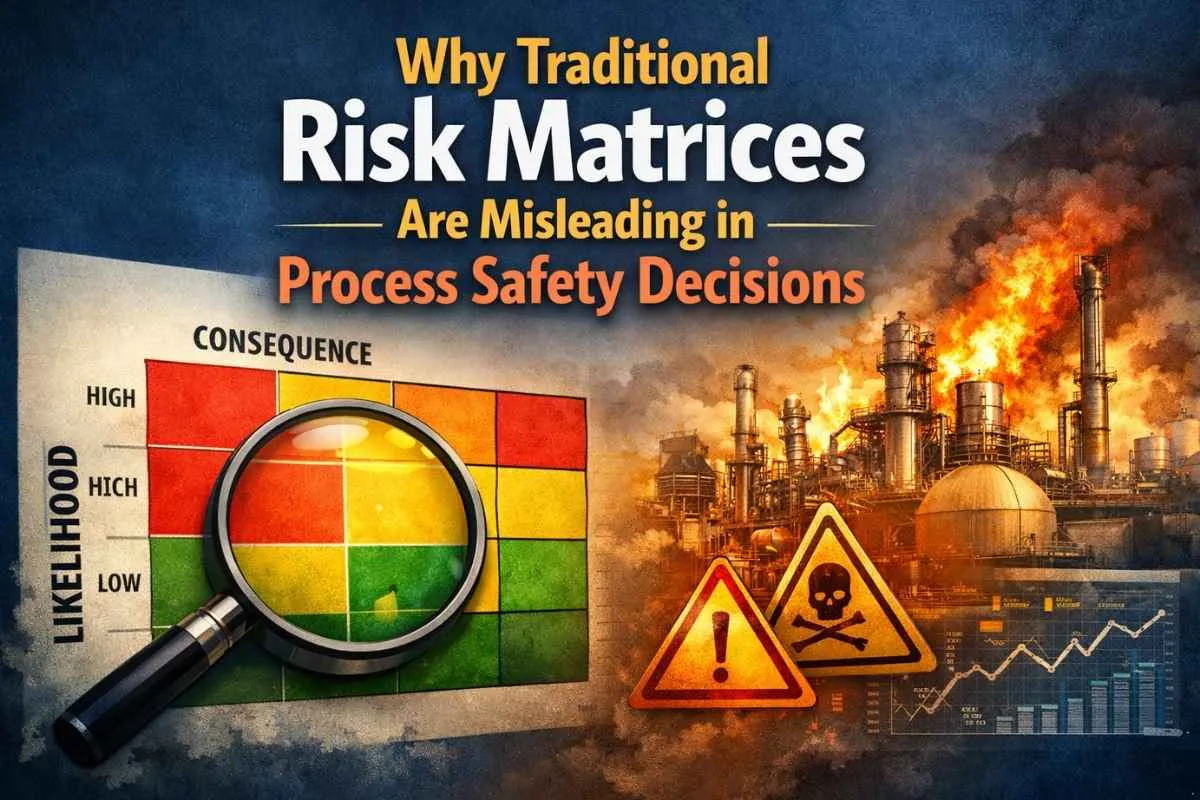

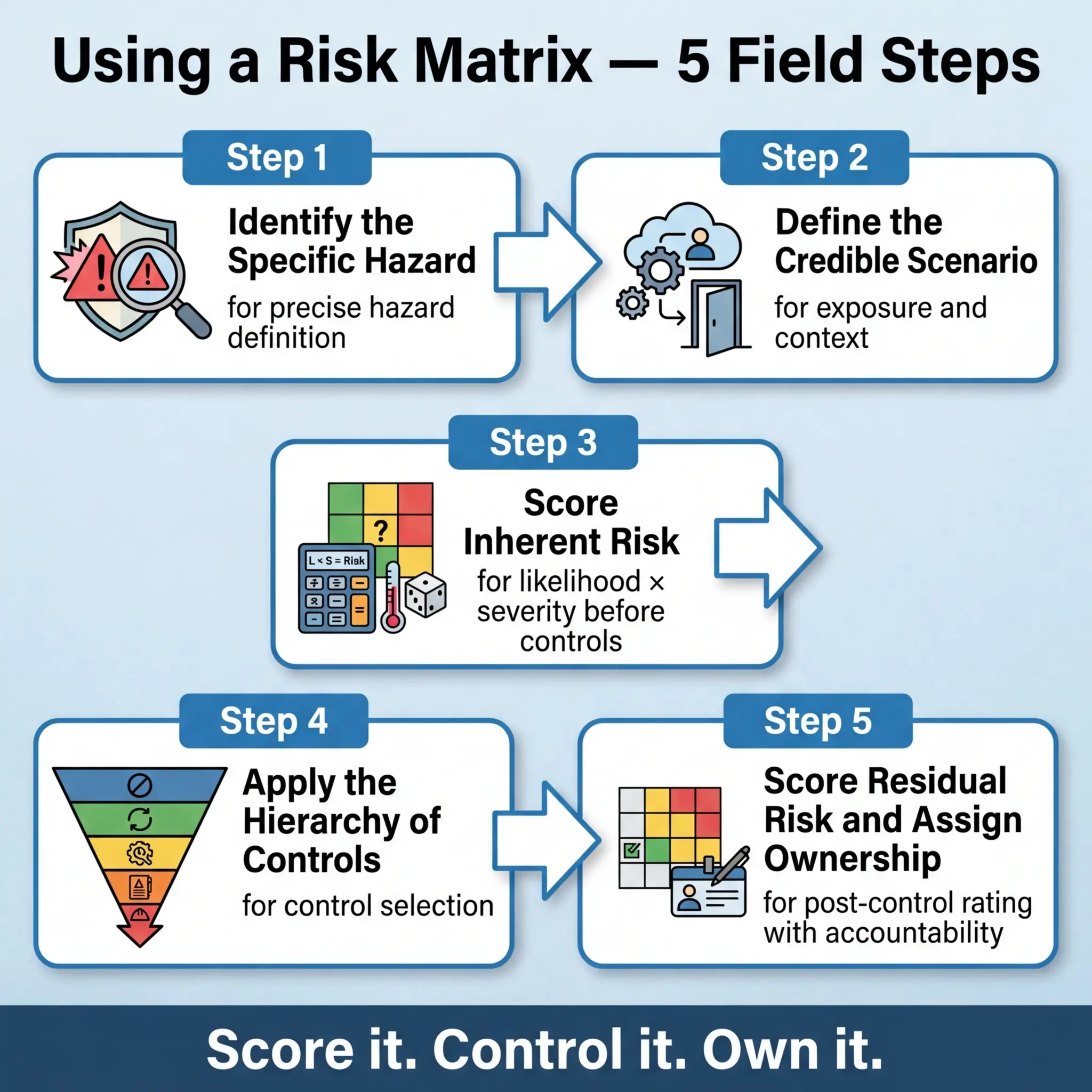
In many industrial environments, risk matrices are treated as a standard tool for evaluating hazards and guiding safety decisions. They appear structured, simple, and easy to communicate across teams. However, when applied to complex industrial systems, especially those involving hazardous chemicals and high-energy processes, traditional risk matrices often create a false sense of control rather than delivering accurate risk insights. Understanding their limitations is essential for improving decision-making within Process Safety Management frameworks.
The Illusion of Simplicity in Complex Systems
Risk matrices typically rely on two variables: likelihood and consequence. These are plotted on a grid to categorize risks as low, medium, or high. While this approach works reasonably well for simple, repetitive tasks, it falls short in process industries where systems are interconnected and failure modes are not always predictable.
In real-world scenarios, incidents rarely follow linear patterns. A minor deviation in pressure, temperature, or human intervention can escalate into a major event. Risk matrices tend to oversimplify these complexities by forcing nuanced risks into predefined categories. As a result, critical hazards may be underestimated simply because they do not fit neatly into the scoring framework.
Subjectivity in Risk Scoring
One of the most significant flaws of traditional risk matrices is their dependence on subjective judgment. Terms like “unlikely,” “possible,” or “frequent” are interpreted differently by individuals based on their experience, bias, or organizational culture.
For example, a maintenance engineer may rate a failure scenario as unlikely based on past experience, while a safety professional might consider it possible due to known industry incidents. This inconsistency leads to unreliable risk ratings, making it difficult to prioritize hazards effectively. Over time, such subjectivity can dilute the credibility of the entire risk assessment process.
Poor Representation of Low-Probability, High-Consequence Events
Process safety incidents are often characterized by low probability but extremely high consequences. Events like explosions, toxic releases, or major fires may not occur frequently, but when they do, the impact is severe.
Traditional risk matrices struggle to capture this imbalance. A scenario with catastrophic consequences but low likelihood may still fall into a “medium risk” category, leading to inadequate attention and control measures. This misrepresentation can result in organizations focusing more on frequent, low-impact risks while overlooking rare but devastating hazards.
Lack of Dynamic Risk Assessment
Industrial operations are dynamic by nature. Equipment conditions change, process parameters fluctuate, and human factors evolve over time. However, risk matrices are typically static tools, often created during initial assessments and rarely updated in real time.
This static nature means that risk evaluations may not reflect current operating conditions. For instance, a system operating under degraded conditions may carry significantly higher risk than initially assessed, but the matrix does not account for these changes unless manually revised. This gap can lead to outdated risk perceptions and delayed corrective actions.
Inadequate Consideration of Barrier Effectiveness
Effective process safety relies on multiple layers of protection, including engineering controls, administrative procedures, and safety systems. Traditional risk matrices often assume that these barriers are fully functional without evaluating their reliability or performance.
In practice, safety barriers can degrade over time due to poor maintenance, human error, or system design limitations. A risk matrix that does not account for barrier failure probabilities may significantly underestimate actual risk levels. This creates a disconnect between perceived safety and actual system resilience.
Over-Reliance on Color Coding
Color-coded risk matrices—typically using green, yellow, and red—are designed for quick visualization. While visually appealing, this approach can oversimplify decision-making. Stakeholders may focus more on the color category than on understanding the underlying risk factors.
For example, a “yellow” risk may be perceived as acceptable without deeper analysis, even if it involves a critical process deviation. This reliance on visual cues can discourage detailed discussions and lead to complacency in addressing underlying hazards.
Limited Support for Decision-Making
Risk matrices are often used to prioritize actions, allocate resources, and justify safety investments. However, their limitations reduce their effectiveness as decision-making tools. They do not provide quantitative insights into risk reduction, nor do they help compare the effectiveness of different mitigation strategies.
Advanced methodologies such as Layer of Protection Analysis (LOPA) or quantitative risk assessment (QRA) offer more precise evaluations by incorporating data, probabilities, and system behavior. These methods provide a clearer understanding of risk levels and support more informed decisions.
The Need for Competency and Structured Analysis
Improving process safety outcomes requires moving beyond simplistic tools toward more structured and analytical approaches. Competency plays a critical role in this transition. Professionals must understand system behavior, failure mechanisms, and risk modeling techniques to assess hazards accurately.
Programs like HAZOP Training help develop this capability by focusing on systematic hazard identification and deviation analysis. Such approaches encourage deeper examination of process conditions, interactions, and potential consequences, leading to more reliable risk assessments.
Moving Toward Better Risk Understanding
While risk matrices can still serve as a preliminary screening tool, they should not be the sole basis for critical safety decisions. Organizations need to integrate them with more robust methodologies, continuous monitoring, and data-driven insights.
A more effective approach involves combining qualitative and quantitative techniques, regularly updating risk assessments, and validating safety barriers. This ensures that risk evaluations remain aligned with actual operating conditions and system behavior.
Conclusion
Traditional risk matrices offer simplicity and ease of use, but their limitations make them unreliable for complex process safety decisions. Their reliance on subjective judgment, inability to capture high-consequence events accurately, and lack of dynamic assessment can lead to misleading conclusions.
To improve safety outcomes, organizations must adopt more comprehensive and analytical methods that reflect the true nature of industrial risks. By doing so, they can move from a compliance-driven mindset to a more informed and resilient approach to process safety.




























Sign in to leave a comment.