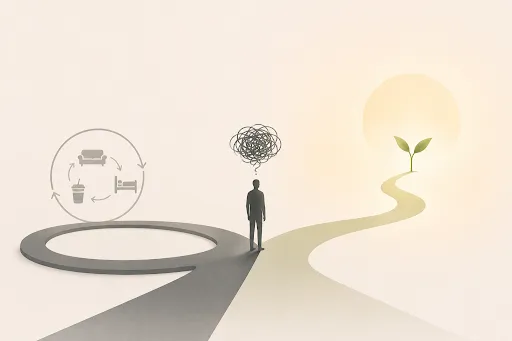

You have read the books. Atomic Habits is on your shelf, possibly dog-eared. You know about habit stacking, cue-routine-reward loops, the two-minute rule. You could probably teach a seminar on the theory of behavior change.
You have started the morning routine, the meditation practice, the consistent bedtime, the meal prep Sunday, more times than you can count.
And within two to three weeks, sometimes less, it quietly falls apart. Not from a dramatic failure. Just an erosion. A skipped day becomes two becomes the old pattern again, and you are left wondering what is wrong with your discipline.
Nothing is wrong with your discipline.
Something else is happening, and it has very little to do with willpower.
The Brain Defaults to Habit Under Stress, Not Despite It
Here is what habit research consistently shows: under conditions of stress, distraction, or high mental demand, the brain doesn't resist falling back into old patterns. It is built to.
Neuroscience research on habit formation from PennNeuroKnow shows that conditions such as stress, time pressure, and sleep deprivation weaken the brain's goal-directed system. This is the part of the brain responsible for making deliberate choices and building new behaviors. At the same time, these conditions strengthen the stimulus-response system, which relies on automatic habits and routines. As a result, the brain becomes less focused on conscious goals and more likely to fall back on familiar patterns and behaviors.
This is not a character flaw. It is the brain conserving energy under perceived threat, exactly as it is designed to. Habits exist precisely because they let the brain stop critically thinking about a behavior. That is an asset when the behavior is one you want. It becomes a serious liability when stress pushes you straight back toward the behavior you are trying to leave behind, simply because it requires the least cognitive effort to execute.
Which means: if your nervous system is chronically activated, treating ordinary daily pressure as a sustained threat, you are trying to build new habits using precisely the cognitive system that gets shut down first whenever your body senses it needs to conserve resources for survival rather than growth.
You are not failing at habits. You are fighting your own physiology, and your physiology is winning every time, by design.
Why "New" Reads as "Unsafe"
There is a second layer to this that most habit advice never addresses, and it goes beyond simple energy conservation.
A nervous system that has spent a long time in sympathetic dominance, the chronic stress response, doesn't just conserve energy under pressure. It becomes oriented toward predictability as a survival strategy. Familiar patterns, even unhelpful ones, are processed as safe simply because they are known and have not yet caused catastrophe. Unfamiliar ones, even genuinely good ones, register as a variable the system hasn't yet confirmed it can survive.
This is part of why chronic stress sensitizes reactivity to new stimuli — the system that has adapted to prolonged pressure becomes more reactive, not less, to anything that introduces uncertainty.
A new habit is, by definition, uncertainty. It asks the body to tolerate an unfamiliar routine, an unfamiliar discomfort, an unfamiliar version of identity. The nervous system doesn't evaluate any of this on its actual merits. It evaluates it on whether it disrupts the known pattern, and disruption is exactly what a dysregulated system is organized to resist.
This is also why the resistance often shows up strongest right when things are going well. The third or fourth successful day of a new habit can trigger more anxiety than the first, because the nervous system registers sustained change as a bigger threat than a single deviation. People frequently interpret this anxiety as evidence the habit "isn't working" for them, when it is actually evidence that it is working exactly as expected for a system unaccustomed to new input.
This is why willpower-based approaches work for a while and then collapse. Willpower is a finite cognitive resource. It depletes under stress, often within days. The nervous system's resistance to change does not deplete. It persists for as long as the underlying dysregulation persists, which for many people is years.
The Self-Criticism Loop That Makes It Worse
There is a particularly cruel irony built into most people's response to a broken habit streak: they respond with self-criticism, which is itself a stress response, which further entrenches the very system working against the new habit in the first place.
Research from the Australian Society of Lifestyle Medicine on the neuroscience of habit change has found that a critical, judgmental view of one's own behavior directly activates the sympathetic nervous system. The moment you tell yourself you have no discipline, you are not motivating future behavior. You are recreating the exact physiological state, sympathetic activation, that made the original habit difficult to sustain.
A self-compassionate stance, by contrast, has been shown to help the nervous system relax enough to actually investigate what triggered the lapse in the first place, whether it was a particular emotion, a specific time of day, or a place associated with the old pattern.
This is not a minor detail. It is often the actual hinge point between people who eventually build lasting change and people who stay stuck in the same cycle for years, blaming themselves for a problem that was never really about effort.
What Actually Has to Shift First
Caitilin Twain, a National Board-Certified Health and Wellness Coach with nearly two decades of experience helping high performers build lasting change, sees this pattern constantly in her work.
"People come to me believing they have a discipline problem," she says. "What they almost always have is a safety problem. Their nervous system has never been given a reason to believe that change is something it can survive. Until that shifts, no habit plan, however well designed, is going to hold."
This is the foundation of the mindset pillar in her C.Twain Method — not positive thinking, but the deliberate work of helping the nervous system register new behavior as safe rather than threatening, so that change can actually take root instead of being overridden the moment stress rises.
In practice, this often means starting with changes far smaller than the person initially wants to attempt, not because the bigger goal isn't valid, but because a nervous system that has been resisting change for years needs repeated, low-stakes evidence that new behavior does not lead to disaster before it will stop fighting larger shifts.
Twain's work pairs this nervous-system-first approach with constructive rest and breathwork, addressing the physiological baseline that has to shift before any new behavior has a real chance of becoming automatic rather than another thing willpower has to fight for day after day.
Where to Actually Start
If you have tried every system, every app, every accountability partner, and still find yourself back at the beginning, the missing variable usually is not the system.
It is whether your nervous system believes, at a physiological level, that this version of you is safe to become.
That belief is not built through willpower. It is built through consistent, deliberate signals of safety, the kind that calm the threat response enough for new patterns to finally have room to exist without being treated as an emergency.
The habit was never really the problem. The system underneath it was. And that system can change. It simply requires a different kind of work than the kind most habit advice prepares you for.



























Sign in to leave a comment.