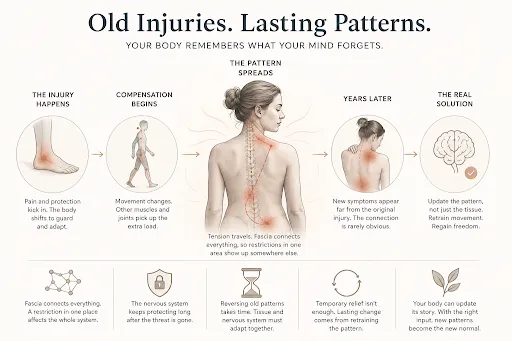

You sprained your ankle years ago. Maybe it was a car accident. A fall on the ice. A shoulder injury from a sport you don't even play anymore.
At the time, it hurt, then it healed. The doctor cleared you. The imaging came back clean. You stopped thinking about it.
And yet somewhere along the way, tension started showing up in places that have nothing, structurally, to do with that old injury. A stiff hip. A shoulder that never quite relaxes. A lower back that aches for no obvious reason. You have probably never connected these to the injury from years ago, because why would you. It healed. That was a long time ago.
But your body may never have gotten the memo.
Healed Tissue Is Not the Same as a Resolved Pattern
When an injury occurs, the body's first priority is protection, not full function.
It guards. It shifts weight away from the injured area. It recruits other muscles and joints to compensate, often without any conscious decision involved. This is adaptive and necessary in the short term. The problem is what happens after the tissue itself has healed.
When the body remains in protective holding for long enough, even after the original threat has resolved, connective tissue receives less varied movement and mechanical input over time. This contributes to the stiffness and reduced mobility many people simply accept as "getting older" or "just how my body is," without realizing it traces back to a single specific event.
This is not a structural problem the way an X-ray would show it. It is a learned pattern, one the nervous system continues to run long after the reason for running it has disappeared.
How One Injury Becomes a Body-Wide Pattern
The mechanism behind this is called compensation, and it is well documented in physical rehabilitation literature.
If you injure an ankle and unconsciously avoid putting full weight on it, you begin walking differently. That altered gait doesn't stay contained to the ankle. It shifts load to the opposite leg, which changes how the hips track, which changes spinal alignment, which can eventually show up as neck or shoulder tension that seems to have nothing to do with the original ankle injury at all.
The further the symptom shows up from the original site, the less obvious the connection becomes, and the more likely it is to be treated as an unrelated, isolated problem.
This compounding effect is amplified by fascia, the connective tissue web that runs continuously throughout the body. Because fascia connects everything, muscle, bone, organ, and nerve, in one continuous network, a restriction in one area does not stay local. It propagates. A tailbone injury, for example, can stiffen pelvic fascia in a way that alters posture and creates compensatory tension patterns that travel all the way up the spine.
The deeper issue is that the nervous system has effectively built a map, a default movement and protection pattern based on an injury that, structurally, no longer exists. Updating that map takes more than time. It takes deliberate, gradual input that teaches the nervous system the threat has genuinely passed.
Why This Takes Time to Reverse
This is one of the most important and most overlooked aspects of working with old injury patterns: the body cannot simply be forced back into its original alignment in a single session.
Addressing old injury patterns happens in stages, because the surrounding tissue and the nervous system both need time to adapt to new movement possibilities. You cannot release tight fascia and expect it to simply stay released if the nervous system underneath it has not also updated its sense of what is safe. The tissue change and the neurological change have to happen together, gradually, for the new pattern to actually hold.
This is also why so many people experience temporary relief from massage, chiropractic adjustment, or stretching, only to find the original tension fully returns within days. The intervention addressed the tissue. It did not address the nervous system pattern still generating the guarding in the first place.
What Changes When the Root Pattern Is Addressed
Caitilin Twain, a National Board-Certified Health and Wellness Coach and movement specialist with nearly two decades of experience, sees this pattern constantly in her work.
"People come to me thinking their current pain started recently," she explains. "Often, when we actually map their movement and tension patterns, it traces directly back to something that happened years, sometimes decades, earlier. The body never stopped protecting that area. It just got quieter about it, until the compensation finally caught up somewhere else."
This is the foundation of the fascia and movement pillar in her C.Twain Method, combining self-myofascial release with nervous system regulation so the body can finally update the protective patterns it has been running on autopilot, rather than simply releasing surface tension that returns within days. Her full approach is detailed at ctwain.com.
Where to Start Looking
If you have an area of chronic tension or restriction that has never fully made sense, ask yourself when it actually started. Not when you first noticed it, but what happened in the months or years before.
An old injury, a surgery, a fall you barely remember, a sport you stopped playing because something never felt quite right afterward.
The connection is often there. It simply requires looking further back than most people think to ask.































Sign in to leave a comment.