
There is a particular version of sleep deprivation that has nothing to do with time.
You are in bed by ten. You are getting seven, maybe eight hours. You have tried the magnesium, the weighted blanket, the blackout curtains. You have an alarm set and you are following all the rules.
And yet you wake up tired. Again.
Not the tired that a lazy Sunday fixes. A deeper tired. The kind that has been accumulating for months, possibly years, and that no amount of horizontal time seems to touch.
If this is familiar, the problem is almost certainly not your sleep habits. The problem is that your nervous system was never given the signal that it was safe to actually rest.
Sleep Quantity and Sleep Quality Are Not the Same Thing
This is the distinction that most sleep advice skips entirely.
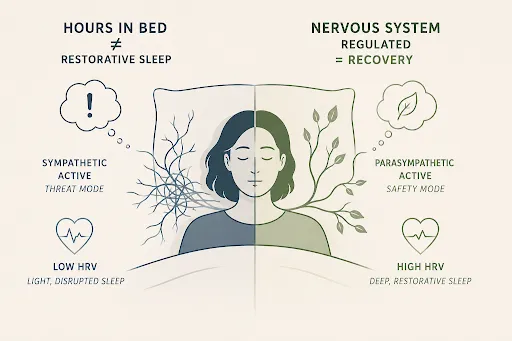
Hours in bed are not hours of restorative sleep. For genuine recovery to happen, the kind that repairs tissue, consolidates memory, regulates hormones, and leaves you functional the next morning, your nervous system needs to shift into a parasympathetic state. The rest-and-digest mode. The one that signals safety, slows the heart rate, and allows the body to stop defending itself and start rebuilding.
For someone living under chronic stress, that shift often never fully happens.
The sympathetic nervous system, your threat-detection system, doesn't clock out when you close your eyes. If it has been running in the background for months or years without adequate recovery, it stays activated through the night. The result is sleep that looks normal on a calendar and feels like a performance review.
What Your HRV Is Actually Telling You
Heart rate variability, the slight fluctuation in time between each heartbeat, has become a reliable window into the state of the autonomic nervous system. When HRV is high, the parasympathetic system is in charge and the body is genuinely recovering. When HRV is low, the sympathetic system is dominant and the body is working, even in sleep.
Research published in the Annals of Behavioral Medicine found that people with lower resting HRV were significantly more vulnerable to sleep disturbances under chronic stress, and that this poor sleep quality, in turn, was linked to higher rates of depressive symptoms. The authors identified low HRV as a biomarker for what they called "sleep reactivity to stress": the tendency to experience disrupted sleep not because anything is wrong with sleep itself, but because the nervous system is treating rest as another thing to get through.
A separate study published in Frontiers in Physiology confirmed that heightened parasympathetic activity is associated with both faster sleep onset and more time in deep, restorative sleep. Increased sympathetic activity, on the other hand, is linked to difficulty falling asleep and a higher proportion of light sleep that doesn't recover the body adequately.
In other words: the wearable on your wrist may already be telling you something your sleep tracker's basic readout is glossing over. Low nightly HRV is not a hardware problem. It is a nervous system signal.
Why Better Sleep Habits Only Go So Far
Sleep hygiene matters. Consistent timing, reducing stimulants, darkening the room, these are not useless recommendations. But they address the conditions around sleep. They do not address the system that determines whether sleep is actually restorative.
If the nervous system hasn't been given the chance to return to a regulated baseline during the day, it cannot simply snap into recovery mode at night because the lights are off. The nervous system doesn't respond to scheduling. It responds to sustained safety, and sustained safety takes deliberate practice to rebuild.
This is why high performers who "sleep fine" by conventional measures can still feel chronically depleted. They are accumulating hours without accumulating recovery.
The Most Direct Tool Available
Breathwork, specifically slow, diaphragmatic breathing, is one of the most rigorously evidenced and immediately accessible tools for shifting the nervous system toward genuine rest.
A 2025 review in Frontiers in Sleep, examining studies across multiple adult populations, found that controlled breathing exercises activate the parasympathetic nervous system while suppressing sympathetic activity, creating physiological conditions that are directly conducive to sleep. Four weeks of daily diaphragmatic breathing practice significantly improved sleep quality and reduced anxiety across participants. The mechanism is straightforward: slow exhalation in particular engages the vagus nerve, signaling safety to the brain and beginning the downshift that quality sleep depends on.
This is not a relaxation hack. It is a physiological intervention that addresses the actual barrier between you and restorative rest.
Caitilin Twain, a National Board-Certified Health and Wellness Coach who has worked with high-achieving clients for nearly two decades, integrates breathwork as a foundational pillar of her method for exactly this reason. "Breath is the one input you can control that speaks directly to the nervous system," she explains. "Until the nervous system receives the signal that it's safe to downregulate, sleep is just unconsciousness. It's not recovery."
She also uses HeartMath® biofeedback technology with clients struggling to break this pattern, since it offers something breathwork alone cannot: real-time visual proof that the nervous system is actually shifting. Rather than guessing whether a practice is working, clients can watch their own heart rhythm move from the erratic, incoherent pattern of sympathetic dominance into the smoother, more coherent rhythm associated with genuine parasympathetic recovery. For someone who has spent years unable to tell the difference between exhaustion and rest, that kind of immediate feedback can be the missing piece that makes the nervous system work click into place.
Her approach addresses the full nervous system picture, not sleep as an isolated problem, but as an expression of a system that has been asked to do too much without adequate support. For those also experiencing the physical toll of chronic tension alongside disrupted sleep, her Neck and Shoulder Pain Relief method addresses one of the most consistent physical expressions of a system running in overdrive, the kind that keeps the body guarded even when the mind is trying to wind down.
The Question Worth Asking
If you wake up and genuinely feel rested - not functional, not caffeinated - but actually restored, that is a nervous system that recovered overnight.
If that rested feeling is something you are struggling to remember, the solution is not just an earlier bedtime or a different pillow.
It is giving your nervous system, during the day and before sleep, what it actually needs to stop treating rest as a threat.
The hours are already there. The question is what is happening inside them.





























Sign in to leave a comment.