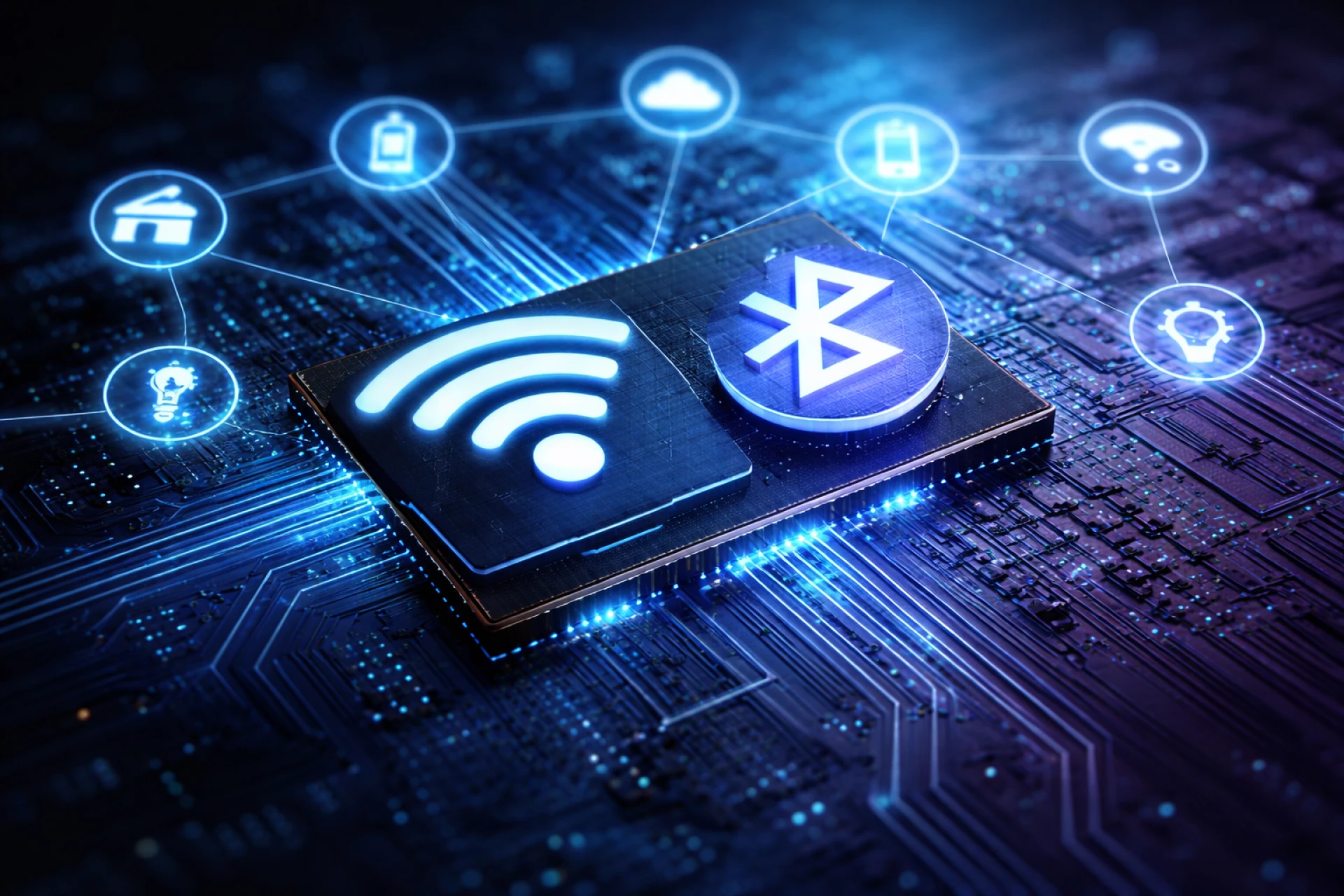

Wireless connectivity has quietly become the foundation of modern digital life. From smart homes and wearable health monitors to industrial sensors and retail automation, connected devices are everywhere. Behind this growing ecosystem lies an important technological shift — the integration of Wi-Fi and Bluetooth Low Energy (BLE) into unified wireless solutions.
Why Dual Wireless Connectivity Matters
Traditionally, devices relied on a single communication protocol. However, the needs of modern electronics are far more complex. Some applications require high-speed data transfer, while others demand extremely low power consumption. Integrating Wi-Fi and BLE into one architecture allows designers to balance performance and efficiency without adding multiple chips or increasing hardware complexity.
Wi-Fi provides fast data throughput and long-range internet connectivity, making it ideal for streaming, firmware updates, and cloud communication. BLE, on the other hand, is optimized for short-range, low-energy communication such as device pairing, sensor monitoring, and background connectivity. When combined, these two technologies enable devices to switch intelligently between speed and efficiency depending on usage.
Benefits for Device Manufacturers
The integration of dual wireless capabilities brings several practical advantages:
- Reduced Hardware Footprint – Fewer components mean smaller PCB layouts and more compact devices.
- Lower Power Consumption – Smart power management extends battery life in portable electronics.
- Cost Optimization – Consolidating communication modules helps reduce bill of materials and manufacturing complexity.
- Improved User Experience – Faster pairing, seamless updates, and stable connectivity enhance product reliability.
These advantages are especially relevant in markets where miniaturization, energy efficiency, and affordability are critical success factors.
Applications Across Industries
Dual wireless connectivity is not limited to consumer gadgets. Its adoption spans multiple sectors:
- Smart Home Automation – Lighting systems, security sensors, and voice-controlled appliances.
- Wearable Technology – Fitness trackers, smartwatches, and medical monitoring bands.
- Industrial IoT – Asset tracking, predictive maintenance sensors, and remote diagnostics.
- Healthcare Devices – Portable monitors and connected diagnostic equipment.
- Retail and Logistics – Electronic shelf labels, inventory tracking, and payment systems.
As industries move toward automation and real-time data exchange, reliable wireless communication becomes increasingly essential.
Power Efficiency as a Design Priority
One of the most significant challenges in connected electronics is energy consumption. Devices that rely solely on high-bandwidth communication may drain batteries quickly. BLE addresses this issue by allowing continuous low-power operation for background tasks while Wi-Fi activates only when large data transfers are necessary. This hybrid approach ensures longer operational cycles without sacrificing performance.
Scalability and Future Compatibility
Modern wireless architectures are being designed with scalability in mind. Support for firmware upgrades, multiple host interfaces, and evolving security standards ensures devices remain relevant even as protocols and regulations change. Compatibility with emerging ecosystems such as smart home standards and mesh networking further increases long-term value.
The Road Ahead
The demand for connected devices continues to grow as digital transformation reaches every industry. Integration of Wi-Fi and Bluetooth Low Energy is no longer just a technical enhancement — it has become a strategic necessity for efficient, intelligent, and sustainable product design. As semiconductor innovation progresses, unified wireless solutions will likely serve as the backbone of next-generation electronics, enabling smarter systems that are faster, smaller, and more energy efficient than ever before in semiconductor technology


























Sign in to leave a comment.