
You have probably been through the whole list already. Melatonin gummies before bed. A cup of chamomile tea. Cutting your screen time. Going to bed at the same hour every night. Maybe even spending good money on a sleep supplement that promised deep, restful nights.
And yet, there you are at 2 am, wide awake, brain buzzing like you just had a double espresso.
Here is what nobody tells you: most sleep supplements are built to knock you out, not to help your body actually sleep better. There is a big difference between those two things. One is a shortcut. The other is what your body actually needs.

The missing piece for a lot of people is not another herb or a higher melatonin dose. It is a single mineral that your body uses in over 300 different processes every single day, and most of us are not getting enough of it.
That mineral is magnesium.
If you want to understand why your sleep has been off, and what actually helps, keep reading. This is not a product pitch. This is the full picture.
Why Most Sleep Supplements Do Not Fix the Real Problem
When people cannot sleep, the first instinct is to find something that makes you feel sleepy. So the supplement market is full of things that do exactly that: melatonin, valerian root, passionflower, L-theanine, GABA supplements, and so on.
These things are not useless. Some of them can help you fall asleep faster. But here is the honest truth: they work on the surface. They tell your brain to wind down without actually giving your body the tools it needs to do the job properly.
Think of it like this. Imagine your phone battery is running low. You could lower the screen brightness to make it last longer. That is what sedative supplements do. Or you could plug it in and charge it properly. Magnesium is closer to the charger.
Sleep Is Not Passive. Your Body Is Working Hard.
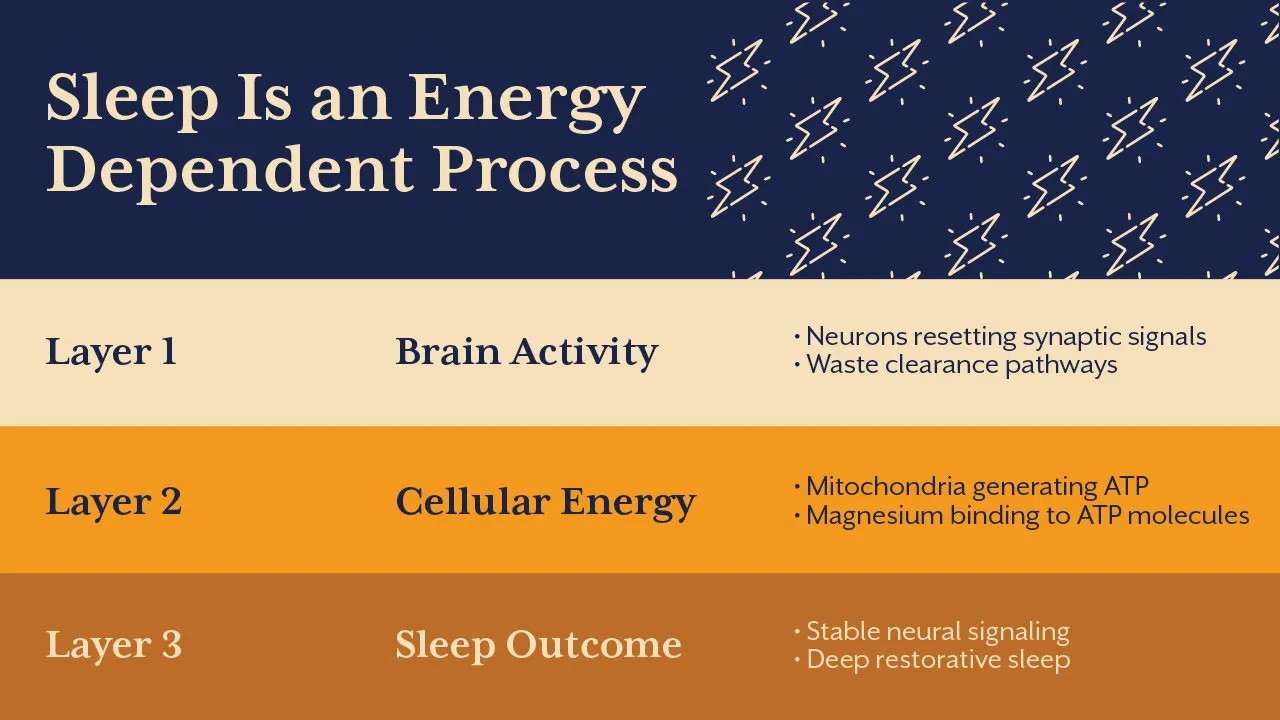
Most people think sleep is just the absence of being awake. But your body is incredibly busy while you sleep. Your brain is clearing out waste products. Your cells are repairing themselves. Your nervous system is resetting for the next day.
All of this work requires energy. And energy in your body comes from a molecule called ATP. Here is the part that surprises most people: ATP only works properly when it is bound to magnesium. Without enough magnesium, your cells cannot use energy efficiently, even during sleep.
So when magnesium is low, your body cannot do the repair work that sleep is supposed to deliver. You might be in bed for eight hours and still wake up feeling flat and drained.
What Magnesium Actually Does for Your Sleep
Magnesium is involved in sleep through several real, physical pathways in the body. It is not a vague wellness claim. Here is how it actually works.
It Helps Your Brain Switch Off
Your brain has two main modes: active and calm. When you are stressed, thinking, working, or anxious, your brain is in active mode. For sleep to happen, it needs to shift into calm mode.
Magnesium plays a key role in this shift. It activates GABA receptors in the brain. GABA is the chemical messenger that puts the brakes on mental activity. When GABA is working well, racing thoughts slow down, your body relaxes, and sleep comes naturally.
Magnesium also keeps something called NMDA receptors in check. These receptors drive excitatory signals in the brain. Too much activity here keeps your mind wired even when you are exhausted. Adequate magnesium helps prevent this from happening.
This is why people with low magnesium often describe feeling tired but wired. Their body wants to sleep, but their brain simply will not let it happen.
It Helps Your Muscles and Body Relax
Magnesium and calcium work together in your muscles. Calcium triggers muscle contractions. Magnesium allows muscles to release and relax. When magnesium is low, muscles stay in a more contracted state.
This is connected to things like leg cramps at night, restlessness, and the feeling that you just cannot get comfortable in bed. Low magnesium may be part of why your body physically struggles to wind down.
It Supports Your Internal Clock
Your body follows a natural rhythm across each 24-hour period. This rhythm tells you when to feel awake and when to feel sleepy. Magnesium plays a role in regulating this clock, especially in how your body responds to light and darkness and produces the hormones that guide the sleep-wake cycle.
When magnesium is insufficient, this rhythm can become disrupted. You may notice you feel awake late at night but groggy in the morning. That mismatch is often a sign that the system is off balance.
Are You Actually Low in Magnesium?
The short answer is: you probably are, and you would not necessarily know it.
Magnesium deficiency is genuinely widespread. Modern farming practices have stripped a lot of magnesium from soil, which means less of it ends up in the food we eat. Add to that the fact that stress burns through magnesium faster than almost anything else, and it becomes clear why so many people are running low.
A standard blood test will not even catch it reliably. Most magnesium in your body is stored in bones and cells, not in the blood. Blood levels can look normal while your tissues are actually depleted.
Signs That Magnesium Could Be Low
- You find it hard to fall asleep, or you wake up multiple times in the night
- Your mind races even when you are physically exhausted
- You get muscle cramps, twitches, or restless legs, especially at night
- You feel anxious or on edge without a clear reason
- You are tired during the day even after a full night in bed
- Headaches or migraines appear regularly
- You have been under prolonged stress for a long period
None of these signs alone proves a deficiency, but if several of them feel familiar, it is worth paying attention to.
Not All Magnesium Supplements Are the Same
If you have ever tried a magnesium supplement before and felt nothing, this part matters a lot.
The most common and cheapest forms of magnesium, like magnesium oxide and magnesium carbonate, have very poor absorption. A large portion of what you swallow passes straight through without being used. Some forms are also harsh on the digestive system and cause loose stools, which puts people off immediately.
The form of magnesium makes a real difference to whether your body can actually use it.
Why Magnesium Bisglycinate Is Different
Magnesium bisglycinate is a chelated form of magnesium. This means the magnesium is bonded to an amino acid called glycine, which helps it pass through the gut wall much more easily and reach the cells where it is needed.
Glycine itself is worth paying attention to. It is a calming amino acid that supports GABA activity and has been shown in research to improve sleep quality on its own. When it is paired with magnesium, you get both nutrients working in the same direction at the same time.
Magnesium bisglycinate is also significantly gentler on the stomach. People who have tried and given up on other magnesium forms often find this one easy to tolerate.
If you are serious about using magnesium to support your sleep, the form you choose is not a minor detail. It is the difference between a supplement that does something and one that does not.
What a Smarter Sleep Routine Actually Looks Like
The people who see real, lasting improvements in sleep are not the ones who find a single magic supplement. They are the ones who treat sleep as something the whole body needs to be prepared for, not just the brain.
Magnesium is a foundational piece, but it works even better when the rest of the picture supports it.
Pair It With Vitamin D
A large portion of the population has low vitamin D, especially in India where sun exposure is not always consistent across seasons and lifestyles. Vitamin D is involved in regulating the sleep-wake cycle and has receptors in the brain that influence how we feel at night. Low vitamin D is consistently linked to poor sleep quality.
If you are taking magnesium and not addressing vitamin D, you may be missing one of the other major contributors to disrupted sleep.
Think About Your B Vitamins
B vitamins support the conversion of the nutrients you eat into the neurotransmitters that actually make you feel calm and sleepy. Serotonin, which is a precursor to melatonin, is made with the help of B6. Deficiency in B vitamins can interfere with both mood and sleep quality in ways that are easy to overlook.
Support Your Nervous System Overall
Sleep is a nervous system event. It requires your parasympathetic nervous system, the rest and digest side, to be dominant. Everything that keeps you in a state of chronic stress: poor nutrition, lack of movement, blood sugar swings, pulls you out of that state.
Magnesium helps push you back toward calm. So does reducing caffeine after midday, eating a proper dinner that includes protein and healthy fats, getting some daylight in the morning, and not checking your phone the moment you open your eyes.
These are not complicated changes. But they work because they work with your body instead of against it. You can explore a range of nutrients designed to support this kind of whole-body balance at iThrive.
How to Take Magnesium for Sleep
A few practical things worth knowing:
Timing
Taking magnesium in the evening, roughly an hour before bed, is when most people find it most useful. This gives it time to be absorbed and to begin supporting the shift toward a calmer nervous system state.
Dosage
General adult recommendations are usually in the range of 200 to 400 mg of elemental magnesium per day. The right amount for you may depend on your individual needs, your diet, and what else you are taking. Starting on the lower end and seeing how you respond is a reasonable approach.
Consistency
Magnesium is not like a sleeping tablet that works the first night and stops when you stop taking it. It builds up in your tissues over time. Most people notice real changes within two to four weeks of consistent daily use. Give it time before deciding whether it is helping.
Food Sources
You can also support your magnesium levels through food. Good sources include dark leafy greens like spinach, pumpkin seeds, dark chocolate, almonds, cashews, black beans, and whole grains. Eating more of these will not replace a supplement if you are genuinely depleted, but it adds up.
Frequently Asked Questions
Does magnesium actually help with sleep, or is it just hype?
It is not hype. Magnesium plays direct roles in the chemistry of sleep, including activating the brain systems that calm neural activity, supporting muscle relaxation, and helping regulate the internal body clock. When levels are low, these processes suffer. Restoring adequate magnesium often leads to genuine, noticeable improvements in sleep quality.
How long does it take for magnesium to improve sleep?
Most people begin noticing a difference within two to four weeks of taking magnesium consistently. Some feel calmer and fall asleep more easily quite quickly. For deeper changes in sleep quality and duration, it generally takes at least a few weeks of regular use because magnesium needs to build up in the tissues, not just the blood.
Can I just take more melatonin instead?
Melatonin and magnesium do different things. Melatonin is a hormone that signals darkness and tells your body that it is time to sleep. It can help shift the timing of sleep, particularly for jet lag or shift work. But it does not address the underlying biology that magnesium supports. If you are deficient in magnesium, more melatonin will not fix that.
Is magnesium bisglycinate safe to take every day?
For most healthy adults, magnesium bisglycinate is well tolerated for daily use and does not cause the digestive discomfort that other forms can. As with any supplement, it is sensible to check with a healthcare professional if you are pregnant, breastfeeding, taking medications, or managing a health condition.
What is the best time to take magnesium for sleep?
Taking it in the evening, about 30 to 60 minutes before bed, tends to work well for most people. This timing lets it absorb and begin working before you are trying to sleep.
Can magnesium help with anxiety and restlessness at night?
Yes. This is actually one of the most commonly reported benefits. Because magnesium supports GABA activity in the brain and helps keep excitatory signals in check, many people find that nighttime anxiety, racing thoughts, and restlessness reduce meaningfully when magnesium levels are adequate.
Are there any foods that deplete magnesium?
Yes. Alcohol, sugar, and highly processed foods can all contribute to magnesium depletion. Chronic stress is also a major factor because cortisol, the stress hormone, accelerates urinary loss of magnesium. If your diet is high in any of these, your needs may be higher than average.
Does the form of magnesium really matter that much?
It matters a great deal. Magnesium oxide, which is the most common form in budget supplements, has a very low absorption rate. A large amount passes through without being used. Chelated forms like magnesium bisglycinate are absorbed much more effectively, meaning more of what you take actually reaches your cells.
The Honest Summary
Poor sleep is genuinely one of the most exhausting things to deal with. You know you need it. You try to do everything right. And still, the nights drag on and the mornings feel harder than they should.
Most sleep supplements approach this problem from the wrong direction. They focus on sedation. They try to force the brain into a sleep state without giving the body what it needs to get there naturally.
Magnesium works differently. It gives your body the tools to do what it already knows how to do. It calms the nervous system, allows muscles to relax, supports the chemical messengers that prepare the brain for sleep, and helps the cells do the repair work that makes sleep actually restorative.
If you have been chasing better sleep and not finding it, magnesium in the right form, taken consistently, may be the piece you have been missing.
For guidance on building a supplement routine that supports your whole body, the team at iThrive Essentials has put together detailed resources worth exploring.
And if you want to understand how functional nutrition fits into the bigger picture of your health, iThrive Alive is a good place to start.
































Sign in to leave a comment.