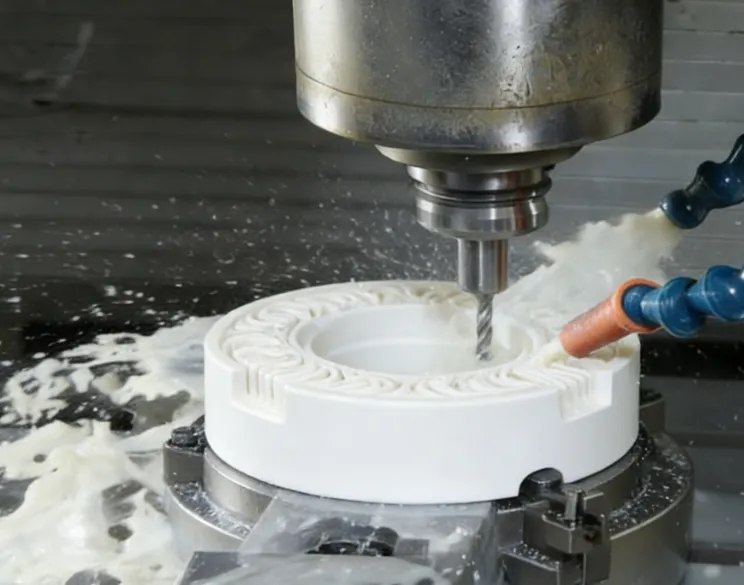

In the field of precision manufacturing, ceramic materials are increasingly used in aerospace, medical implants, semiconductors, and defense due to their outstanding high-temperature resistance, wear resistance, corrosion resistance, and electrical insulation properties. However, the extreme hardness and brittleness of ceramics make CNC machining a highly challenging task—tool selection often determines the success or failure of a project.
In 2026, with advancements in diamond coating technology and CBN material formulations, engineers now have more options for ceramic machining tools. This article, based on the latest industry practices and real-world cases, compares the practical performance of diamond tools (PCD/CVD) versus cubic boron nitride (CBN/PCBN) in ceramic CNC machining to help you make the optimal choice.
Why Are Tool Requirements So Stringent for Ceramic Machining?
Ceramic materials typically have Vickers hardness ranging from 1200–3000 HV (e.g., silicon carbide can reach 2500–3000 HV), far exceeding most metals and conventional carbide tools (800–1500 HV). At the same time, ceramics have low fracture toughness, making them prone to microcracks or chipping during machining.
Standard carbide tools often last only a few minutes when machining ceramics before severe wear occurs, leading to increased cutting forces, heat buildup, and ultimately part scrap. Only superhard materials can handle the job, and diamond and CBN are currently the two mainstream options.
Diamond Tools: The "Trump Card" for Ceramic Machining
Diamond is the hardest substance in nature (approximately 10,000 HV) and dominates over 90% of the ceramic machining market. Main forms include:
- PCD (Polycrystalline Diamond): Sintered from diamond micropowder, ideal for milling, turning, and drilling.
- CVD Diamond Coating: Pure diamond thick film (10–30 μm) deposited on a carbide substrate via chemical vapor deposition, offering flexible geometries and excellent thermal conductivity.
Practical Advantages:
- Superior Wear Resistance: Tool life is typically 2–5 times longer than CBN when machining alumina, silicon carbide, or zirconia.
- Excellent Surface Finish: Sharp edges combined with high thermal conductivity minimize heat-affected zones, achieving Ra < 0.2 μm.
- Broad Applicability: Suitable for nearly all engineering ceramics, especially pure oxides and carbides.
Real-World Case: An aerospace company machining silicon carbide turbine components used CVD diamond end mills, achieving a single-edge life of 35 minutes with no microcracks on the surface, reducing scrap rate from 15% to 2%.Limitations:
- Prone to graphitization (carbonization reaction) when in contact with iron-containing materials; not suitable for iron-containing ceramics or metal-ceramic composites.
- Higher initial cost (PCD inserts are about 1.5–2 times more expensive than CBN).
CBN Tools: Backup Option for High-Temperature and Special ScenariosCubic boron nitride (CBN) has hardness second only to diamond (4500–5000 HV) and superior thermal stability (withstands over 1200°C).
Practical Advantages:
- Excellent High-Temperature Resistance: Does not soften easily during high-speed cutting, suitable for dry or semi-dry machining.
- Good Chemical Inertness: No reaction with iron, making it viable for iron-containing ceramics or metal-matrix composites.
- Relatively Cost-Effective: Lower price in specific scenarios.
Practical Performance:
CBN performs well when machining silicon nitride, aluminum nitride, or certain iron-based ceramics. However, for the most common alumina, zirconia, and silicon carbide, CBN wear rate is typically 2–4 times faster than diamond, with slightly inferior surface quality.
Real-World Case: A semiconductor equipment manufacturer machining aluminum nitride heat sinks initially experienced minor oxidation issues with PCD tools. Switching to PCBN inserts stabilized tool life at 20 minutes and reduced overall costs by 18%.
2026 Tool Selection Decision Table
| Ceramic Material | Recommended Tool | Reasons & Suggested Parameters |
|---|---|---|
| Alumina (Al₂O₃) | PCD/CVD Diamond | Moderate hardness, best diamond wear resistance; feed 0.02–0.05 mm/rev |
| Zirconia (ZrO₂) | CVD Diamond | Higher toughness, requires sharp edge; prefer negative rake angle |
| Silicon Carbide (SiC) | PCD Diamond | Highest hardness, diamond essential; shallow depth of cut + mist cooling |
| Aluminum Nitride (AlN) | CBN or CVD Diamond | High thermal conductivity needs, CBN better prevents oxidation |
| Macor Machinable Glass-Ceramic | PCD or CBN | Easier to machine, CBN can reduce costs with lower parameters |
| Iron-Containing Ceramic Composites | CBN | Avoids diamond graphitization |
Conclusion: Diamond Remains Dominant, CBN Provides Targeted Support
Data from 2026 shows that for pure ceramic CNC machining scenarios, diamond tools (especially CVD thick-film) remain the absolute first choice, unmatched in overall wear resistance, surface quality, and applicability. CBN plays a strong supporting role in high-temperature, iron-containing, or budget-sensitive projects.
The final choice should still be validated through small-batch testing based on your specific material, volume, tolerance requirements, and equipment conditions.
Want a more comprehensive guide to ceramic CNC machining?
We’ve compiled the full [Ceramic CNC Machining: The Ultimate Guide 2026], covering process flow, parameter optimization, design tips, applications, and troubleshooting—available for free reading.






























Sign in to leave a comment.