

Whether you run a two-person startup or a growing team of fifty, the way your business communicates directly impacts productivity, customer satisfaction, and your bottom line. That is why more and more companies across the USA are making the switch to a VoIP phone service for small businesses. In this guide, we break down everything you need to know from what VoIP actually is, to choosing the right system, hardware, and provider for your specific needs.
What Is VoIP and How Does It Work?
VoIP stands for Voice over Internet Protocol. Simply put, it transmits your voice calls over the internet rather than traditional copper telephone lines. Instead of paying for a dedicated phone line, your voice data is converted into digital packets and sent through your existing broadband connection.
For small businesses, this shift is transformative. A traditional landline requires physical infrastructure, ongoing maintenance contracts, and separate billing for every line. A VoIP phone system for small business relies on your internet connection meaning lower costs, faster setup, and far greater flexibility for your entire team.
Key Benefits of VoIP Phones for Business
1. Significant Cost Savings
Traditional phone systems carry high upfront hardware costs, per-minute charges for long-distance calls, and expensive maintenance fees. VoIP phones for business typically offer flat-rate monthly plans that include unlimited domestic calling, drastically reducing your monthly telecom spend. The average small business that switches to VoIP reports savings of 30–50% on their phone bill.
2. Scalability for Growing Teams
Adding a new employee to a legacy phone system can take days and require a technician visit. With a cloud-based VoIP phone system for small business, adding a new user often takes just minutes through an online dashboard. Whether you grow from 5 to 50 employees, VoIP scales effortlessly with no new wiring, no hardware upgrades, no technician required.
3. Remote and Hybrid Work Support
Post-pandemic, remote work is here to stay. VoIP phone service for business supports softphone apps, mobile apps, and desktop clients meaning your team can make and receive business calls from anywhere in the world using any device. Your office number travels with your employees, keeping your business reachable at all times.
4. Advanced Features Included at No Extra Cost
Unlike basic landlines, VoIP phone service for small business typically includes enterprise-grade features as standard, such as:
- Auto-attendant (virtual receptionist)
- Call forwarding and intelligent call routing
- Voicemail-to-email transcription
- Conference calling and video meetings
- Call analytics and reporting dashboards
- CRM integrations with tools like Salesforce and HubSpot
VoIP Phone for Business vs. Traditional Landline
The comparison is straightforward. A traditional landline is rigid, expensive, and difficult to scale. A VoIP phone for business is flexible, cost-efficient, and packed with features that modernize how your team communicates. The only area where landlines have historically had an edge is reliability during internet outages but modern VoIP providers address this with cellular failover, redundant data centers, and 99.99% uptime SLAs that match or exceed traditional carrier reliability.
Cloud-Based vs. On-Premises VoIP Phone Systems for Small Business
Cloud-Based (Hosted) VoIP
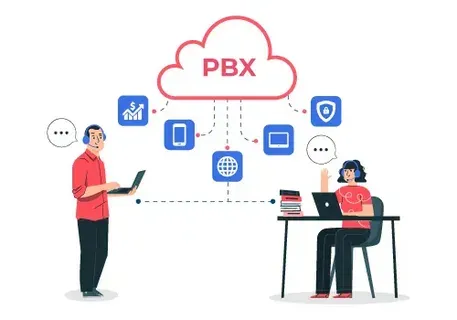
With a hosted solution, the VoIP provider manages all servers and infrastructure in the cloud. You simply connect your VoIP phones for small businesses to the internet and start calling. This is the most popular choice for small businesses because it requires zero upfront hardware investment and shifts all maintenance responsibility to the provider.
On-Premises VoIP (IP-PBX)
On-premises VoIP means purchasing and managing your own PBX hardware on-site. This offers maximum control and customization but requires a higher upfront investment and in-house IT expertise. For most small businesses, a hosted cloud-based solution is the smarter, more practical, and more cost-effective choice.
VoIP Phone Hardware: What Do You Actually Need?
One of the most common questions small business owners ask is: "Do I need to buy new phones?" The answer depends on your setup.
- Desk IP Phones: Physical VoIP handsets that look and feel like traditional office phones but connect over your network ideal for front desks, reception areas, and office-based staff.
- Softphones: Software applications installed on laptops, desktops, or mobile devices that turn any screen into a fully functional business phone perfect for remote and hybrid workers.
- ATA Adapters: Analog Telephone Adapters let you use your existing traditional handsets with a new VoIP service, a cost-effective transition option if you want to avoid replacing all hardware at once.
For most small businesses, a combination of desk IP phones for the office and softphone apps for remote employees is the ideal, flexible setup.
How to Choose the Best VoIP Phone Service for Business
With dozens of VoIP providers competing for your business, choosing the right one can feel overwhelming. Here is a practical checklist to guide your decision:
- Uptime and Reliability: Look for providers with 99.99% uptime guarantees and redundant infrastructure to keep your business connected 24/7.
- Pricing Transparency: Watch for hidden fees on contracts, setup, number porting, and per-minute international overages.
- Feature Set: Ensure the plan includes the features your business actually needs do not pay for bloat you will never use.
- Scalability: Confirm you can add or remove users easily as your team grows or changes.
- Customer Support: 24/7 USA-based support is critical for small businesses without internal IT staff.
- Integrations: Verify the service connects with your existing CRM, helpdesk, or productivity tools.
For a curated comparison of top-rated providers, visit best business VoIP providers in the USA to review plans and features side by side.
VoIP Phone Service for Business: Understanding Costs and Contracts
Most hosted VoIP phone service for small business plans in the USA range from $15 to $50 per user per month, depending on the features included. Entry-level plans typically cover unlimited domestic calling, basic call management, and a mobile app. Premium tiers add video conferencing, advanced analytics, CRM integrations, and priority support.
Always read the fine print. Some providers advertise low per-user rates but charge separately for:
- Number porting fees (transferring your existing business number)
- International calling rates
- E911 service fees
- Contract termination penalties
Month-to-month plans offer maximum flexibility, while annual commitments usually unlock 15–20% discounts. For a small business still evaluating VoIP phones for small business solutions, starting on a monthly plan before committing annually is generally the safer and smarter approach.
VoIP Security Best Practices for Small Businesses
Security is a valid concern for any internet-based communication system. Here is how to keep your VoIP phone system for small business protected:
- Use strong, unique passwords for all VoIP accounts and SIP credentials
- Enable two-factor authentication (2FA) on your admin portal
- Use a VPN for remote employees connecting to the VoIP network
- Keep firmware on all IP phones up to date
- Work with a provider that offers end-to-end encryption for calls and data
Reputable VoIP providers in the USA comply with strict security standards and offer built-in fraud monitoring to detect unusual call patterns before they become costly problems.
Setting Up a VoIP Phone System for Small Business: Step-by-Step
Setting up a modern cloud-based VoIP system is surprisingly simple and fast:
- Choose a VoIP provider and select a plan that fits your team size and budget.
- Port your existing phone number or select a new local or toll-free number.
- Set up users, extensions, and call routing rules in the online dashboard.
- Connect IP desk phones or install softphone apps on your team's devices.
- Test your calls, configure voicemail greetings, and go live.
Most small businesses are fully operational with their new VoIP phone service for small business within a single business day no technician visit required.
Conclusion
Switching to a VoIP phone service for small business is one of the most impactful and cost-effective upgrades a small business can make in 2025. From reducing monthly costs and supporting remote work, to delivering enterprise-grade call management features, modern VoIP phone systems give small businesses the same communication power as large corporations without the large price tag.
Whether you are comparing plans, evaluating hardware, or just beginning your research, the right VoIP phone for business solution is within reach for businesses of every size and industry across the USA.
If you are ready to explore your options, Voxtium is a trusted voice solutions platform serving small and medium-sized businesses across the United States. Voxtium simplifies the process of finding, comparing, and activating the right VoIP phone service for business giving you the clarity and confidence to make the switch on your terms.
Frequently Asked Questions (FAQs)
Q1: What internet speed do I need for VoIP phones for small businesses?
Each active VoIP call typically consumes between 85–100 kbps of bandwidth. A business with 10 simultaneous calls needs roughly 1 Mbps dedicated to VoIP. For most modern broadband connections, this is not a concern, but using a QoS-enabled router is recommended to prioritize call traffic and ensure consistent call quality.
Q2: Can I keep my existing phone number when switching to VoIP?
Yes. The process is called number porting. Most VoIP providers in the USA fully support porting your current local or toll-free number. The process typically takes 5–10 business days, and your existing service remains active during the transition so you never miss a call.
Q3: Are VoIP phones for small businesses reliable enough to fully replace a landline?
For the vast majority of small businesses, yes. Modern hosted VoIP services offer 99.99% uptime SLAs backed by redundant data centers. As long as your business has a reliable broadband connection, VoIP is a complete, dependable replacement for traditional landlines.
























Sign in to leave a comment.